
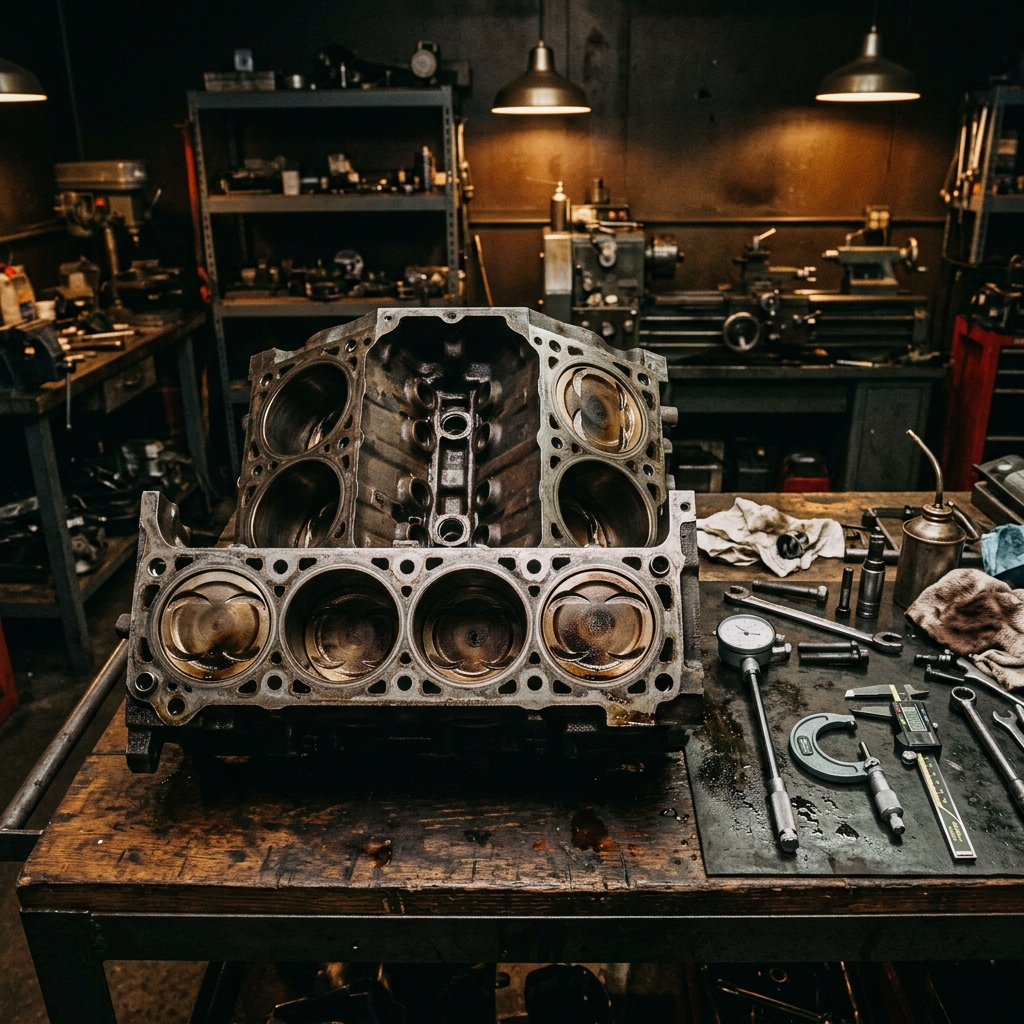
Every piston engine on the road, on a dyno, or in a rulebook is defined by one foundational number: displacement. It is the total volume swept by all pistons in one complete revolution of the crankshaft. If you understand the formula, you can calculate it from 3 measurements, convert it between any unit system, and verify whether a marketing badge matches engineering reality.
This guide walks through the math from first principles, shows worked examples in both metric and imperial, and explains the 3 most common mistakes that produce wrong answers.
If you want to run the math interactively while you read, open the engine displacement calculator in a second tab — it updates live as you type.
The Core Formula: 3 Inputs, 1 Output
Engine displacement is the total swept volume of all cylinders combined. The formula computes the volume of one cylinder (a circular cross-section times a linear travel distance), then multiplies by the number of cylinders:
Displacement = (π ÷ 4) × Bore² × Stroke × Cylinders
Each variable has a specific physical meaning:
| Variable | What It Represents | Example Value |
|---|---|---|
| Bore | Internal diameter of each cylinder | 101.6 mm (4.000”) |
| Stroke | Distance the piston travels from TDC to BDC | 88.4 mm (3.480”) |
| Cylinders | Total number of cylinders in the engine | 8 |
| π ÷ 4 | Converts bore diameter into circular cross-sectional area | 0.7854 (constant) |
The π ÷ 4 factor exists because cylinders are round. The area of a circle is π × r², but since engine specs use diameter (bore) rather than radius, the formula rewrites as (π ÷ 4) × d². This is not an approximation — it is the exact mathematical conversion from diameter to area.
Step-by-Step Example in Millimeters
Let’s calculate displacement for a classic small-block V8 with the following specifications:
- Bore: 101.6 mm
- Stroke: 88.4 mm
- Cylinders: 8
Step 1 — Calculate One-Cylinder Area
Cylinder cross-sectional area = (π ÷ 4) × 101.6² = 0.7854 × 10,322.56 = 8,107.32 mm²
Step 2 — Calculate One-Cylinder Volume
One-cylinder volume = 8,107.32 × 88.4 = 716,887 mm³
Step 3 — Multiply by Cylinder Count
Total displacement = 716,887 × 8 = 5,735,099 mm³
Step 4 — Convert to Useful Units
| Conversion | Formula | Result |
|---|---|---|
| Cubic centimeters (cc) | mm³ ÷ 1,000 | 5,735 cc |
| Liters (L) | cc ÷ 1,000 | 5.735 L |
| Cubic inches (CID) | cc ÷ 16.387064 | 350.0 CID |
This is the classic Chevrolet 350 — one of the most produced engines in history. The formula confirms that the marketing name “350” is almost perfectly aligned with the engineering calculation.
Step-by-Step Example in Inches
The same formula works directly in inches. Using a Ford 302:
- Bore: 4.000”
- Stroke: 3.000”
- Cylinders: 8
Displacement = (π ÷ 4) × 4.000² × 3.000 × 8 = 0.7854 × 16.000 × 3.000 × 8 = 302.1 CID
From there:
- 302.1 × 16.387064 = 4,949 cc
- 4,949 ÷ 1,000 = 4.949 L
Ford markets this as a “5.0L” engine. The actual displacement is 51 cc short of 5,000 cc — a common pattern where marketing rounds to the nearest half-liter.
Unit Conversion Reference Table
All 3 unit systems describe the same physical quantity. The conversion factors are exact, not approximations:
| From | To | Multiply By |
|---|---|---|
| Cubic inches | cc | 16.387064 |
| cc | Cubic inches | 0.061024 |
| cc | Liters | 0.001 |
| Liters | cc | 1,000 |
| Cubic inches | Liters | 0.016387 |
| Liters | Cubic inches | 61.024 |
Use the displacement converter when you need to switch between unit systems without re-entering bore and stroke.
The 3 Mistakes That Produce Wrong Answers
Mistake 1: Mixing Unit Systems
If bore is entered in millimeters and stroke is entered in inches, the result is mathematically meaningless. Both dimensions must be in the same unit before the formula runs. A 101.6 mm bore with a 3.480” stroke produces a number that is neither cubic inches nor cubic centimeters.
Fix: Convert all inputs to the same unit before calculating. The formula does not care which system you use — it only requires consistency.
Mistake 2: Forgetting the π ÷ 4 Factor
Some builders calculate bore × bore × stroke × cylinders and skip the circular-area constant. This treats each cylinder as a square instead of a circle, overstating displacement by approximately 27%. A 350 CID engine would appear to be 446 CID under this error.
Fix: Always include the 0.7854 constant. If you are using the calculator, this factor is built into the tool.
Mistake 3: Converting at the Wrong Step
Converting bore from millimeters to inches, then calculating in millimeters, then converting the result back to inches produces double-conversion errors. The conversion should happen either at the input stage or at the output stage — never at both.
Fix: Pick one unit system, calculate, then convert the final result.
Why Bore Has More Leverage Than Stroke
Bore is squared in the formula. Stroke is not. This means a 1% increase in bore adds approximately 2% to displacement, while a 1% increase in stroke adds approximately 1%.
| Change | Original (350 CID) | New Value | New Displacement | Gain |
|---|---|---|---|---|
| +1mm bore (101.6 → 102.6) | 4.000” | 4.039” | 353.5 CID | +3.5 |
| +1mm stroke (88.4 → 89.4) | 3.480” | 3.519” | 354.0 CID | +4.0 |
| +0.030” overbore | 4.000” | 4.030” | 355.4 CID | +5.4 |
| +0.250” stroke (stroker) | 3.480” | 3.730” | 375.1 CID | +25.1 |
Notice that a 1mm bore increase and a 1mm stroke increase produce nearly the same gain on this engine (3.5 vs 4.0 CID) — but the bore change is amplified by the squaring while the stroke change is amplified by the larger absolute dimension. On smaller-bore engines, the bore advantage is more pronounced.
For a deeper dive into bore machining, read The Effects of Overboring an Engine Block.
What Each Input Really Means
Bore — The Cylinder’s Footprint
Bore is the internal diameter of the cylinder, measured in millimeters or inches. Increasing bore expands the circular footprint of the combustion chamber and allows larger valves, improving high-RPM airflow. However, increasing bore requires removing material from the cylinder wall, which is limited by casting thickness.
Bore is measured with a dial bore gauge or snap gauge at multiple points in the cylinder to check for taper and out-of-round. Factory tolerance is typically ±0.0005” (0.013 mm).
Stroke — The Piston’s Travel Distance
Stroke is the linear distance between top dead center (TDC) and bottom dead center (BDC). It is determined entirely by the crankshaft throw — the offset distance between the main journal centerline and the rod journal centerline.
Changing stroke requires a different crankshaft. A longer stroke increases displacement and also increases mean piston speed at any given RPM, which limits the safe redline. Use the mean piston speed calculator to check whether a stroker combination stays within material limits.
Cylinder Count — The Multiplier
Cylinder count is the simplest variable. Once you know the volume of one cylinder, multiply by the total count. Common configurations include inline-4 (4 cylinders), V6 (6), V8 (8), inline-6 (6), and flat-6 (6).
Displacement vs. Marketed Engine Size
Manufacturers round displacement to clean marketing numbers. The formula gives the engineering reality:
| Marketing Name | Actual CID | Actual cc | Actual Liters | Difference |
|---|---|---|---|---|
| ”2.0L” (Honda K20) | 121.9 | 1,998 | 1.998 | −2 cc |
| ”5.0L” (Ford Coyote) | 302.1 | 4,951 | 4.951 | −49 cc |
| ”5.7L” (Hemi) | 345.0 | 5,654 | 5.654 | −46 cc |
| ”6.2L” (GM LS3) | 376.0 | 6,162 | 6.162 | −38 cc |
| ”350” (Chevy SBC) | 350.0 | 5,735 | 5.735 | exact |
The badge is always the rounded approximation. The formula is always the precise answer.
Use Displacement as a Starting Point
Displacement is the most fundamental engine specification, but it is only one dimension of engine behavior. Two engines with identical displacement can produce very different power and torque curves depending on:
- Bore-to-stroke ratio — determines rev ceiling and torque character (read more)
- Compression ratio — determines thermal efficiency (calculate it)
- Cam timing — determines where in the RPM range the engine breathes best
- Airflow — determines volumetric efficiency and actual cylinder filling
Start with displacement to establish the baseline. Then branch into the supporting calculators to build the complete picture. The main calculator links directly to every supporting tool on the site.