
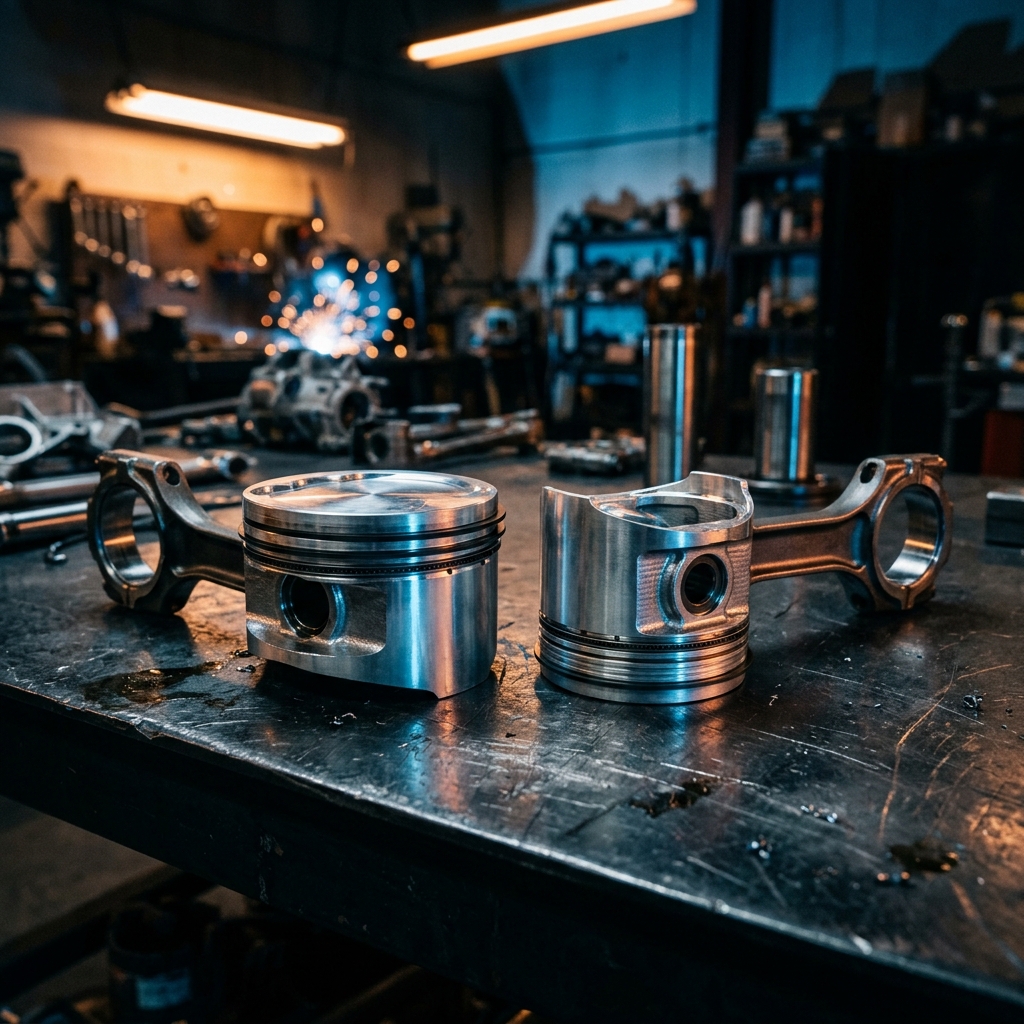
Two engines can share identical displacement and still behave in completely different ways. One revs eagerly to 8,000 RPM and makes its power at the top of the tachometer. The other produces a broad torque curve that peaks at 3,500 RPM and feels effortless under load. The difference often comes down to a single ratio: bore divided by stroke.
This ratio classifies every piston engine into one of 3 geometric categories — square, oversquare, or undersquare — and each category creates distinct mechanical consequences for airflow, piston speed, torque character, and maximum RPM.
The 3 Bore-to-Stroke Categories
The bore-to-stroke ratio is calculated by dividing the cylinder bore diameter by the crankshaft stroke length. Both measurements must be in the same unit.
Ratio = Bore ÷ Stroke
| Category | Ratio | Bore vs. Stroke | Character |
|---|---|---|---|
| Square | ≈ 1.00 | Bore ≈ Stroke | Balanced — moderate rev ceiling and torque |
| Oversquare | > 1.00 | Bore > Stroke | Rev-biased — higher RPM potential, less piston speed |
| Undersquare | < 1.00 | Bore < Stroke | Torque-biased — stronger low-end, higher piston speed |
The ratio does not predict horsepower or torque directly. Instead, it describes the geometry that shapes how the engine breathes, wears, and responds to RPM.
Oversquare Engines: Built to Breathe
An oversquare engine has a bore diameter larger than its stroke. This creates a wide, short cylinder that offers several mechanical advantages for high-RPM operation.
Why Oversquare Favors RPM
A larger bore provides more room for valve heads in the combustion chamber. Larger intake and exhaust valves mean lower restriction at high airflow rates, which is the fundamental bottleneck at high RPM. The shorter stroke also means the piston travels less distance per revolution, reducing mean piston speed and allowing a higher safe redline.
Consider the Ferrari F136 V8 (4.5L, used in the 458 Italia):
- Bore: 94.0 mm
- Stroke: 81.0 mm
- Ratio: 1.160 (strongly oversquare)
- Redline: 9,000 RPM
- Mean piston speed at redline: 24.3 m/s
The 1.16 ratio allows enough valve area and low enough piston speed to sustain 9,000 RPM safely. An undersquare engine with the same displacement could not reach this RPM without exceeding material limits.
The Trade-Off
Oversquare engines tend to produce a torque curve biased toward the upper RPM range. Low-speed torque is often modest because the shorter stroke provides less mechanical leverage at the crankshaft. This is why oversquare engines feel “peaky” — they reward RPM.
Undersquare Engines: Built for Torque
An undersquare engine has a stroke longer than its bore. This creates a tall, narrow cylinder that produces strong low-RPM torque through increased crankshaft leverage.
Why Undersquare Favors Torque
A longer stroke acts as a longer lever arm on the crankshaft. At any given cylinder pressure, the longer moment arm converts that pressure into more rotational force (torque). This is the same physics that makes a longer wrench more effective — the force is identical, but the leverage multiplies it.
Consider the Cummins 6BT diesel (5.9L):
- Bore: 102.0 mm
- Stroke: 120.0 mm
- Ratio: 0.850 (strongly undersquare)
- Peak torque RPM: 1,600 RPM
- Character: Massive low-end torque for towing
The Trade-Off
The longer stroke increases mean piston speed at any given RPM. A 120 mm stroke at 4,000 RPM produces 16.0 m/s piston speed — the same as a 94 mm stroke engine at 5,100 RPM. This higher piston speed increases ring wear, cylinder wall friction, and mechanical stress, which limits the safe redline. Most undersquare engines have redlines between 4,000 and 5,500 RPM.
Square Engines: The Balanced Compromise
A square engine has bore and stroke dimensions that are equal or very close. This geometry does not strongly favor either high RPM or low-RPM torque, producing a balanced power delivery.
Consider the GM LS1 (5.7L):
- Bore: 99.0 mm
- Stroke: 92.0 mm
- Ratio: 1.076 (slightly oversquare — nearly square)
- Redline: 6,000–6,500 RPM
- Character: Broad, flat torque curve with a useful rev range
Square engines are common in production vehicles because they satisfy multiple design requirements simultaneously: adequate valve area, reasonable piston speed, acceptable torque spread, and manageable mechanical stress.
Real-World Bore-to-Stroke Ratio Comparison
The table below compares stock bore-to-stroke ratios across a range of engine families, from strongly undersquare diesels to extremely oversquare motorcycle engines:
| Engine | Bore (mm) | Stroke (mm) | Ratio | Category | Peak RPM |
|---|---|---|---|---|---|
| Cummins 6BT 5.9L | 102.0 | 120.0 | 0.850 | Undersquare | 3,200 |
| Ford PowerStroke 6.0L | 95.0 | 105.0 | 0.905 | Undersquare | 3,300 |
| Chevy 350 SBC | 101.6 | 88.4 | 1.149 | Oversquare | 5,500 |
| GM LS1 5.7L | 99.0 | 92.0 | 1.076 | Slightly oversquare | 6,000 |
| Honda K20A 2.0L | 86.0 | 86.0 | 1.000 | Square | 8,100 |
| Ferrari F136 4.5L | 94.0 | 81.0 | 1.160 | Oversquare | 9,000 |
| Ducati Panigale 1.3L | 116.0 | 60.8 | 1.908 | Extremely oversquare | 12,100 |
| Honda CBR600RR | 67.0 | 42.5 | 1.576 | Oversquare | 15,000 |
Notice the pattern: as the ratio increases (more oversquare), the practical redline ceiling also increases. The Ducati’s 1.908 ratio allows a 12,100 RPM redline despite being a 1,285 cc twin, because the extremely short stroke keeps piston speed manageable.
5 Mechanical Consequences of Bore-to-Stroke Ratio
1. Valve Size and Airflow
A larger bore creates a wider cylinder head deck, leaving more room for bigger valves. A 100 mm bore can fit intake valves up to approximately 50 mm diameter. An 80 mm bore is limited to roughly 37 mm. This is one reason undersquare engines are harder to make breathe at high RPM — the valves are physically smaller.
2. Mean Piston Speed
Mean piston speed = 2 × stroke × RPM ÷ 60. A longer stroke at the same RPM produces higher piston speed, which increases ring friction, cylinder wall wear, and the risk of ring flutter. The widely accepted limit for cast pistons is approximately 20 m/s; forged pistons can sustain 25+ m/s in racing applications.
Use the mean piston speed calculator to check your combination.
3. Combustion Chamber Shape
Oversquare engines tend to have wider, shallower combustion chambers. This shape can make it harder to maintain a compact flame front, potentially increasing the combustion time. Undersquare engines have taller, narrower chambers that concentrate the flame kernel, which can improve burn efficiency but may increase susceptibility to detonation.
4. Rod-to-Stroke Ratio Interaction
When stroke increases, the connecting rod angularity increases (unless a longer rod is used). This creates more piston side-loading, which accelerates bore wear. Builders compensating for a long stroke often upgrade to a longer connecting rod to maintain a favorable rod-to-stroke ratio.
5. Exhaust Scavenging
A shorter stroke (oversquare) gives the exhaust valve less time to evacuate the cylinder at high RPM, which is why oversquare engines benefit more from tuned exhaust headers. A longer stroke (undersquare) provides more crank degrees for exhaust blowdown, making exhaust tuning less critical for low-RPM torque production.
How to Choose the Right Geometry for Your Build
The “best” ratio depends entirely on the application:
| Application | Ideal Ratio Range | Why |
|---|---|---|
| Drag racing / high-RPM NA | 1.10–1.30+ | Maximum valve area, lowest piston speed at redline |
| Street performance | 1.00–1.15 | Balance of torque and rev range |
| Towing / truck | 0.85–1.00 | Maximum low-RPM torque, lower stress at cruise |
| Boosted / turbocharged | 0.95–1.10 | Undersquare adds torque leverage; boost compensates for airflow |
| Endurance / high-mileage | 1.00–1.10 | Moderate piston speed reduces long-term wear |
Start with the Numbers, Then Read the Geometry
The most effective workflow for engine planning is:
- Enter bore, stroke, and cylinder count into the engine displacement calculator.
- Read the total displacement in your preferred unit.
- Calculate the bore-to-stroke ratio (bore ÷ stroke).
- Use the ratio to understand the engine’s natural tendencies before selecting cams, heads, and induction.
- Check mean piston speed to verify your RPM target is within material limits.
Geometry is not destiny — a well-designed undersquare engine can outperform a poorly designed oversquare engine. But geometry sets the direction, and understanding that direction before you start spending money is what separates informed builds from expensive experiments.