
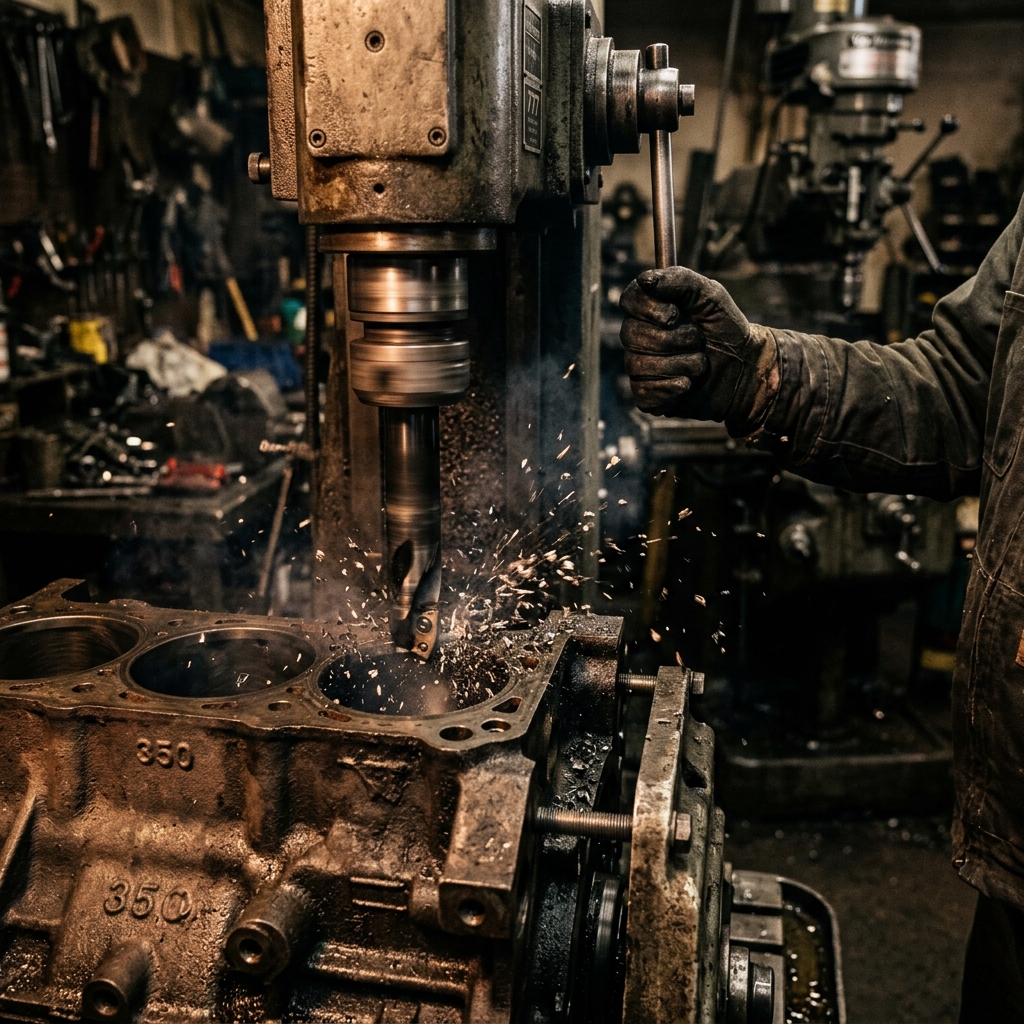
Overboring is one of the most common machine shop operations during an engine rebuild. It serves two purposes simultaneously: it restores worn cylinders to a round, straight condition, and it increases displacement by enlarging the bore diameter. The displacement gain comes from the mathematics of circular area — and it is often larger than builders expect.
This guide explains exactly where the gains come from, how much each common overbore step adds, where the safety limits are, and when an overbore is the wrong tool for the job.
Why Bore is Squared in the Displacement Formula
The displacement formula is:
Displacement = (π ÷ 4) × Bore² × Stroke × Cylinders
Bore appears squared because the formula calculates the area of a circle from its diameter. The area of a circle is π × r², which rewrites as (π ÷ 4) × d² when using diameter instead of radius.
This squaring has a practical consequence: a small bore change produces a disproportionately large displacement change. A 0.030” increase on a 4.000” bore is only a 0.75% diameter change, but it produces approximately 1.5% more cylinder area.
To visualize why, consider that the overbore adds a thin ring of area around the entire circumference of each cylinder. The circumference of a 4.000” bore is 12.566 inches, so even a 0.015”-wide ring (the radius change from a 0.030” diameter increase) creates 0.188 square inches of additional area per cylinder. Across 8 cylinders, that thin ring adds 5.4 cubic inches of displacement.
How Much Displacement Does Each Overbore Add?
The table below shows the displacement gain for common overbore amounts on 3 popular engine platforms:
Chevrolet Small Block (Stock: 4.000” bore × 3.480” stroke × 8 cyl = 350.0 CID)
| Overbore | New Bore | New CID | Gain | Common Name |
|---|---|---|---|---|
| Standard | 4.000” | 350.0 | — | “350” |
| +0.020” | 4.020” | 353.5 | +3.5 | cleanup bore |
| +0.030” | 4.030” | 355.4 | +5.4 | ”355” (standard rebuild) |
| +0.040” | 4.040” | 357.2 | +7.2 | ”357” |
| +0.060” | 4.060” | 360.9 | +10.9 | max safe for most blocks |
Ford 302 Windsor (Stock: 4.000” bore × 3.000” stroke × 8 cyl = 302.1 CID)
| Overbore | New Bore | New CID | Gain |
|---|---|---|---|
| Standard | 4.000” | 302.1 | — |
| +0.030” | 4.030” | 306.9 | +4.8 |
| +0.040” | 4.040” | 308.3 | +6.2 |
| +0.060” | 4.060” | 311.2 | +9.1 |
Honda K20A (Stock: 86.0 mm bore × 86.0 mm stroke × 4 cyl = 1,998 cc)
| Overbore | New Bore | New cc | Gain |
|---|---|---|---|
| Standard | 86.0 mm | 1,998 | — |
| +0.50 mm | 86.5 mm | 2,021 | +23 cc |
| +1.00 mm | 87.0 mm | 2,044 | +46 cc |
Notice that the absolute gain varies by engine. The same 0.030” overbore adds 5.4 CID to the 350 but only 4.8 CID to the 302 — because the 302 has a shorter stroke, so each square inch of added bore area sweeps less volume.
Use the overbore displacement calculator to model your specific combination.
The Scaling Is Not Linear
Each additional increment of overbore adds slightly more displacement than the previous one. This is because the circumference of the bore increases with each step, meaning the next thin ring of area is slightly larger than the last.
| Step | Bore | Incremental Gain (CID) |
|---|---|---|
| +0.010” (from 4.000 to 4.010) | 4.010” | +1.77 |
| +0.010” (from 4.010 to 4.020) | 4.020” | +1.78 |
| +0.010” (from 4.020 to 4.030) | 4.030” | +1.79 |
| +0.010” (from 4.030 to 4.040) | 4.040” | +1.80 |
| +0.010” (from 4.040 to 4.050) | 4.050” | +1.81 |
The incremental difference between steps is small (fractions of a cubic inch), but it demonstrates that the relationship is truly quadratic, not linear.
Cylinder Wall Thickness: The Absolute Limit
Why Walls Thin Out
Each thousandth of overbore removes 0.0005” of wall thickness from each side of the cylinder (half the diameter increase). A 0.060” overbore removes 0.030” of material from the wall. If the original wall started at 0.160”, only 0.130” remains.
Safe Minimums
| Block Material | Minimum Safe Wall | Typical Stock Wall |
|---|---|---|
| Cast iron (production) | 0.100” | 0.130–0.200” |
| Cast iron (aftermarket) | 0.100” | 0.200–0.250” |
| Aluminum with iron sleeves | 0.080” sleeve | 0.100–0.150” sleeve |
| Siamese-bore iron | 0.060” between bores | 0.080–0.120” |
Why Sonic Testing Is Essential
Factory castings have core shift — the internal water jacket cores are not perfectly centered during casting. One cylinder may have 0.190” walls while the adjacent cylinder has only 0.130”. You cannot see this from the outside.
Sonic testing uses ultrasound to measure actual wall thickness at 4–8 points around each bore. It costs $50–$100 and takes 30 minutes. Skipping this step and machining a 0.060” overbore on a bore that only had 0.130” of wall leaves 0.100” — right at the minimum. If core shift put that bore at 0.110” stock, the overbore leaves 0.080” — structurally compromised.
Rule of thumb: Never assume wall thickness from the block casting number alone. Always sonic-check before committing to an aggressive overbore.
What Happens When You Go Too Far
Overboring past safe wall thickness creates 3 failure modes:
1. Cylinder Distortion Under Load
Thin walls flex under combustion pressure and thermal expansion. This distortion breaks the ring seal, allowing combustion gases to blow past the rings. Symptoms include oil consumption, loss of compression, and blue exhaust smoke under load.
2. Cooling System Hot Spots
Thinner walls conduct heat faster from the combustion chamber into the water jacket — but they also create localized thin spots where cooling is uneven. This produces hot spots that promote detonation and can crack the block at the thinnest point.
3. Block Cracking
At extreme levels (below 0.060” cast iron), the wall can fracture during thermal cycling. A crack between the bore and the water jacket allows coolant into the cylinder, producing hydrostatic lock risk and catastrophic failure.
Overbore vs. Stroker: A Decision Framework
Both overboring and stroking increase displacement, but they do it through different mechanisms with different trade-offs:
| Factor | Overbore | Stroker Kit |
|---|---|---|
| Gain per step | Small (3–11 CID typical) | Large (25–75 CID typical) |
| Cost | $150–$300 (boring + pistons) | $1,500–$3,500 (crank + rods + pistons) |
| Block modification | Bore machining only | Possible clearancing, oil pan |
| Piston speed impact | No change | Increases (limits RPM) |
| Rod ratio impact | No change | Decreases (unless rod is changed) |
| Torque character | Minimal shift | Shifts toward low-RPM torque |
| Rebuild flexibility | Reduces future overbore options | No wall thickness concern |
When to Overbore
- The block needs machining anyway (worn, tapered, or out-of-round cylinders)
- You want a modest displacement bump during a rebuild
- Budget is limited and the crankshaft is serviceable
- You want to maintain the stock stroke and RPM ceiling
When to Stroke
- You need significant displacement gain (30+ CID)
- The engine is going into a torque-biased application (towing, street cruising)
- The block walls are too thin for an aggressive overbore
- You are building from a bare block and can select all rotating assembly components
Effects on Compression Ratio
An overbore increases cylinder swept volume without changing combustion chamber volume, gasket volume, or piston dome/dish volume. This means the compression ratio shifts slightly upward:
| Overbore | Original CR (9.0:1) | New CR | Change |
|---|---|---|---|
| +0.020” | 9.00 | 9.04 | +0.04 |
| +0.030” | 9.00 | 9.06 | +0.06 |
| +0.040” | 9.00 | 9.08 | +0.08 |
| +0.060” | 9.00 | 9.12 | +0.12 |
The change is small enough to ignore for most builds. However, an engine already at the detonation threshold (high compression, aggressive timing, marginal fuel octane) should account for even this minor increase.
Use the compression ratio calculator to model the exact effect for your combination.
The Best Overbore Workflow
- Sonic test the block to establish actual wall thickness at every bore.
- Determine the minimum machining needed to clean up all cylinders (some may need more than others).
- Calculate the displacement change at the planned overbore using the overbore calculator.
- Select matching pistons — common oversizes (0.020”, 0.030”, 0.040”) have the widest selection; unusual sizes may require custom orders.
- Verify compression ratio shift if the engine is already at the upper limit.
- Confirm ring end gap at the new bore size — larger bores need slightly larger end gaps.
The math is fast. The machining judgment still matters more than the displacement number. A safe 0.030” overbore on verified walls always beats an aggressive 0.060” overbore on untested walls, regardless of the cubic-inch gain.