
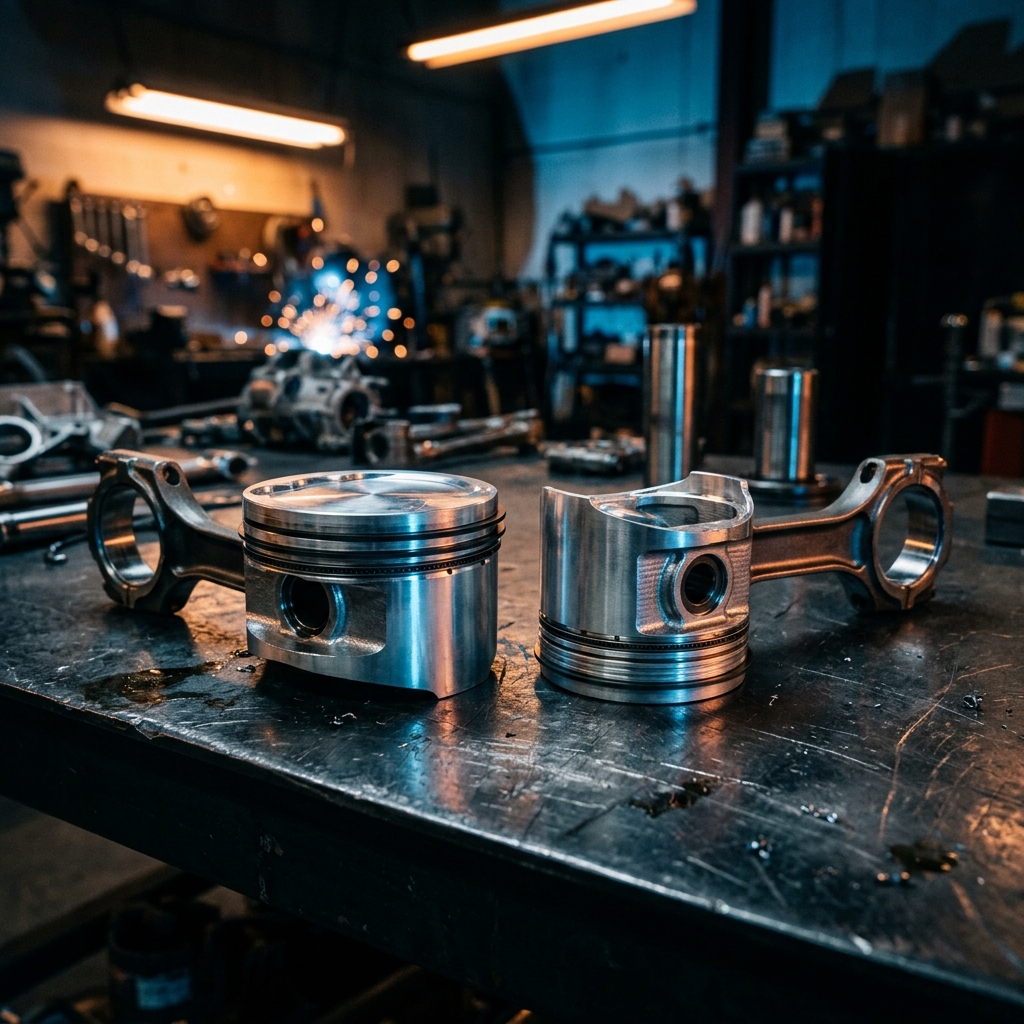
An engine’s displacement comes from a simple formula, but the decisions behind that formula are never simple. Increasing bore adds cylinder area. Increasing stroke adds piston travel. Either move increases total displacement — but they shape the engine in fundamentally different ways.
Understanding why bore and stroke create different engine characteristics is essential for any builder choosing between an overbore, a stroker kit, or a combination of both.
The Displacement Formula: Where Bore and Stroke Live
Displacement = (pi / 4) x Bore² x Stroke x Cylinders
Two critical observations:
- Bore is squared. A small change in bore has a disproportionately large effect on displacement.
- Stroke is linear. A change in stroke produces a proportional change in displacement.
The Math Behind the Sensitivity
For a single cylinder with a 4.000-inch bore and 3.480-inch stroke:
| Change | New Value | New Per-Cylinder Volume | Displacement Change |
|---|---|---|---|
| Baseline | 4.000” bore, 3.480” stroke | 43.73 CID | — |
| +0.030” bore | 4.030” bore | 44.40 CID | +0.67 CID |
| +0.030” stroke | 3.510” stroke | 44.11 CID | +0.38 CID |
| +0.060” bore | 4.060” bore | 45.08 CID | +1.35 CID |
| +0.060” stroke | 3.540” stroke | 44.49 CID | +0.76 CID |
For an 8-cylinder engine:
| Modification | Displacement Gain |
|---|---|
| +0.030” bore (8 cyl) | +5.4 CID |
| +0.030” stroke (8 cyl) | +3.0 CID |
| +0.060” bore (8 cyl) | +10.8 CID |
| +0.270” stroke (8 cyl) | +27.2 CID |
Bore changes are nearly twice as effective per thousandth of change as stroke changes. But stroke changes are typically much larger in magnitude (0.250–0.500 inches) versus bore changes (0.020–0.060 inches), so stroker kits usually add more total displacement despite the formula weighting.
Try different combinations with the engine displacement calculator.
How Bore Affects Engine Character
Larger Bore = More Valve Area
A wider cylinder can accommodate larger intake and exhaust valves. Larger valves flow more air at any given lift, increasing volumetric efficiency and shifting the power peak to higher RPM:
| Bore | Max Intake Valve Size | Relative Airflow |
|---|---|---|
| 3.750” | 1.840” | 1.00x |
| 4.000” | 2.020” | 1.14x |
| 4.030” | 2.050” | 1.17x |
| 4.125” | 2.100” | 1.22x |
| 4.250” | 2.190” | 1.30x |
A 4.250-inch bore supports 30% more intake valve area than a 3.750-inch bore. This is why oversquare engines (bore larger than stroke) dominate high-RPM racing — they can support the airflow needed at 7,000+ RPM.
Larger Bore = Lower Piston Speed at Equal RPM
For a given stroke, larger bores do not change piston speed. But because oversquare engines achieve their displacement through bore rather than stroke, they can rev higher before reaching the piston speed limit:
Mean Piston Speed = 2 x Stroke x RPM / 60
| Engine | Bore | Stroke | MPS at 7,000 RPM |
|---|---|---|---|
| Oversquare (4.125 x 3.000) | 4.125” | 3.000” | 22.1 m/s |
| Square (3.800 x 3.800) | 3.800” | 3.800” | 28.0 m/s |
| Undersquare (3.500 x 4.250) | 3.500” | 4.250” | 31.3 m/s |
The oversquare engine operates safely at 7,000 RPM (22.1 m/s is well within forged piston limits). The undersquare engine at the same RPM exceeds the safe limit for any piston material.
Larger Bore = Higher Surface-to-Volume Ratio
A wider, shallower combustion chamber (from large bore) has more surface area relative to its volume. This increases heat loss to the chamber walls, slightly reducing thermal efficiency compared to a compact, deep chamber (from small bore, long stroke).
How Stroke Affects Engine Character
Longer Stroke = More Crank Leverage
The crankshaft throw (half the stroke) acts as a lever arm. Longer throw = more leverage = more torque per unit of cylinder pressure:
| Stroke | Crank Throw | Relative Leverage |
|---|---|---|
| 3.000” | 1.500” | 1.00x |
| 3.480” | 1.740” | 1.16x |
| 3.750” | 1.875” | 1.25x |
| 4.000” | 2.000” | 1.33x |
A 4.000-inch stroke engine produces 33% more torque per unit of cylinder pressure than a 3.000-inch stroke engine — regardless of bore, RPM, or airflow. This mechanical advantage is why long-stroke engines feel “torquey” and respond strongly to throttle input at low RPM.
Longer Stroke = Higher Piston Speed
More stroke = more piston travel per revolution = higher piston speed at any given RPM. This limits the safe maximum RPM:
| Stroke | Safe RPM (cast pistons, 20 m/s limit) | Safe RPM (forged, 25 m/s limit) |
|---|---|---|
| 3.000” | 7,874 RPM | 9,842 RPM |
| 3.480” | 6,787 RPM | 8,483 RPM |
| 3.750” | 6,299 RPM | 7,874 RPM |
| 4.000” | 5,906 RPM | 7,382 RPM |
Calculate your combination with the mean piston speed calculator.
Longer Stroke = Lower Rod Ratio
With the same connecting rod, a longer stroke reduces the rod-to-stroke ratio, increasing rod angularity and piston side-loading:
| Rod Length | Stroke | R/S Ratio | Max Rod Angle |
|---|---|---|---|
| 5.700” | 3.000” | 1.900 | 15.3° |
| 5.700” | 3.480” | 1.638 | 17.8° |
| 5.700” | 3.750” | 1.520 | 19.2° |
| 5.700” | 4.000” | 1.425 | 20.5° |
Evaluate with the rod ratio calculator.
The 3 Engine Geometry Types
Oversquare (Bore larger than Stroke)
| Characteristic | Value |
|---|---|
| Bore/stroke ratio | Above 1.00 |
| Typical application | Sport bikes, F1, high-RPM NA race engines |
| Power character | High-RPM power, needs high RPM to shine |
| Example | Honda S2000 F20C (87mm bore x 84mm stroke = 1.036) |
Square (Bore equals Stroke)
| Characteristic | Value |
|---|---|
| Bore/stroke ratio | 1.00 |
| Typical application | Balanced street/track engines |
| Power character | Flat, broad torque curve |
| Example | Honda Gold Wing (73mm x 73mm = 1.000) |
Undersquare (Stroke larger than Bore)
| Characteristic | Value |
|---|---|
| Bore/stroke ratio | Below 1.00 |
| Typical application | Diesel trucks, marine, torque-biased street |
| Power character | Strong low-RPM torque, limited high-RPM potential |
| Example | Cummins 6BT (102mm bore x 120mm stroke = 0.850) |
Real-World Bore/Stroke Ratios by Engine
| Engine | Bore | Stroke | B/S Ratio | Character |
|---|---|---|---|---|
| Honda S2000 (F20C) | 87.0 mm | 84.0 mm | 1.036 | High-RPM screamer |
| GM LS3 6.2L | 103.3 mm | 92.0 mm | 1.123 | Oversquare power |
| Chevy 350 SBC | 101.6 mm | 88.4 mm | 1.149 | Classic balance |
| Chevy 383 Stroker | 102.4 mm | 95.3 mm | 1.074 | Mild oversquare |
| Ford Coyote 5.0L | 92.2 mm | 92.7 mm | 0.995 | Nearly square |
| Cummins 6.7L | 107.0 mm | 124.0 mm | 0.863 | Diesel torque |
| Cat C15 | 137.2 mm | 171.4 mm | 0.800 | Heavy-duty diesel |
Choosing Between Bore and Stroke for Your Build
| Build Goal | Bore Increase | Stroke Increase |
|---|---|---|
| Maximum high-RPM power | ✅ Preferred | ❌ Raises piston speed |
| Low-RPM torque | Neutral | ✅ Preferred (more crank leverage) |
| Budget displacement gain | ✅ Cheaper (overbore only) | ❌ Requires new crank, rods, pistons |
| Maximum total displacement | Combine both | Combine both |
| Keep existing pistons | ❌ New pistons needed | ❌ New pistons needed |
| Maintain high-RPM capability | ✅ Safe | ❌ Check piston speed limit |
The Bore/Stroke Workflow
- Establish the baseline — enter current bore, stroke, and cylinders into the displacement calculator.
- Decide on the target — more displacement, more torque, higher RPM capability, or balanced?
- Model an overbore — use the overbore calculator to see how bore changes affect displacement.
- Model a stroker — use the stroker planner to evaluate stroke changes.
- Check piston speed — verify the stroke choice stays within material limits at your target RPM.
- Evaluate rod ratio — ensure the rod length produces an acceptable ratio with the new stroke.
Bore and stroke are the two levers that control displacement. Pulling one lever or the other — or both — shapes not just the number but the entire personality of the engine. Understanding which lever does what is the first step in any displacement decision.
For a deeper breakdown of the geometry categories, continue to Square, Oversquare, and Undersquare Engines.