
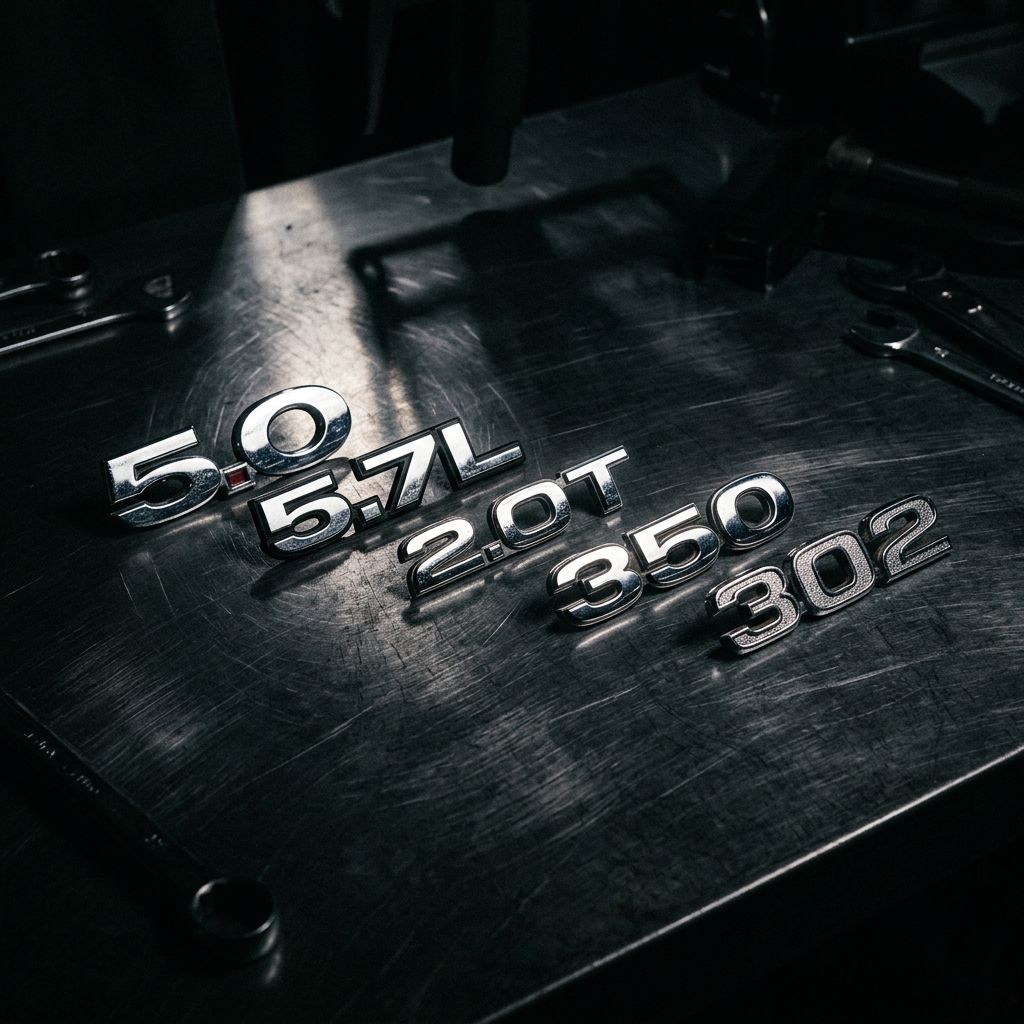
Engine displacement is the same physical quantity everywhere in the world — the total swept volume of all cylinders. But it is expressed in three different unit systems depending on geography, tradition, and context. A Chevy 350 is also a 5.7L and also a 5,735 cc. A Honda 250 is also 0.25L and also 15.3 CID.
Understanding these three systems — and how to convert between them without errors — prevents costly mistakes when ordering parts, comparing engines across regions, and verifying race class eligibility.
The Three Unit Systems
Cubic Centimeters (cc)
Definition: The volume of a cube measuring 1 cm x 1 cm x 1 cm.
| Symbol | cc (or cm³) |
|---|---|
| Used primarily for | Motorcycles, small engines, Japanese and European specs |
| Precision | Whole numbers (599 cc, 998 cc, 1,998 cc) |
| Marketing examples | ”A 600cc sportbike” / “The 2,000 cc engine” |
CC is the most precise unit commonly used because it avoids the decimal places that liters require for accuracy. A “599 cc” description communicates more specific information than “0.6L.”
Liters (L)
Definition: 1,000 cubic centimeters. One liter is exactly one cubic decimeter.
| Symbol | L |
|---|---|
| Used primarily for | Modern automobile marketing worldwide |
| Precision | One decimal place typical (2.0L, 3.5L, 6.2L) |
| Marketing examples | ”The 5.0-liter V8” / “A 2.0L turbo” |
Liters are the standard marketing unit for automobile engines globally. However, the single-decimal-place convention loses precision — a “2.0L” engine could be anywhere from 1,950 cc to 2,049 cc and still use the same badge.
Cubic Inches (CID)
Definition: The volume of a cube measuring 1 inch x 1 inch x 1 inch.
| Symbol | CID (Cubic Inch Displacement) or CI |
|---|---|
| Used primarily for | American V8 engines, vintage engines, US racing classes |
| Precision | Whole numbers (302, 350, 454) |
| Marketing examples | ”A 454 big-block” / “The 302 small-block” |
CID was the primary displacement unit in the United States until the late 1970s when the industry began transitioning to metric. Today, CID is still the dominant unit in American V8 discussions, hot-rod culture, and many US racing organizations.
Conversion Formulas
The three conversions are derived from a single base relationship:
1 inch = 2.54 centimeters
Since displacement is a volume (length cubed):
1 cubic inch = 2.54³ = 16.387064 cc
From there:
| Conversion | Formula | Example |
|---|---|---|
| CID to cc | CID x 16.387 | 350 x 16.387 = 5,735 cc |
| cc to CID | cc / 16.387 | 5,735 / 16.387 = 350.0 CID |
| cc to Liters | cc / 1,000 | 5,735 / 1,000 = 5.735 L |
| Liters to cc | L x 1,000 | 5.735 x 1,000 = 5,735 cc |
| CID to Liters | CID x 0.016387 | 350 x 0.016387 = 5.735 L |
| Liters to CID | L / 0.016387 | 5.735 / 0.016387 = 350.0 CID |
Use the displacement converter for instant conversions.
Common Engine Displacements in All Three Units
American V8 Engines
| Badge Name | CID | cc | Liters |
|---|---|---|---|
| Chevy 283 | 283 | 4,638 | 4.6L |
| Chevy 327 | 327 | 5,359 | 5.4L |
| Chevy 350 | 350 | 5,735 | 5.7L |
| Chevy 383 (stroker) | 383 | 6,276 | 6.3L |
| Chevy 454 | 454 | 7,440 | 7.4L |
| Ford 289 | 289 | 4,737 | 4.7L |
| Ford 302 | 302 | 4,950 | 5.0L |
| Ford 351W | 351 | 5,752 | 5.8L |
| Mopar 340 | 340 | 5,572 | 5.6L |
| Mopar 360 | 360 | 5,899 | 5.9L |
| Mopar 440 | 440 | 7,211 | 7.2L |
Modern Global Engines
| Badge Name | Liters | cc | CID |
|---|---|---|---|
| Honda 1.5T (L15B) | 1.5L | 1,498 | 91.4 |
| Toyota 2.5 (A25A) | 2.5L | 2,487 | 151.8 |
| BMW 3.0T (B58) | 3.0L | 2,998 | 183.0 |
| Ford EcoBoost 3.5T | 3.5L | 3,496 | 213.3 |
| GM LS3 | 6.2L | 6,162 | 376.0 |
| Dodge Hellcat | 6.2L | 6,166 | 376.3 |
| Ford Godzilla | 7.3L | 7,292 | 445.0 |
Motorcycle Engines
| Badge Name | cc | Liters | CID |
|---|---|---|---|
| Kawasaki Ninja 400 | 399 | 0.399L | 24.3 |
| Yamaha YZF-R6 | 599 | 0.599L | 36.6 |
| Kawasaki ZX-10R | 998 | 0.998L | 60.9 |
| Ducati Panigale V4 | 1,103 | 1.103L | 67.3 |
| Harley Milwaukee-Eight 114 | 1,868 | 1.868L | 114.0 |
| Triumph Rocket 3 | 2,458 | 2.458L | 150.0 |
Why Badge Numbers Do Not Match Exact Math
Manufacturers round displacement for marketing simplicity:
| Actual Displacement | Badge Name | Rounding |
|---|---|---|
| 1,998 cc | ”2.0L” | Rounded up 2 cc |
| 4,951 cc | ”5.0L” | Rounded down 49 cc |
| 5,735 cc | ”5.7L” | Rounded down 35 cc |
| 6,162 cc | ”6.2L” | Rounded down 38 cc |
| 3,496 cc | ”3.5L” | Rounded down 4 cc |
Some badges reference the CID tradition even on metric engines. The Dodge “392” Hemi badge refers to 392 CID (6,424 cc), but the actual bore and stroke produce 6,417 cc (391.6 CID). Close enough for marketing, but not for precision engine work.
Read more about why these mismatches occur in Why Engines Are a Few CCs Short of Exact Liters.
When the Wrong Unit Causes Real Problems
Race Class Eligibility
Many racing organizations define displacement limits in one specific unit:
| Organization | Unit | Example Limit |
|---|---|---|
| NHRA Stock Eliminator | CID | Class-specific (e.g., 350 CID max) |
| FIA GT3 | cc | Displacement-based BoP (Balance of Performance) |
| AMA Superbike | cc | 1,000 cc 4-cylinder / 1,200 cc twin |
| SCCA | Liters | Class-dependent |
| MotoGP | cc | 1,000 cc maximum |
A builder targeting an NHRA class limit of 350.000 CID must verify the actual displacement, not rely on the “350” badge. A 0.030-inch overbore changes the bore from 4.000” to 4.030”, which increases displacement from 350.0 to 355.3 CID — exceeding the class limit by 5.3 cubic inches.
Parts Ordering
Japanese pistons are specified in millimeters. American pistons are specified in inches. A bore of 4.000 inches equals 101.60 mm. Ordering a “101 mm” piston for a 4.000-inch bore produces a piston that is 0.024 inches undersized — an unacceptable clearance error.
EFI Configuration
Standalone EFI systems may request displacement in CID, cc, or liters depending on the manufacturer. Entering the wrong unit (cc where CID is expected, for example) produces a fuel delivery error proportional to the unit mismatch — a factor of 16.4x if cc and CID are swapped.
The Conversion Confidence Table
Use this table when you know the displacement in one unit and need the others:
| If You Know | Multiply By | To Get |
|---|---|---|
| CID | 16.387 | cc |
| CID | 0.016387 | Liters |
| cc | 0.06102 | CID |
| cc | 0.001 | Liters |
| Liters | 61.024 | CID |
| Liters | 1,000 | cc |
Or skip the math entirely and use the displacement converter — it outputs all three units simultaneously from any input.
Historical Context: Why Three Systems Exist
Cubic Inches (pre-1970s)
The United States, Britain, and Australia used cubic inches as the standard displacement unit through the muscle car era. The “327,” “350,” “454,” “289,” “302,” and “440” engine badges from this era are CID designations that became cultural icons.
Liters (1970s–present)
When the global automotive industry began standardizing on metric measurement, manufacturers transitioned their marketing to liters. GM’s “5.7L” Corvette engine was the same 350 CID engine — just renamed for metric consistency.
CC (always for motorcycles, small engines)
Motorcycle manufacturers have always used cc because the displacement numbers (125, 250, 600, 1000) are more communicative in that range than liters (0.125, 0.250, 0.600, 1.000).
The Unit Conversion Workflow
- Calculate displacement from bore and stroke using the engine displacement calculator — the result appears in all three units simultaneously.
- Use the badge-appropriate unit for conversation and parts ordering.
- Use CID for American V8 contexts — forums, racing classes, parts catalogs.
- Use cc for precision — race tech inspection, EFI configuration, engineering calculations.
- Use liters for general comparison — marketing, cross-brand comparisons, casual conversation.
- When in doubt, convert with the displacement converter rather than doing mental math.
Displacement is displacement regardless of units. But using the wrong unit — or converting incorrectly — turns a simple number into an expensive mistake.