
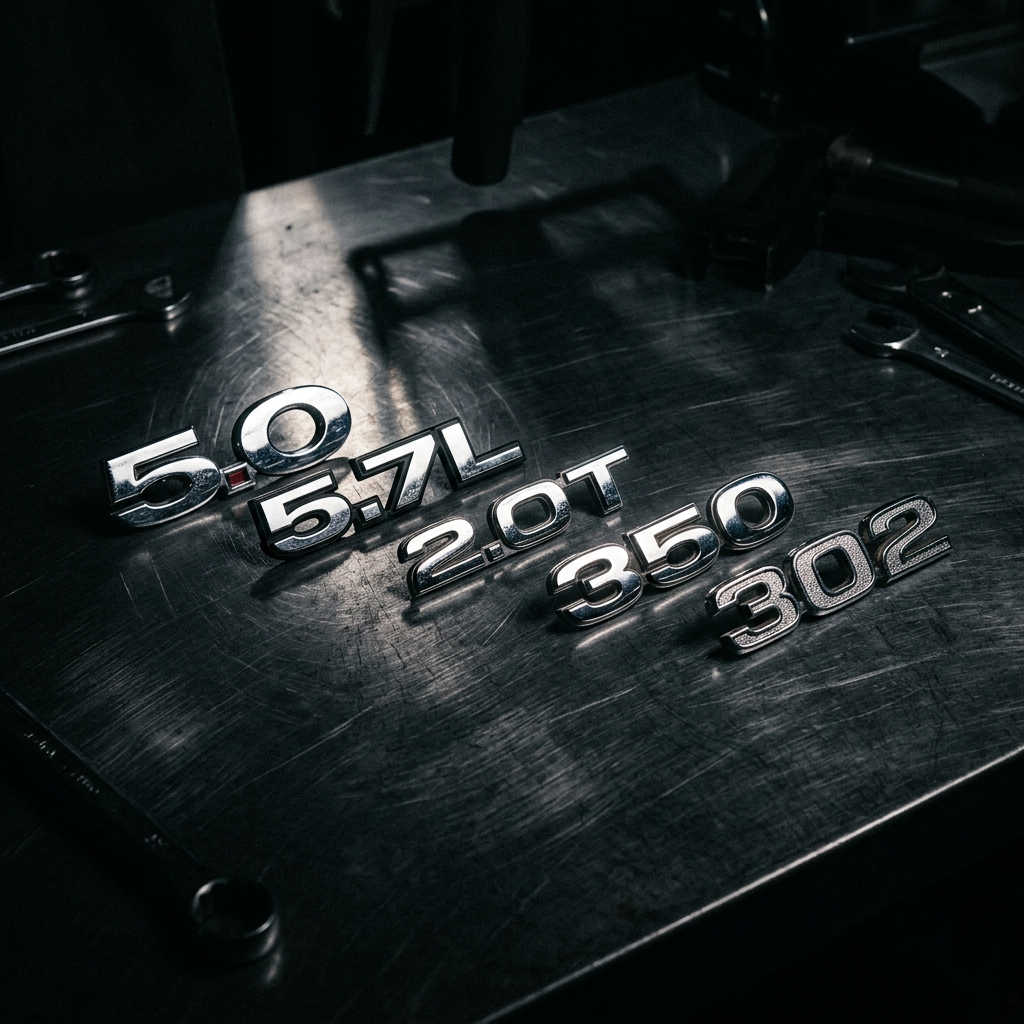
A Chevrolet “5.0L” V8 calculates to 4,999 cc. A Honda “2.0L” four-cylinder measures 1,998 cc. The BMW “3.0L” inline-six is actually 2,979 cc. Every badge on every engine rounds to a clean, memorable number that the actual engineering dimensions never quite produce.
This is not deception. It is the inevitable result of designing an engine around physical constraints that have nothing to do with landing on a neat liter figure. Understanding why the numbers never quite match helps builders, tuners, and enthusiasts separate marketing language from engineering reality.
Why Clean Liter Numbers Are Nearly Impossible
To produce exactly 2,000.0 cc from 4 cylinders, the bore and stroke would need to satisfy:
(π ÷ 4) × Bore² × Stroke × 4 = 2,000,000 mm³
Simplifying: Bore² × Stroke = 636,619.77 mm³
Any combination of bore and stroke that hits this target would work — for example, 86.056 mm bore × 86.056 mm stroke. But bore and stroke are not free variables. They are constrained by at least 6 physical and business factors that all take priority over hitting a round number.
The 6 Constraints That Set Bore and Stroke
1. Bore Spacing and Block Architecture
Every engine family has a fixed bore spacing — the center-to-center distance between adjacent cylinders. This dimension is set during the initial block design and determines the maximum bore diameter. The bore spacing of the GM LS family is 111.76 mm (4.400”), which limits bore to approximately 103.25 mm before the cylinder walls become too thin.
Once bore spacing is locked, the bore diameter must fit within it while leaving adequate wall thickness and cooling passage width. The available bore range is usually a 4–8 mm window, not a free choice.
2. Stroke and Piston Speed Targets
Engineers set stroke length based on target RPM range and acceptable mean piston speed. The 25 m/s limit for forged pistons and the 20 m/s limit for cast pistons define how long the stroke can be at the intended redline.
A 2.0L engine targeting 7,500 RPM cannot have a stroke much longer than 90 mm without exceeding piston speed limits. This constrains the stroke to a narrow range that is unlikely to combine with the bore to produce exactly 2,000 cc.
3. Combustion Chamber Geometry
The bore diameter directly determines combustion chamber width, which affects flame travel distance, quench area, and spark plug placement. Changing bore by even 1 mm to hit a round displacement number could require redesigning the cylinder head casting, intake port geometry, and valve placement.
4. Emissions Certification
Engines are emissions-certified at a specific displacement. The certification covers a tolerance band (typically ±1%), but the bore and stroke are fixed in the certification documents. Adjusting dimensions to hit a rounder number would require re-certification — a process that costs millions of dollars and months of testing.
5. Manufacturing Tolerance and Tooling
Production bore and stroke dimensions are specified to ±0.013 mm (±0.0005”) tolerance. The nominal dimension is chosen to work with existing tooling, machining centers, and quality control fixtures. Changing a bore by 0.5 mm to achieve a rounder displacement would require new tooling across every production facility — a capital expense measured in millions.
6. Cross-Platform Parts Sharing
Modern automakers share bore and stroke dimensions across multiple engines. The Honda K-series uses an 86.0 mm bore across the K20 (2.0L) and K24 (2.4L) — only the stroke changes (86.0 mm vs. 99.0 mm). If Honda adjusted the K20 bore to hit exactly 2,000 cc, it would break the parts-sharing strategy with the K24, increasing manufacturing cost.
How Marketing Labels Are Assigned
Automakers assign displacement labels using a simple rounding convention:
| Rule | Example |
|---|---|
| Round to nearest 0.1 L | 1,998 cc → “2.0L” |
| Round to nearest 0.5 L for large engines | 4,951 cc → “5.0L” |
| Use cubic inches for American muscle car heritage | 5,735 cc → “350” |
| Include turbo indicator for boosted engines | 1,998 cc turbo → “2.0T” |
The badge communicates the engine’s size class, not its exact volume. From a consumer’s perspective, the difference between 1,998 cc and 2,000 cc is meaningless. From a builder’s perspective, the exact number is the only one that matters.
The Real Displacement of Famous “Round Number” Engines
| Badge Name | Bore × Stroke | Cylinders | Actual cc | Actual Liters | Difference from Badge |
|---|---|---|---|---|---|
| ”2.0L” Honda K20A | 86.0 × 86.0 | 4 | 1,998 | 1.998 | −2 cc |
| ”2.0T” VW EA888 | 82.5 × 92.8 | 4 | 1,984 | 1.984 | −16 cc |
| ”3.0L” BMW B58 | 82.0 × 94.6 | 6 | 2,998 | 2.998 | −2 cc |
| ”3.5L” Toyota 2GR-FE | 94.0 × 83.0 | 6 | 3,456 | 3.456 | −44 cc |
| ”5.0L” Ford Coyote | 92.2 × 92.7 | 8 | 4,951 | 4.951 | −49 cc |
| ”5.0L” Chevy 305 | 95.5 × 88.4 | 8 | 4,999 | 4.999 | −1 cc |
| ”5.7L” Chevy LS1 | 99.0 × 92.0 | 8 | 5,665 | 5.665 | −35 cc |
| ”5.7L” Chrysler Hemi | 99.5 × 90.9 | 8 | 5,654 | 5.654 | −46 cc |
| ”6.2L” Chevy LS3 | 103.25 × 92.0 | 8 | 6,162 | 6.162 | −38 cc |
| ”350” Chevy SBC | 101.6 × 88.4 | 8 | 5,735 | 5.735 | +35 cc (rounds to 350 CID) |
Several observations:
- Most engines are below their badge number, not above. Automakers almost always round up to the next clean figure.
- The Chevy 305 is remarkably close — only 1 cc from 5,000 cc. This is a coincidence of bore and stroke dimensions, not intentional targeting.
- Two engines sharing the same badge (like the Coyote and Chevy 305 both being “5.0L”) can differ by 48 cc in actual displacement.
When the Exact Number Matters
The badge is fine for casual conversation. The calculated displacement matters whenever precision is required:
Racing Class Compliance
Sanctioning bodies (NHRA, SCCA, FIA) define class limits in exact cubic centimeters or cubic inches. A car entered in a “5.0L and under” class with an engine that calculates to 5,001 cc is disqualified — regardless of what badge the manufacturer put on it. Racers use the engine displacement calculator to verify compliance before tech inspection.
Performance Estimates
The horsepower and torque estimator uses displacement as a primary input. Entering “5.0” when the actual engine is 4,951 cc creates a 1% error that cascades through every dependent calculation — airflow requirements, fuel injector sizing, and torque estimates.
Overbore and Stroker Planning
After a 0.030” overbore, the displacement changes. After a stroker crank install, it changes more. If the starting baseline uses the badge instead of the measured bore and stroke, every subsequent calculation starts from a wrong number. Use the actual dimensions, not the marketing approximation.
Insurance and Registration
Some jurisdictions tax vehicles by displacement bracket. The difference between 1,998 cc (taxed as a 2.0L) and 2,003 cc (potentially taxed as a 2.1L) can affect annual registration fees. The calculation, not the badge, determines the legal classification in these cases.
How to Find Your Engine’s Actual Displacement
- Look up the bore and stroke in the manufacturer’s service manual or engine specification sheet. Factory specs are published to 0.1 mm or 0.001” precision.
- Enter the values into the engine displacement calculator along with the cylinder count.
- Read the exact result in cc, liters, and cubic inches simultaneously.
- Compare to the marketing badge to understand the rounding.
The badge tells you what family of engine you are looking at. The formula tells you what the engine actually is. Both are useful — but only one is precise enough for build planning, and it is never the badge.