
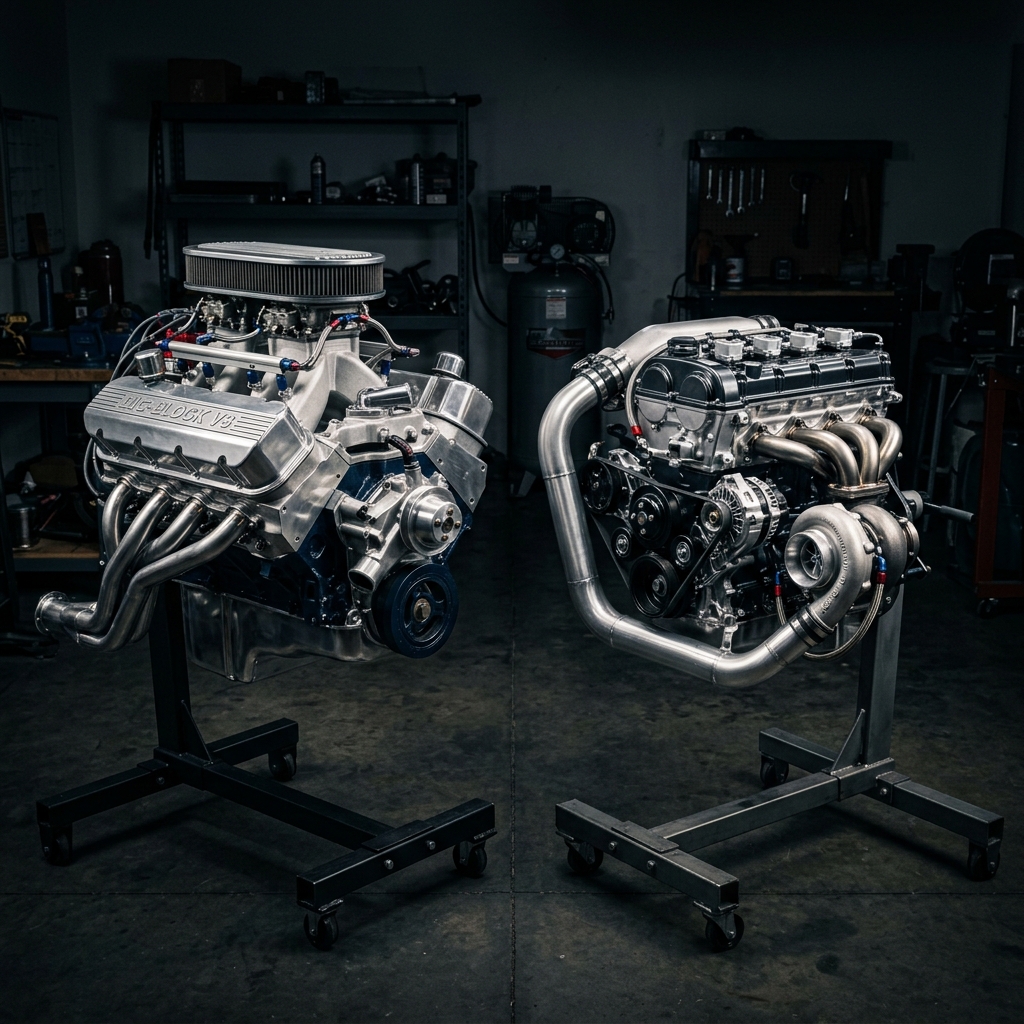
In 2010, Ford replaced the 6.2L V8 in the F-150 with a 3.5L twin-turbo V6 called EcoBoost. The smaller engine produced more torque (420 lb-ft vs. 405 lb-ft), more horsepower (365 hp vs. 411 hp was close), weighed 130 lb less, and achieved 20% better fuel economy on the EPA highway cycle.
This single decision captured the entire industry trend: replace large naturally aspirated engines with smaller turbocharged engines that deliver equal performance with less fuel. The engineering case is compelling. The business case is mandatory. And the physics makes it work.
The Physics: Why Smaller + Boost = More Efficient
The Part-Throttle Advantage
The efficiency advantage of downsizing comes not from peak power but from cruise conditions — where most driving occurs.
At 60 mph cruise, both engines need approximately 20 hp to maintain speed. Here is how each engine delivers that 20 hp:
| Parameter | 6.2L V8 (NA) | 3.5L V6 (Turbo) |
|---|---|---|
| Displacement | 6,162 cc | 3,496 cc |
| Cylinders active at cruise | 8 (or 4 with AFM) | 6 |
| Throttle position at cruise | 12% | 22% |
| Manifold vacuum | 19 in-Hg | 12 in-Hg |
| Pumping loss | 4.3 hp | 1.9 hp |
| Friction loss | 14 hp | 8 hp |
| Total parasitic loss | 18.3 hp | 9.9 hp |
| BSFC at cruise | 0.51 lb/hp-hr | 0.42 lb/hp-hr |
| Fuel consumption at cruise | 1.8 gal/hr | 1.4 gal/hr |
The smaller engine is 22% more fuel-efficient at cruise because:
- Less pumping: Fewer cylinders pulling against the throttle restriction
- Less friction: Fewer bearings, rings, and valve train components
- Higher per-cylinder load: Each cylinder operates closer to its efficiency sweet spot
The Effective Displacement Concept
Under boost, the turbo engine’s effective displacement exceeds the larger NA engine:
Effective Displacement = Physical Displacement x (1 + Boost/Atmospheric)
| Engine | Physical | Boost | Effective Displacement |
|---|---|---|---|
| 3.5L EcoBoost (cruise) | 3,496 cc | 0 psi | 3,496 cc |
| 3.5L EcoBoost (full power) | 3,496 cc | 16 psi | 7,308 cc |
| 6.2L NA (any condition) | 6,162 cc | 0 psi | 6,162 cc |
At full power, the 3.5L turbo has an effective displacement of 7.3L — 19% larger than the 6.2L V8 it replaced. This is how it matches or exceeds the larger engine’s peak torque.
At cruise, the turbo sits idle and the engine operates as a 3.5L — a 43% reduction in effective displacement compared to the V8.
The Business Case: CAFE Compliance
US Corporate Average Fuel Economy (CAFE) standards require manufacturers to achieve fleet-wide fuel economy targets. Every vehicle sold contributes to the average.
| CAFE Target | 2016 | 2020 | 2025 | 2031 |
|---|---|---|---|---|
| Passenger cars | 34.1 mpg | 36.0 mpg | 43.7 mpg | 50.4 mpg |
| Light trucks | 26.2 mpg | 28.4 mpg | 31.5 mpg | 37.2 mpg |
A 6.2L V8 truck at 20 mpg drags the fleet average down. A 3.5L turbo truck at 24 mpg provides the same capability while improving the average. Across millions of vehicles sold, this difference determines whether a manufacturer pays CAFE fines or avoids them.
The fine for non-compliance is $15 per 0.1 mpg under target per vehicle sold. For a manufacturer selling 2 million trucks, each 1 mpg improvement avoids $300 million in fines. That financial pressure makes turbo downsizing a business necessity.
The 7 Advantages of Turbo Downsizing
1. Weight Reduction
| Component | 6.2L V8 | 3.5L V6 Turbo | Savings |
|---|---|---|---|
| Engine block | 180 lb | 120 lb | 60 lb |
| Heads (2 vs. 2) | 80 lb | 55 lb | 25 lb |
| Rotating assembly | 85 lb | 50 lb | 35 lb |
| Turbo + intercooler | — | 30 lb | (added) |
| Total dressed weight | 580 lb | 450 lb | 130 lb |
The 130 lb savings improves front-end weight distribution, braking, and tire wear.
2. Packaging
A V6 is physically shorter than a V8. A 4-cylinder is shorter than a V6. Smaller engines allow:
- More compact engine bays
- Better crumple zone design (safety)
- Front-wheel-drive compatibility (no longitudinal V8 needed)
- Space for hybrid battery and motor integration
3. Manufacturing Efficiency
Fewer cylinders = fewer parts = lower manufacturing cost. A 4-cylinder engine has 50% fewer pistons, rods, rings, spark plugs, fuel injectors, and valve train components than a V8.
4. Faster Warm-Up
Less thermal mass means the engine reaches operating temperature sooner, reducing the cold-start emissions penalty that dominates urban driving.
5. Lower Emissions
Smaller displacement = less exhaust volume = smaller, lighter catalytic converters that reach operating temperature faster. Modern turbocharged engines meet Tier 3 and Euro 6 standards that would be difficult for large NA engines.
6. Torque Curve Shaping
Variable geometry turbochargers (VGT) and electronic wastegates allow engineers to shape the torque curve precisely. Modern 2.0L turbo engines produce peak torque from 1,500 to 4,500 RPM — a broader plateau than most NA engines achieve.
7. Altitude Immunity
NA engines lose approximately 3% power per 1,000 ft of altitude because atmospheric pressure drops. Turbocharged engines compensate by increasing boost to maintain manifold pressure, losing only 1–2% per 1,000 ft.
Where Downsized Turbo Engines Fall Short
1. Turbo Lag
Despite improvements, there is still a measurable delay between throttle input and boost delivery. Electric turbo assist (e-turbo) is the latest solution.
2. Complexity and Cost of Repair
Turbo engines have more components that can fail:
| Additional Component | Failure Mode | Repair Cost |
|---|---|---|
| Turbocharger | Bearing failure, oil coking | $1,200–$3,000 |
| Intercooler | Boost leak, impact damage | $400–$800 |
| Wastegate | Sticking, actuator failure | $300–$700 |
| Boost control solenoid | Electrical failure | $100–$300 |
| High-pressure fuel pump (DI) | Cam lobe wear, seal failure | $600–$1,500 |
3. Real-World vs. EPA Fuel Economy
Downsized turbo engines achieve their best fuel economy under light-load, steady-state conditions — exactly what EPA test cycles emphasize. In aggressive real-world driving with frequent boost requests, the fuel economy advantage shrinks. Some owners report that heavy-footed driving eliminates the MPG advantage entirely.
4. Towing Under Sustained Load
A turbo engine towing at high altitude in hot weather operates at high boost, high exhaust temperature, and high thermal stress simultaneously. Large NA engines handle sustained load with less thermal stress because they do not rely on forced induction to meet the demand.
Displacement Downsizing Timeline
| Era | Typical Engine | Power | Why |
|---|---|---|---|
| 1970s | 7.0L V8 | 250 hp (net) | No emissions targets, cheap fuel |
| 1980s | 5.0L V8 | 225 hp | Early CAFE, catalytic converters |
| 1990s | 4.6L V8 | 260 hp | Multi-valve heads recovered power |
| 2000s | 5.7–6.2L V8 | 400 hp | Improved efficiency offset size increase |
| 2010s | 3.5L V6 Turbo | 365 hp | CAFE pressure forced downsizing |
| 2020s | 2.0L I4 Turbo + Hybrid | 350 hp | Electrification offsets displacement further |
When a Larger NA Engine Still Wins
| Application | Better Choice | Why |
|---|---|---|
| Restricted NA racing | Large NA | Turbo is banned |
| Sustained heavy towing | Large NA or large turbo diesel | Less thermal stress |
| Maximum reliability | Large NA | Fewer failure points |
| Sound and character | Large NA | V8 exhaust note cannot be replicated |
| Regulated racing classes | Per class rules | Displacement limits vary |
The Builder’s Perspective
For aftermarket and custom builds, the choice between large NA and small turbo is a design decision, not a mandate:
- Use the displacement calculator to establish the NA baseline.
- Use the HP/torque estimator to compare NA and boosted power targets.
- Use the effective displacement formula to determine what boost level matches a specific NA displacement.
Automakers chose turbo downsizing because the physics, regulations, and economics demanded it. Enthusiasts can choose either path — but understanding why the industry moved explains what the trade-offs actually are.