
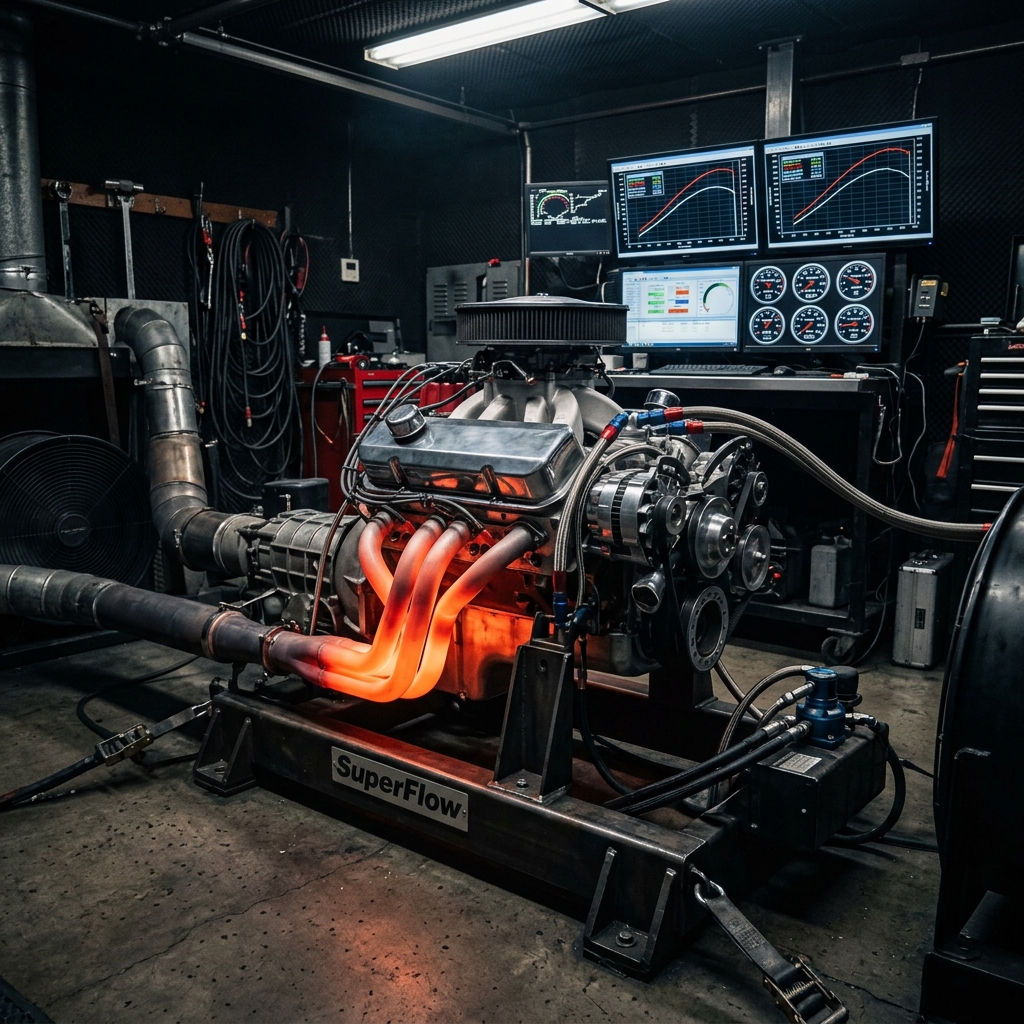
The check engine light illuminates when the engine control unit (ECU) detects a sensor reading or system behavior that falls outside its programmed acceptable range. What most vehicle owners do not realize is that those acceptable ranges are fundamentally shaped by engine displacement — because displacement determines how much air the engine should move, how much fuel it should consume, and what pressure and temperature values are normal at any given operating point.
Understanding the 5 most common OBD-II codes through the lens of displacement gives you a diagnostic framework that goes beyond “look up the code and replace the part.”
The 5 Most Common OBD-II Codes
1. P0300 — Random/Multiple Cylinder Misfire Detected
What it means: The ECU detected combustion events that did not produce the expected crankshaft acceleration. Multiple cylinders are affected (individual cylinder misfires use P0301–P0308 for cylinders 1–8).
How displacement matters: The ECU monitors crankshaft speed variation to detect misfires. Each cylinder’s power stroke should accelerate the crankshaft by a specific amount. That amount depends on:
| Factor | Larger Displacement | Smaller Displacement |
|---|---|---|
| Expected acceleration per cylinder | Higher (more torque per event) | Lower (less torque per event) |
| Sensitivity to single misfire | Lower (other cylinders compensate) | Higher (fewer cylinders, each matters more) |
| RPM drop from one misfire | ~5–15 RPM | ~15–40 RPM |
A V8 engine can tolerate occasional misfires before the code sets because 7 other cylinders maintain crankshaft speed. A 3-cylinder engine trips P0300 much faster because each misfire represents 33% of the engine’s power.
Common causes: Worn spark plugs, failing ignition coils, vacuum leaks, low fuel pressure, carbon-fouled injectors.
2. P0171 / P0174 — System Too Lean (Bank 1 / Bank 2)
What it means: The ECU detects that the fuel mixture is leaner (more air, less fuel) than the target ratio. The system is adding more fuel than expected to maintain stoichiometric (14.7:1) mixture.
How displacement matters: The expected airflow and fuel delivery are directly proportional to displacement:
| Engine | Displacement | Expected Idle Airflow | Expected Idle Fuel Rate |
|---|---|---|---|
| 1.5L I4 | 1,498 cc | 3–5 g/s | 0.5–0.8 g/s |
| 2.0L I4 | 1,998 cc | 4–7 g/s | 0.7–1.0 g/s |
| 3.5L V6 | 3,456 cc | 7–11 g/s | 1.2–1.8 g/s |
| 5.0L V8 | 4,951 cc | 10–16 g/s | 1.5–2.5 g/s |
| 6.2L V8 | 6,162 cc | 13–20 g/s | 2.0–3.2 g/s |
A vacuum leak that admits an extra 3 g/s of unmetered air is a 60% error on a 1.5L engine but only a 20% error on a 5.0L engine. This is why lean codes are more sensitive on small engines — a proportionally smaller leak triggers the threshold.
Common causes: Vacuum leaks (intake manifold gaskets, PCV hoses, brake booster lines), dirty MAF sensor, failing fuel pump, clogged fuel filter.
3. P0420 — Catalyst System Efficiency Below Threshold (Bank 1)
What it means: The rear oxygen sensor (downstream of the catalytic converter) shows a switching pattern similar to the front sensor, indicating the catalyst is not converting pollutants effectively.
How displacement matters: Larger displacement engines produce more exhaust volume and higher exhaust temperatures, which affects catalyst aging:
| Displacement Class | Exhaust Volume (cruise) | Typical Cat Life |
|---|---|---|
| 1.0–2.0L | 2,500–5,000 L/hr | 120,000–150,000 miles |
| 2.0–3.5L | 5,000–9,000 L/hr | 100,000–130,000 miles |
| 3.5–5.0L | 8,000–14,000 L/hr | 80,000–120,000 miles |
| 5.0L+ | 12,000–20,000 L/hr | 70,000–100,000 miles |
Larger engines push more exhaust through the catalyst, accelerating thermal aging. A 6.2L V8 may trigger P0420 at 80,000 miles while a 1.5L I4 may not trigger it until 140,000 miles — not because of build quality, but because of the volume of exhaust processed.
Common causes: Aged catalytic converter, exhaust leaks before the rear sensor, oil consumption contaminating the catalyst, engine misfires (unburned fuel overheating the cat).
4. P0101 — Mass Air Flow (MAF) Circuit Range/Performance
What it means: The MAF sensor reading does not match the expected airflow for the current engine operating conditions (RPM, throttle position, manifold pressure).
How displacement matters: The ECU compares the MAF reading to a calculated expected airflow based on displacement, RPM, and volumetric efficiency:
Expected Airflow (g/s) = (Displacement in L × RPM × VE × Air Density) ÷ 3,456
| Condition | 1.5L Engine | 5.0L Engine |
|---|---|---|
| Idle (700 RPM, 30% VE) | 2.5 g/s | 8.3 g/s |
| Cruise (2,500 RPM, 45% VE) | 6.1 g/s | 20.4 g/s |
| WOT (5,000 RPM, 85% VE) | 15.5 g/s | 51.6 g/s |
If the MAF reads 25 g/s at cruise on the 5.0L engine, that is within the expected range. If it reads 25 g/s on the 1.5L engine at the same cruise RPM, the ECU knows something is wrong — the sensor is reading 4× higher than expected.
Common causes: Contaminated MAF sensor element (oil from aftermarket air filters), damaged MAF sensor wiring, air leaks between MAF and throttle body, aftermarket intake without MAF recalibration.
5. P0128 — Coolant Thermostat Below Regulating Temperature
What it means: The ECU detects that the engine coolant temperature is not reaching the expected operating temperature within a programmed time period after cold start.
How displacement matters: Larger engines generate more combustion heat and warm up faster:
| Displacement | Typical Warm-Up Time (40°F ambient) | ECU Timer |
|---|---|---|
| 1.0–1.5L | 6–10 minutes | 10–12 min |
| 2.0–3.0L | 4–7 minutes | 8–10 min |
| 3.5–5.0L | 3–5 minutes | 6–8 min |
| 5.0L+ | 2–4 minutes | 5–7 min |
A stuck-open thermostat on a 1.5L engine may take 15+ minutes to reach operating temperature in winter — easily triggering P0128. The same thermostat on a 6.2L V8 might still reach temperature within the timer because the engine produces enough heat to overcome the stuck valve.
Common causes: Stuck-open thermostat, incorrect thermostat rating, low coolant level, cooling fan stuck on.
The Diagnostic Framework: Displacement as a Baseline
Every diagnostic procedure benefits from knowing the engine’s displacement because it establishes what normal looks like:
| Diagnostic Check | What Displacement Tells You |
|---|---|
| MAF reading at idle | Expected g/s range scales with displacement |
| Fuel trim at cruise | Acceptable % correction depends on base fuel flow |
| Misfire sensitivity | Larger engines mask misfires; smaller engines amplify them |
| Catalyst life expectancy | Larger engines age cats faster from exhaust volume |
| Warm-up time | Larger engines produce more heat and warm faster |
| Injector pulse width | Base pulse width scales linearly with per-cylinder volume |
Expected MAF Readings by Displacement
This reference table helps diagnose MAF and airflow-related codes:
| Displacement | Idle MAF (g/s) | 2,500 RPM Cruise (g/s) | WOT Peak (g/s) |
|---|---|---|---|
| 1.0L | 1.5–3.0 | 4–7 | 10–15 |
| 1.5L | 2.5–5.0 | 6–10 | 15–22 |
| 2.0L | 3.5–6.5 | 8–14 | 20–30 |
| 2.5L | 4.5–8.0 | 10–17 | 25–38 |
| 3.5L | 6.0–11.0 | 14–24 | 35–55 |
| 5.0L | 9.0–16.0 | 20–35 | 50–80 |
| 6.2L | 11.0–20.0 | 25–42 | 65–100 |
If your reading falls significantly outside the expected range for your engine’s displacement, the MAF sensor, air path, or engine breathing is the issue — not the ECU.
The Displacement-to-Diagnosis Workflow
- Identify your engine displacement — use the badge, service manual, or the displacement calculator with measured bore and stroke.
- Pull the codes with an OBD-II scanner.
- Reference expected values for your displacement class (tables above).
- Compare actual sensor readings to expected ranges.
- Diagnose the deviation — is the reading too high, too low, or erratic?
- Address the root cause rather than just clearing the code.
The check engine light tells you something is wrong. Displacement tells you what “right” should look like. Together, they turn a generic code into a specific diagnosis.