
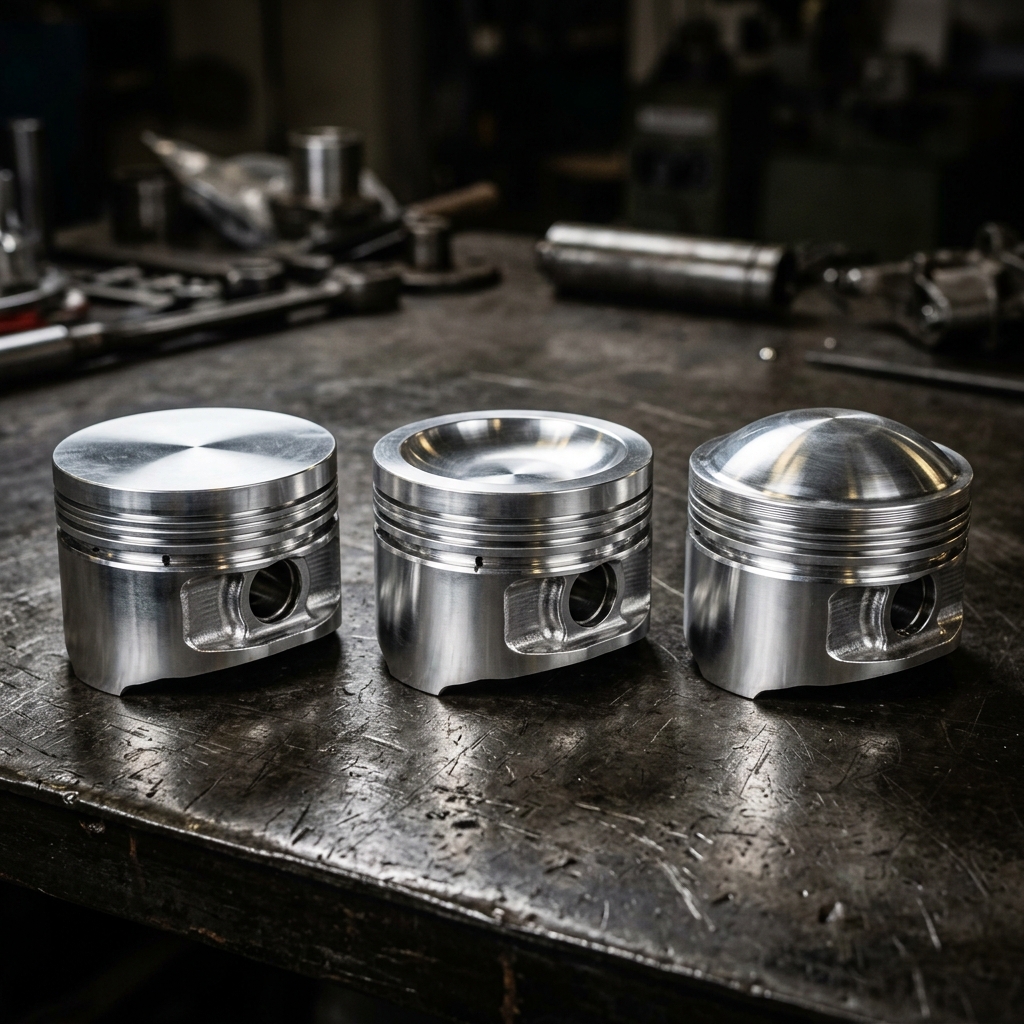
Displacement tells you how much air and fuel the engine can draw in. Compression ratio tells you how much the engine squeezes that charge before igniting it. The piston crown shape — flat, dished, or domed — is one of the most powerful levers for setting compression ratio without changing displacement, cylinder heads, or gaskets.
Understanding piston volume is essential because it directly affects detonation resistance, thermal efficiency, power output, and fuel octane requirements. A 10 cc difference in piston dish volume can swing compression ratio by a full point — the difference between running on 87 octane and requiring 93.
The 3 Piston Crown Shapes
Flat-Top Piston
A flat-top piston has a crown surface that is approximately flush with the bore diameter. The crown adds zero volume and removes zero volume from the combustion chamber.
- Volume contribution: 0 cc (neutral)
- Effect on compression: Baseline — no addition or subtraction
- Typical use: High-performance NA engines, balanced builds
- Advantage: Maximum quench area for detonation resistance
Dished Piston (Concave Crown)
A dished piston has a concave depression machined into the crown. This dish adds volume to the space above the piston at TDC, effectively enlarging the combustion chamber and lowering compression ratio.
- Volume contribution: +4 to +22 cc (adds clearance volume)
- Effect on compression: Lowers ratio
- Typical use: Factory engines, low-compression turbo builds, emissions compliance
- Advantage: Allows use of factory heads with large chambers while maintaining safe CR
Domed Piston (Convex Crown)
A domed piston has a raised section on the crown that protrudes into the combustion chamber. This dome displaces volume from the chamber space, reducing clearance volume and raising compression ratio.
- Volume contribution: −4 to −20 cc (reduces clearance volume)
- Effect on compression: Raises ratio
- Typical use: High-compression NA builds, vintage engines with large chambers
- Disadvantage: Dome can impede flame travel, create hot spots, and reduce quench effectiveness
How Piston Volume Affects Compression Ratio
The static compression ratio formula is:
CR = (Swept Volume + Clearance Volume) ÷ Clearance Volume
Where clearance volume includes:
- Combustion chamber volume (cc)
- Head gasket volume
- Deck clearance volume
- Piston dish volume (positive = adds to clearance)
- Piston dome volume (negative = subtracts from clearance)
Worked Example
Consider a Chevy 350 with the following specifications:
| Parameter | Value |
|---|---|
| Bore | 4.030” (after 0.030” overbore) |
| Stroke | 3.480” |
| Chamber volume | 64 cc |
| Gasket thickness | 0.041” (compressed) |
| Gasket bore | 4.100” |
| Deck clearance | 0.020” |
Now compare 3 piston options:
| Piston Type | Crown Volume | Total Clearance Volume | Compression Ratio |
|---|---|---|---|
| Dished (−16 cc) | +16 cc dish | 86.8 cc | 8.5:1 |
| Flat-top (0 cc) | 0 cc | 70.8 cc | 9.9:1 |
| Domed (+8 cc) | −8 cc dome | 62.8 cc | 10.9:1 |
The same engine with the same heads and gaskets produces compression ratios from 8.5:1 to 10.9:1 — a 2.4-point swing — by changing only the piston crown shape. This is why piston selection is one of the most impactful decisions in short-block planning.
Use the compression ratio calculator to model your specific combination.
Piston Volume Reference by Application
Common Dish Volumes (Positive — Lowers CR)
| Application | Typical Dish Volume | Purpose |
|---|---|---|
| Factory low-compression | 16–22 cc | Meet emissions with large chambers |
| Mild street performance | 8–14 cc | Moderate CR on pump gas |
| Turbo / supercharged | 12–20 cc | Reduce CR for boost tolerance |
| Diesel (indirect injection) | 20–35 cc | Pre-chamber geometry |
Common Dome Volumes (Negative — Raises CR)
| Application | Typical Dome Volume | Purpose |
|---|---|---|
| High-performance NA | 4–8 cc | Raise CR with open-chamber heads |
| Vintage muscle car | 6–14 cc | Compensate for large factory chambers |
| Racing (NA, high octane) | 8–20 cc | Maximum compression for power |
How to Measure Piston Crown Volume
Method 1: Liquid Filling (CC’ing the Piston)
This is the standard machine shop method:
- Install the piston in a bare cylinder at the desired position (typically flush with or slightly below the deck).
- Seal the rings with light grease to prevent fluid leakage past the rings.
- Place a flat plate (plate glass or machined aluminum) across the bore to create a sealed chamber above the piston.
- Fill the cavity through a small hole in the plate using a graduated burette.
- Read the burette to determine the exact fluid volume used.
For a dished piston flush with the deck, the fluid volume equals the dish volume directly. For a domed piston, the measurement requires comparing the volume with a known flat reference.
Accuracy: ±0.5 cc when performed carefully.
Method 2: Manufacturer Specification
Piston manufacturers publish crown volume for every part number:
| Manufacturer | Specification Format | Typical Accuracy |
|---|---|---|
| JE Pistons | Crown volume in cc, published per part number | ±0.5 cc |
| Wiseco | Dome volume included in tech sheet | ±0.5 cc |
| Mahle | Published in catalog with compression height | ±0.5 cc |
| Keith Black | Included in piston specification card | ±1.0 cc |
Manufacturer specs are sufficient for calculation purposes. Physical measurement is recommended only when using unknown or used pistons.
Method 3: Water Displacement (for domes)
For domed pistons where the dome protrudes above the bore:
- Measure the total chamber volume with a flat plate (no piston).
- Install the piston at TDC.
- Measure the remaining chamber volume.
- Dome volume = Total chamber volume − Remaining volume with piston.
Why Dome Shape Matters for Combustion
Flame Travel Distance
A flat-top piston creates a uniform gap between the piston crown and the chamber ceiling. The flame front travels outward from the spark plug in a relatively even pattern.
A domed piston creates an uneven gap — thick over the dome and thin at the edges. This forces the flame front to navigate around the dome, increasing the total flame travel path. Longer flame travel means more time for end-gas autoignition (detonation), which is why domed pistons are more knock-sensitive than flat-tops at the same compression ratio.
Quench Area
The quench zone is the narrow gap between the piston crown and the flat portion of the cylinder head. When the piston approaches TDC, the mixture in this narrow gap is rapidly compressed and accelerated (“squished”) toward the combustion chamber center, promoting turbulence and faster burn.
- Flat-top pistons maximize quench area — the entire piston crown participates.
- Dished pistons reduce quench area — the dish is too far from the head to produce quench.
- Domed pistons can either help or hurt quench depending on dome placement relative to the chamber shape.
A flat-top piston with 0.040” quench clearance is generally the most detonation-resistant configuration at any given compression ratio.
The Piston Selection Decision Framework
| Goal | Recommended Crown | Reasoning |
|---|---|---|
| Maximum power (NA, race fuel) | Flat-top or mild dome | Highest safe CR with good quench |
| Street performance (91–93 octane) | Flat-top | CR typically 9.5–10.5:1 with modern chambers |
| Turbo/supercharged (8–15 psi) | Dished (8–16 cc) | CR needs to drop to 8.0–9.5:1 for boost tolerance |
| Turbo/supercharged (15+ psi) | Deep dish (16–22 cc) | CR target 7.5–8.5:1 for high boost |
| Factory rebuild (match original) | Match OEM spec | Maintains calibration compatibility |
Common Mistakes
1. Confusing Dish Volume with Displacement
Piston dish volume changes clearance volume, not swept volume. Your displacement number does not change when you swap piston crown shapes — only your compression ratio changes.
2. Ignoring Valve Reliefs
Most pistons have valve relief notches cut into the crown to provide valve clearance. These notches add 1–4 cc of additional clearance volume that is separate from the published dish volume. Some manufacturers include relief volume in their published number; others do not. Always verify whether the spec includes or excludes valve reliefs.
3. Assuming All Flat-Tops Are 0 cc
Some “flat-top” pistons have shallow valve reliefs that add 2–5 cc of dish volume. A piston marketed as “flat-top” with 4 valve reliefs of 1.2 cc each adds 4.8 cc of clearance volume — enough to reduce compression ratio by 0.5 points.
The Calculation Workflow
- Determine your target compression ratio based on fuel octane and intended use.
- Enter all known values (bore, stroke, chamber volume, gasket specs, deck clearance) into the compression ratio calculator.
- Adjust the piston volume field until the calculated CR matches your target.
- Select a piston with a dome or dish volume that matches the calculated requirement.
- Verify after assembly by cc’ing the actual chamber with the piston installed at TDC.
The piston crown is the adjustment knob for compression ratio. Understanding its volume — and how to measure, select, and calculate with it — is what separates a build that runs on the intended fuel from one that detonates on the first hard pull.