
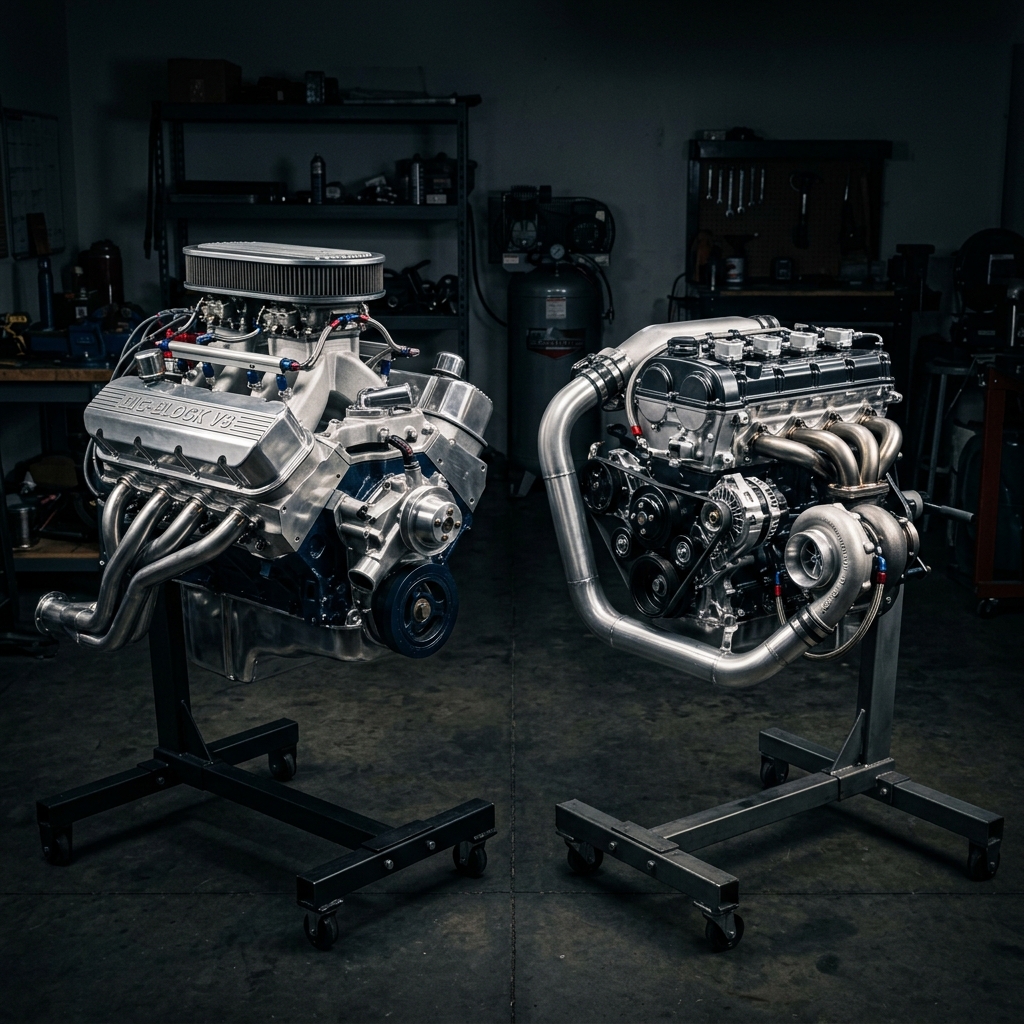
“There’s no replacement for displacement” has been the default defense of big engines for 60 years. And for 60 years, smaller engines have been proving it wrong — at least partially. The truth is more nuanced than the bumper sticker suggests: displacement provides advantages that nothing else can replicate in some contexts, and it is irrelevant in others.
This article examines both sides with engineering data to determine exactly where displacement still wins, where it loses, and why the answer depends entirely on what you are trying to achieve.
Where the Saying Is Still True
1. Naturally Aspirated Torque Production
In an NA engine, torque is fundamentally limited by how much air the engine can ingest per cycle. More displacement means more air, which means more fuel can be burned, which means more cylinder pressure, which means more torque.
Torque (ft-lb) ≈ Displacement (CID) × BMEP (psi) ÷ 150.8
At equal BMEP (brake mean effective pressure), a larger engine always produces more torque:
| Engine | Displacement | BMEP (typical) | Estimated Torque |
|---|---|---|---|
| Honda K20A (NA) | 122 CID | 185 psi | 150 ft-lb |
| Ford Coyote 5.0 (NA) | 302 CID | 190 psi | 380 ft-lb |
| Chevy LS3 6.2L (NA) | 376 CID | 185 psi | 461 ft-lb |
| Chevy 454 BBC (NA) | 454 CID | 170 psi | 512 ft-lb |
The LS3 produces over 3× the torque of the K20A despite similar BMEP. In naturally aspirated form, displacement is torque.
2. Low-RPM Response Without Lag
A large NA engine produces its torque immediately at any RPM because its volumetric capacity is always available. There is no boost threshold, no spool time, and no turbo lag. Step on the throttle at 1,500 RPM and the torque is there.
For towing, off-roading, and heavy-vehicle applications, this immediate response is more valuable than peak power numbers.
3. Simplicity and Reliability
A large NA engine achieves its output with fewer stress-inducing components than a small turbo engine. No turbocharger, no intercooler, no wastegate, no boost control system. Fewer components means fewer potential failure points, which matters for commercial trucks, marine engines, and applications where downtime is expensive.
4. Restricted Racing Classes
Many racing sanctioning bodies ban forced induction (NA-only classes). In these environments, displacement is the primary performance variable, and the saying is literally true — there is no legal replacement for cubic inches.
Where the Saying Breaks Down
1. Effective Displacement Through Boost
A turbocharger or supercharger forces more air into the cylinder than atmospheric pressure alone can provide. This creates an effective displacement that far exceeds the physical swept volume:
Effective Displacement = Physical Displacement × (1 + Boost Pressure ÷ Atmospheric Pressure)
| Engine | Physical | Boost (psi) | Effective Displacement |
|---|---|---|---|
| 2.0L Turbo (EcoBoost) | 122 CID | 18 | 271 CID |
| 2.0L Turbo (tuned) | 122 CID | 25 | 330 CID |
| 3.5L Twin-Turbo (EcoBoost) | 213 CID | 16 | 445 CID |
| 2.0L Turbo (race, E85) | 122 CID | 35 | 412 CID |
A tuned 2.0L turbo on E85 at 35 psi has an effective displacement of 412 CID — exceeding the physical 454 big-block while weighing 250 lb less and fitting in a subcompact chassis.
2. Power-to-Weight Ratio
Displacement adds weight. A fully dressed Chevy 454 weighs approximately 685 lb. A complete 2.0L EcoBoost weighs approximately 380 lb — a 305 lb difference. In a vehicle where weight matters (sports cars, autocross, road racing), that weight penalty erases any torque advantage.
| Setup | Power | Weight | Power-to-Weight |
|---|---|---|---|
| 454 BBC (NA) | 425 hp | 685 lb | 0.62 hp/lb |
| 2.0L Turbo (tuned) | 350 hp | 380 lb | 0.92 hp/lb |
| 5.0L Coyote (NA) | 460 hp | 445 lb | 1.03 hp/lb |
| 2.0L Turbo (race) | 500 hp | 395 lb | 1.27 hp/lb |
The race-tuned 2.0L turbo produces nearly 2× the power per pound of engine weight compared to the big-block.
3. Fuel Efficiency at Cruise
Large displacement engines have more friction surface area, heavier reciprocating mass, and greater pumping losses at part throttle. At cruise (2,000 RPM, 20% throttle), a 6.2L V8 is operating at very low BMEP, wasting much of its volumetric capacity. A 2.0L turbo at the same cruise speed operates at higher BMEP efficiency.
Modern downsized turbo engines achieve 25–40% better fuel economy at cruise compared to NA engines of equivalent peak power.
4. Technology Multipliers
Modern engines use technology that was unavailable when the saying was coined:
| Technology | Effect | Displacement Equivalent |
|---|---|---|
| Direct injection | +5–8% torque from better filling | ~15 CID equivalent on 2.0L |
| Variable valve timing | +10–15% broadened torque curve | ~20 CID equivalent |
| Turbocharging (15 psi) | +100% effective displacement | Doubles displacement |
| Electric hybrid assist | +50–100 hp instant torque fill | ~50 CID at low RPM |
| Variable compression ratio | Optimizes CR for every condition | Not displacement-related |
A modern 2.0L turbo with VVT, DI, and integrated mild hybrid has access to performance mechanisms that make the raw displacement number less relevant than ever.
The Real Comparison Framework
Instead of arguing displacement vs. technology in absolute terms, the honest comparison asks: what is the application?
| Application | Displacement Wins? | Why |
|---|---|---|
| NA racing (restricted class) | ✅ Yes | Boost is banned; CID = performance |
| Towing 10,000+ lb | ✅ Yes | Sustained low-RPM torque without thermal stress |
| Marine / generator | ✅ Yes | Reliability and simplicity > power density |
| Street performance (daily driver) | ❌ No | Turbo offers better power + fuel economy |
| Track day / road racing | ❌ No | Power-to-weight matters more than peak torque |
| Quarter-mile drag racing (unlimited) | ❌ Mixed | Big-inch turbo or supercharged combos dominate |
| Fuel economy compliance | ❌ No | Downsizing + boost always wins |
The Quantitative Test
The horsepower and torque estimator allows you to compare combinations directly:
Enter a 454 CID engine at 5,000 RPM with 80% VE and 9.0:1 compression, then enter a 122 CID engine at 7,000 RPM with 100% VE (boosted) and 9.0:1 CR. The numbers tell a story that the bumper sticker cannot.
For quarter-mile performance specifically, use the quarter-mile ET calculator — it uses weight and power, not displacement, because that is what actually determines acceleration.
The Updated Version of the Saying
A more accurate version would be: “There is no replacement for airflow.”
Displacement is one way to get more airflow per cycle. Boost is another. Port design is another. Higher RPM is another. The engine that moves the most air through the most efficient combustion process at the right RPM for the application will always win — regardless of whether it achieves that airflow through 454 cubic inches of swept volume or 122 cubic inches plus 25 psi of boost.
The saying is not wrong. It is incomplete. And for naturally aspirated builds where simplicity, reliability, and immediate torque response are the priorities, it remains as true today as it was in 1965.