
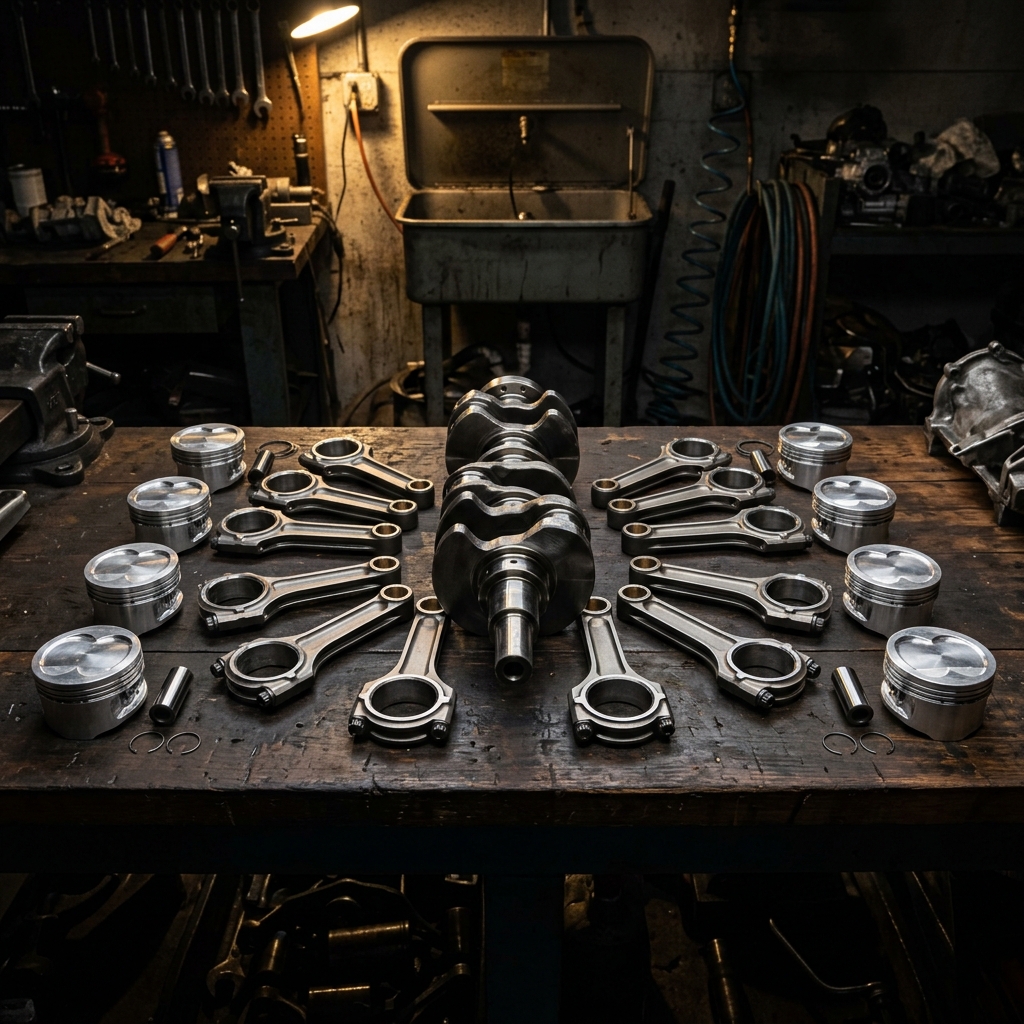
A stroker kit is the most effective single modification for increasing engine displacement. While an overbore adds 3–11 cubic inches, a stroker kit adds 25–75 cubic inches using the same block. The trade-off is complexity — a stroker changes the crankshaft, connecting rods, and pistons simultaneously, and it creates geometry changes that ripple through every aspect of the rotating assembly.
This guide explains what each component in a stroker kit does, how the displacement gain is calculated, what secondary effects must be managed, and how to evaluate whether a stroker build is right for your application.
What Is in a Stroker Kit?
A complete stroker kit includes 3 matched components designed to work together:
| Component | Purpose | Example (Chevy 383 Kit) |
|---|---|---|
| Crankshaft | Provides the longer stroke via increased throw | 3.750” stroke (from 3.480”) |
| Connecting rods | Bridge the new crank-to-piston geometry | 5.700” or 6.000” center-to-center |
| Pistons | Match the new bore, stroke, and rod length | 4.030” bore, calculated compression height |
Some kits also include piston rings, rod bearings, and main bearings. Premium kits include a balancing service (external or internal balance).
How Displacement Changes with Stroke
The displacement formula makes the math clear:
Displacement = (π ÷ 4) × Bore² × Stroke × Cylinders
Stroke is linear in the formula — doubling stroke doubles displacement (assuming bore and cylinder count stay constant). In practice, the stroke increase is much more modest (7–30%), but the displacement gain is still dramatic:
Common Stroker Combinations
| Base Engine | Stock Stroke | Stroker Stroke | Stock CID | Stroker CID | Gain |
|---|---|---|---|---|---|
| Chevy 350 SBC | 3.480” | 3.750” | 350 | 383 | +33 CID |
| Chevy 350 SBC | 3.480” | 4.000” | 350 | 408 | +58 CID |
| Ford 302 Windsor | 3.000” | 3.400” | 302 | 347 | +45 CID |
| Ford 351W | 3.500” | 4.000” | 351 | 408 | +57 CID |
| Mopar 360 LA | 3.580” | 4.000” | 360 | 408 | +48 CID |
| Mopar 340 LA | 3.310” | 3.580” | 340 | 371 | +31 CID |
| GM LS1 (5.7L) | 3.622” | 4.000” | 346 | 383 | +37 CID |
| GM LS1 (5.7L) | 3.622” | 4.125” | 346 | 402 | +56 CID |
The Chevy 350-to-383 is the most popular stroker combination in the aftermarket, with kits available from under $1,200 to over $4,000 depending on materials and brand.
Use the stroker engine planner to calculate the exact displacement for any bore/stroke combination.
The 5 Geometry Changes a Stroker Creates
1. Mean Piston Speed Increases
Longer stroke = more piston travel per revolution = higher piston speed at any given RPM.
MPS = 2 × Stroke × RPM ÷ 60
| Combination | Stroke | MPS at 5,500 RPM | MPS at 6,500 RPM |
|---|---|---|---|
| Stock 350 | 3.480” | 16.0 m/s | 18.9 m/s |
| 383 Stroker | 3.750” | 17.2 m/s | 20.4 m/s |
| 408 Stroker | 4.000” | 18.4 m/s | 21.8 m/s |
The 383 at 6,500 RPM exceeds the 20 m/s cast-piston limit. This is why most 383 kits include forged pistons — not for strength at that RPM, but because cast pistons cannot survive the piston speed.
Check your combination with the mean piston speed calculator.
2. Rod-to-Stroke Ratio Decreases
Rod ratio = Rod Length ÷ Stroke. A longer stroke with the same rod produces a lower ratio:
| Combination | Rod Length | Stroke | Rod Ratio |
|---|---|---|---|
| Stock 350 (5.700” rod) | 5.700” | 3.480” | 1.638 |
| 383 Stroker (5.700” rod) | 5.700” | 3.750” | 1.520 |
| 383 Stroker (6.000” rod) | 6.000” | 3.750” | 1.600 |
| 408 Stroker (6.000” rod) | 6.000” | 4.000” | 1.500 |
Lower rod ratios increase the connecting rod’s maximum angularity during the power stroke, which increases piston side-loading. The 5.700” rod in a 383 produces a ratio of 1.520 — adequate but not ideal. Many builders upgrade to a 6.000” rod to restore the ratio closer to 1.6.
Evaluate your combination with the rod ratio calculator.
3. Piston Compression Height Changes
The piston compression height must adjust to keep the piston at the correct position relative to the deck:
Compression Height = Block Deck Height − (Stroke ÷ 2 + Rod Length)
| Combination | Deck | Half Stroke | Rod | Compression Height |
|---|---|---|---|---|
| Stock 350 (5.700” rod) | 9.025” | 1.740” | 5.700” | 1.585” |
| 383 (5.700” rod) | 9.025” | 1.875” | 5.700” | 1.450” |
| 383 (6.000” rod) | 9.025” | 1.875” | 6.000” | 1.150” |
The 383 with a 5.700” rod requires a 1.450” compression height piston — widely available. The 383 with a 6.000” rod requires 1.150” — much shorter and often a custom-order item. Piston availability is a practical consideration when selecting rod length.
4. Deck Clearance Tightens
A longer stroke pushes the piston closer to (or beyond) the block deck surface. If the piston protrudes above the deck, it must be addressed through machining (deck the block) or component selection (shorter compression height).
Model the stack-up with the deck height calculator.
5. Crankshaft Counterweight Balance Changes
A longer stroke crank has different rotating mass distribution. Most aftermarket stroker cranks are designed for internal balance (no external Harmonic balancer weight). If the stock engine was externally balanced (Chevy 400, some Ford 351), the stroker crank must match the balance scheme or the harmonic balancer and flywheel/flexplate must be changed.
Stroker Kit Cost Comparison
| Quality Level | Components | Typical Cost | Best For |
|---|---|---|---|
| Budget cast crank | Cast crank, I-beam rods, hypereutectic pistons | $800–$1,200 | Mild street builds |
| Mid-range forged | Forged crank, H-beam rods, forged pistons | $1,500–$2,500 | Street/strip performance |
| Premium forged | Forged/billet crank, forged rods, custom pistons, balanced | $3,000–$5,000 | Serious performance / racing |
| Billet / race-spec | Billet crank, titanium rods, custom pistons, fully balanced | $5,000–$10,000+ | Pro racing / extreme HP |
When a Stroker Kit Is the Right Choice
| Situation | Stroker? | Reasoning |
|---|---|---|
| Want 30+ CID gain | ✅ Yes | Only practical way to gain this much displacement |
| Building a torque-biased street engine | ✅ Yes | Longer stroke adds torque character |
| Block walls too thin for overbore | ✅ Yes | Stroke increase avoids wall thickness issue |
| Engine already apart for rebuild | ✅ Yes | Best time to change rotating assembly |
| Budget under $1,000 | ❌ No | Quality kits start at $800+, assembly labor adds more |
| Need to maintain high-RPM character | ❌ Consider | Higher piston speed may limit safe RPM |
| Block cannot accept longer stroke | ❌ No | Some blocks lack clearance for stroker cranks |
The Stroker Build Workflow
- Start with the stock baseline. Enter current bore, stroke, and cylinders into the displacement calculator to establish the starting displacement.
- Choose a target. Use the stroker planner to find the stroke needed for your target displacement.
- Check piston speed. Verify the new stroke stays within material limits at your target RPM using the piston speed calculator.
- Evaluate rod ratio. Use the rod ratio calculator to compare different rod length options.
- Calculate deck clearance. Use the deck height calculator to confirm piston position.
- Select the kit. Match the calculated compression height, bore, and stroke to an available kit.
- Build and verify. Trial-assemble, check clearances, confirm deck clearance, and degree the cam.
A stroker kit is not just a crankshaft purchase — it is a geometry change that affects every connected dimension. The calculators exist to make that geometry visible before the parts arrive.