
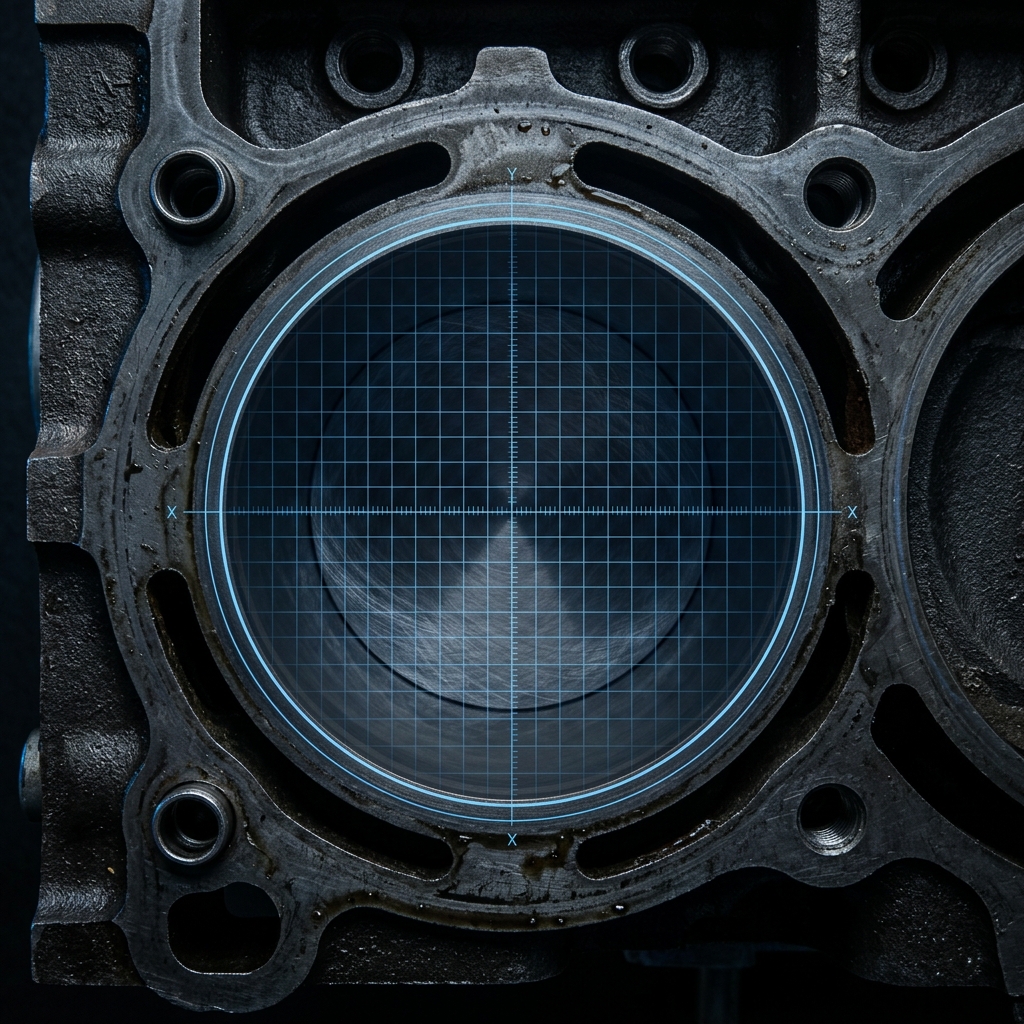
Every engine displacement calculation passes through a single mathematical constant before it can produce a correct answer. That constant is π (pi) — the ratio of a circle’s circumference to its diameter, approximately 3.14159265. It appears in the formula because every cylinder bore is round, and the area of a round opening depends on pi.
This is not a correction factor. It is not a tuning constant. It is not optional. Pi is the reason the formula works at all, and understanding its role clarifies why displacement math behaves the way it does.
Where Pi Enters the Formula
The standard displacement formula is:
Displacement = (π ÷ 4) × Bore² × Stroke × Cylinders
Pi appears inside the (π ÷ 4) term, which equals 0.785398…
This term converts the bore diameter into a circular cross-sectional area. Here is the derivation:
From Radius to Diameter
The area of a circle is commonly written as:
A = π × r²
Engine specifications always list bore as a diameter, not a radius. Since radius = diameter ÷ 2, substituting:
A = π × (d ÷ 2)² = π × d² ÷ 4 = (π ÷ 4) × d²
This is not an approximation — it is an algebraically exact rewrite. The (π ÷ 4) form is simply more convenient when working with bore diameter directly.
The Complete Chain
Once you have the bore area, the rest of the formula is linear:
| Step | Operation | Physical Meaning |
|---|---|---|
| (π ÷ 4) × Bore² | Bore diameter → cylinder area | Cross-sectional area of one bore |
| × Stroke | Area × distance | Swept volume of one cylinder |
| × Cylinders | Single cylinder → total engine | Total engine displacement |
Every step after the bore-area calculation is straightforward multiplication. Pi is the bridge between a linear measurement (bore diameter) and a two-dimensional area (cylinder cross-section).
What Happens If You Leave Pi Out
Leaving pi out of the formula treats each cylinder bore as a square with sides equal to the bore diameter instead of a circle. The area of a square with side length equal to the bore is Bore², which is larger than the circular area (π/4 × Bore²) by a factor of 4/π = 1.2732.
This means omitting pi overstates displacement by 27.32%:
| Engine | Correct Displacement | Without Pi | Error |
|---|---|---|---|
| Chevy 350 (101.6 × 88.4 × 8) | 5,735 cc (350.0 CID) | 7,304 cc (445.7 CID) | +27.3% |
| Honda K20A (86.0 × 86.0 × 4) | 1,998 cc | 2,544 cc | +27.3% |
| Ford Coyote 5.0 (92.2 × 92.7 × 8) | 4,951 cc | 6,305 cc | +27.3% |
The error is always 27.32% regardless of bore size, stroke, or cylinder count. This is because the ratio between a square’s area and an inscribed circle’s area is always 4/π.
If your calculation produces a displacement that seems suspiciously high, the most likely cause is a missing π/4 factor.
Why Pi Is Always the Same Number
Pi is a mathematical constant — it does not change based on bore size, material, temperature, or any physical property of the engine. A 50 mm motorcycle bore and a 120 mm diesel bore both use the same pi value (3.14159265…).
This universality is what makes the displacement formula work across every engine ever built. Whether the bore is measured in millimeters, inches, or any other unit, the relationship between diameter and area is always mediated by the same constant.
The Infinite Decimal
Pi is an irrational number — its decimal expansion never terminates and never repeats. The first 20 digits are:
3.14159265358979323846…
For engine displacement calculations, even 4 decimal places (3.1416) provides accuracy to within 0.0003% — less than 0.001 CID on a 350 CID engine. Computers store pi to 15+ decimal places, making the truncation error effectively zero.
Pi in Related Engine Calculations
Pi appears in every engine calculation that involves circular or cylindrical geometry:
| Calculation | Where Pi Appears | Formula |
|---|---|---|
| Displacement | Bore area | (π/4) × B² × S × N |
| Combustion chamber volume | Chamber dome area | (π/4) × B² × gasket thickness (for gasket volume portion) |
| Piston dome/dish volume | Curved surface area | π × r² × h (for dish approximation) |
| Port cross-sectional area | Round port opening | (π/4) × D² |
| Valve curtain area | Cylindrical flow area | π × valve diameter × lift |
| Cylinder wall surface area | Cylinder inner surface | π × B × S |
Understanding pi’s role in the displacement formula automatically prepares you for every other engine geometry calculation on the site, including the compression ratio calculator, port area calculator, and overbore calculator.
The Bore-Area Sensitivity Effect
Because bore is squared and then multiplied by pi/4, small bore changes create area changes that feel disproportionate. This is not pi’s “fault” — it is a property of squaring. But pi amplifies the perception because builders tend to think in diameter (a linear dimension) while the formula operates in area (a squared dimension).
Consider the Chevy small block at 4.000” bore:
| Bore Change | New Bore | Area Change | Displacement Change |
|---|---|---|---|
| +0.010” | 4.010” | +0.0315 sq in per cyl | +0.88 CID |
| +0.030” | 4.030” | +0.0950 sq in per cyl | +2.68 CID |
| +0.060” | 4.060” | +0.1916 sq in per cyl | +5.44 CID |
Each 0.010” of bore adds more area than the previous 0.010” — not because pi changes, but because the circumference at which the area ring is added gets larger. Pi scales this circumference-to-area conversion identically at every bore size.
A Historical Note: How Pi Became Part of Engine Math
The first recorded use of the displacement formula in an automotive engineering context dates to the early 1900s, when the RAC (Royal Automobile Club) developed a taxation formula that used bore and cylinder count — but initially ignored stroke entirely. The RAC formula was:
RAC HP = (Bore² × Cylinders) ÷ 2.5
This formula included bore squared but used an empirical divisor (2.5) instead of the mathematically correct pi/4 factor. The result was that engines were taxed by a formula that did not accurately represent displacement, which created strange engineering incentives — manufacturers built engines with small bores and extremely long strokes to minimize tax while maximizing actual displacement.
The modern formula, using pi/4 correctly, eliminates this distortion. Every engine is measured by its actual swept volume, regardless of bore-to-stroke ratio.
Practical Takeaway
Pi is not a complication — it is a simplification. Without it, you would need to measure the actual circular area of each bore directly (a laborious process) instead of calculating it from a single diameter measurement.
The diameter-to-area conversion (π/4 × d²) is one of the most fundamental relationships in geometry. In engine displacement math, it is the bridge between what you can measure with a caliper (bore diameter) and what the engine actually sweeps (cylinder volume).
Every calculator on this site — from the main displacement tool to the overbore planner to the compression ratio calculator — uses pi identically. Understand it once, and every calculation that follows becomes transparent.