
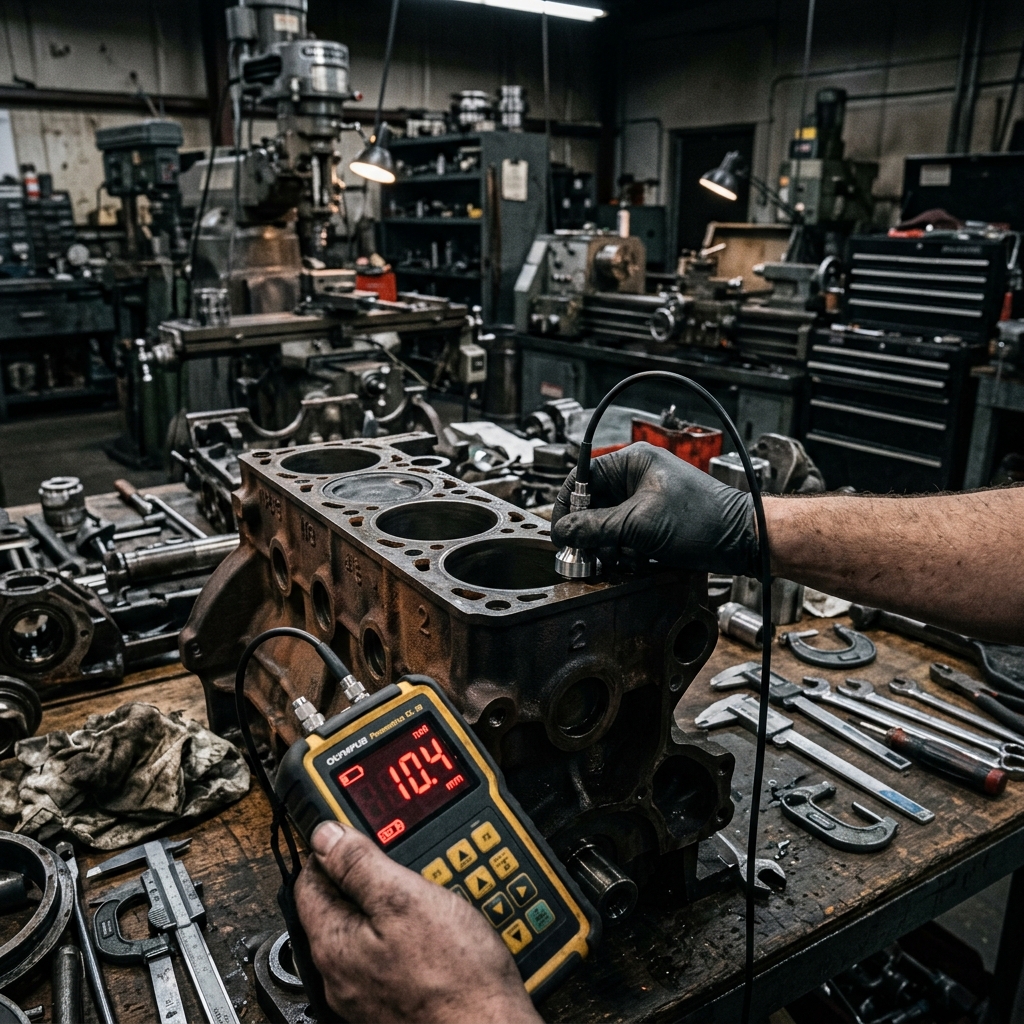
The overbore calculator can tell you exactly how many cubic inches or cubic centimeters a larger bore adds. What it cannot tell you is whether the block will survive the machining. That answer comes from sonic checking — an ultrasonic wall thickness test that maps the actual cylinder wall dimensions of a specific casting before the boring bar touches it.
Every engine block is a casting with internal water passages. The cores that form those passages are not perfectly centered — they shift during the casting process. This means two blocks with identical part numbers can have radically different wall thicknesses at the same cylinder location. Sonic checking reveals what is actually there, not what the factory intended to be there.
How Ultrasonic Wall Thickness Testing Works
The Physics
A sonic tester sends a high-frequency sound pulse (typically 5–10 MHz) into the cylinder wall from the outside of the block. The pulse travels through the cast iron or aluminum until it reaches the inner bore surface, where it reflects back. The tester measures the time between the transmitted pulse and the reflected echo, then calculates wall thickness:
Wall Thickness = (Speed of Sound × Round-Trip Time) ÷ 2
The speed of sound in cast iron is approximately 4,600 m/s (15,100 ft/s). In aluminum, it is approximately 6,400 m/s (21,000 ft/s). The tester is calibrated for the specific material before testing.
What the Equipment Looks Like
| Component | Function |
|---|---|
| Transducer probe | Transmits and receives ultrasonic pulses |
| Coupling gel | Eliminates air gap between probe and block surface |
| Digital readout | Displays wall thickness to 0.001” (0.025 mm) |
| Calibration block | Known-thickness reference for zeroing |
The probe is pressed against the outside of the block, aligned perpendicular to the bore axis. The operator moves the probe around each cylinder, recording thickness at every measurement point.
Where to Measure: The Standard Grid
A thorough sonic test measures each cylinder at 4–8 locations. The most common protocol uses 4 points per bore at 3 depths:
The 4 Compass Points
| Position | Location | Why It Matters |
|---|---|---|
| 12 o’clock | Top of bore (toward deck surface) | Often thinnest due to core shift |
| 3 o’clock | Thrust side | High wear zone — future thinning |
| 6 o’clock | Bottom of bore (toward main caps) | Usually thickest — least casting concern |
| 9 o’clock | Anti-thrust side | Lower wear but still needs verification |
The 3 Depths
| Depth | Distance from Deck | Why It Matters |
|---|---|---|
| Top | 0.5–1.0” below deck | Ring reversal zone — most critical for overbore |
| Middle | Center of bore | General casting quality check |
| Bottom | 1.0” above bottom of bore | Usually less concern — water jacket may not extend here |
A complete V8 sonic test produces 96 readings (8 cylinders × 4 positions × 3 depths) — a comprehensive map of the entire block’s wall structure.
How to Read a Sonic Report
A typical sonic report looks like this:
Example: Chevy 350 Block (Casting #010)
| Cylinder | 12:00 Top | 3:00 Top | 6:00 Top | 9:00 Top | 12:00 Mid | 3:00 Mid | 6:00 Mid | 9:00 Mid |
|---|---|---|---|---|---|---|---|---|
| #1 | .155 | .170 | .195 | .180 | .160 | .175 | .200 | .185 |
| #2 | .148 | .165 | .190 | .172 | .152 | .170 | .195 | .178 |
| #3 | .162 | .178 | .200 | .185 | .168 | .182 | .205 | .190 |
| #4 | .140 | .160 | .188 | .168 | .145 | .165 | .192 | .175 |
| #5 | .158 | .172 | .198 | .180 | .163 | .178 | .202 | .186 |
| #6 | .152 | .168 | .193 | .175 | .158 | .173 | .198 | .180 |
| #7 | .165 | .180 | .202 | .188 | .170 | .185 | .208 | .192 |
| #8 | .145 | .162 | .190 | .170 | .150 | .168 | .195 | .176 |
Interpreting This Data
Minimum reading: Cylinder #4, 12 o’clock top position = 0.140”
This is the critical number. After a 0.030” overbore (which removes 0.015” from each side), this location would have:
0.140” − 0.015” = 0.125” remaining
That is above the 0.100” minimum for cast iron, so the 0.030” overbore is safe at this location.
But what about a 0.060” overbore?
0.140” − 0.030” = 0.110”
That leaves only 0.010” of margin above minimum. For a high-performance application with boost or nitrous, most builders would reject this combination as too risky.
Safe Wall Thickness Minimums
| Block Material | Application | Minimum Wall |
|---|---|---|
| Cast iron | Street, naturally aspirated | 0.100” (2.54 mm) |
| Cast iron | Mild performance (under 500 hp) | 0.120” (3.05 mm) |
| Cast iron | Serious performance / boosted | 0.140” (3.56 mm) |
| Aluminum (sleeved) | Street | 0.080” (2.03 mm) |
| Aluminum (sleeved) | Performance | 0.100” (2.54 mm) |
| Siamese bore (shared wall) | Any | 0.060” minimum between bores |
The Core Shift Problem
Core shift is the #1 reason sonic testing exists. During the casting process, the sand cores that form the water jacket passages are held in place by core prints — but they can shift under the pressure and flow of molten metal. A core that shifts 0.020” toward one cylinder wall makes that wall 0.020” thinner than intended while making the opposite wall 0.020” thicker.
In the example report above, Cylinder #4 at 12 o’clock (0.140”) is 0.062” thinner than Cylinder #7 at the same position (0.202”). That 44% variation exists in blocks that look identical from the outside and share the same casting number.
Without sonic testing, you cannot know which cylinder is thin.
When Is Sonic Testing Mandatory?
| Scenario | Sonic Test Required? | Reasoning |
|---|---|---|
| Standard 0.020–0.030” cleanup bore | Recommended | Confirms all walls remain above minimum |
| Aggressive 0.040–0.060” overbore | Mandatory | Risk of hitting minimum on shifted cores |
| Unknown block history (junkyard, unknown machining) | Mandatory | May already be overbored |
| High-performance / boosted application | Mandatory | Higher cylinder pressure needs thicker walls |
| Factory rebuild with factory spec bore | Optional | Factory bore is within original design margins |
| Aftermarket race block (Dart, RHS, etc.) | Optional | Aftermarket blocks have thicker, more consistent walls |
What to Do When Walls Are Too Thin
If sonic testing reveals that one or more cylinders cannot safely support the desired overbore, you have several options:
Option 1: Reduce the Overbore
Instead of a 0.060” overbore across all cylinders, bore only to the size that the thinnest wall can safely support. A 0.030” bore on all 8 cylinders may be safe even when 0.060” is not.
Option 2: Sleeve the Thin Cylinder(s)
Press-fit ductile iron sleeves can restore wall thickness in individual cylinders. The cylinder is bored oversize (typically 0.125–0.250” over), a sleeve is pressed in, and the sleeve is then bored to the desired final size. Cost: $150–$300 per sleeve installed.
Option 3: Use a Different Block
If core shift is severe across multiple cylinders, the block may simply be a bad casting. Finding a better core from the same production run — or stepping up to an aftermarket block — may be more cost-effective than sleeving 4+ cylinders.
Option 4: Go the Stroker Route Instead
If the block cannot safely support a larger bore, increasing displacement through a longer stroke crankshaft avoids the wall thickness issue entirely. The stroker engine planner can model the displacement gain from stroke without touching the bore.
Sonic Testing and the Overbore Calculator Workflow
The correct workflow combines mathematical planning with physical verification:
- Start with the baseline. Enter the current bore, stroke, and cylinder count into the engine displacement calculator to establish stock displacement.
- Model the overbore. Use the overbore calculator to see how much displacement each overbore amount adds.
- Sonic test the block. Record minimum wall thickness across all cylinders at all measurement points.
- Determine the safe limit. Subtract the planned bore increase (÷ 2 for radius) from the minimum wall reading. Verify it exceeds the minimum for your application.
- Make the call. If the math and the sonic data both agree, proceed with confidence. If the walls are marginal, reduce the overbore or choose a different displacement strategy.
The overbore calculator gives you the displacement answer. Sonic testing gives you the safety answer. You need both before the boring bar starts cutting. The math is free. The test is $50–$150. A cracked block is $2,000–$5,000. The economics make the decision easy.