
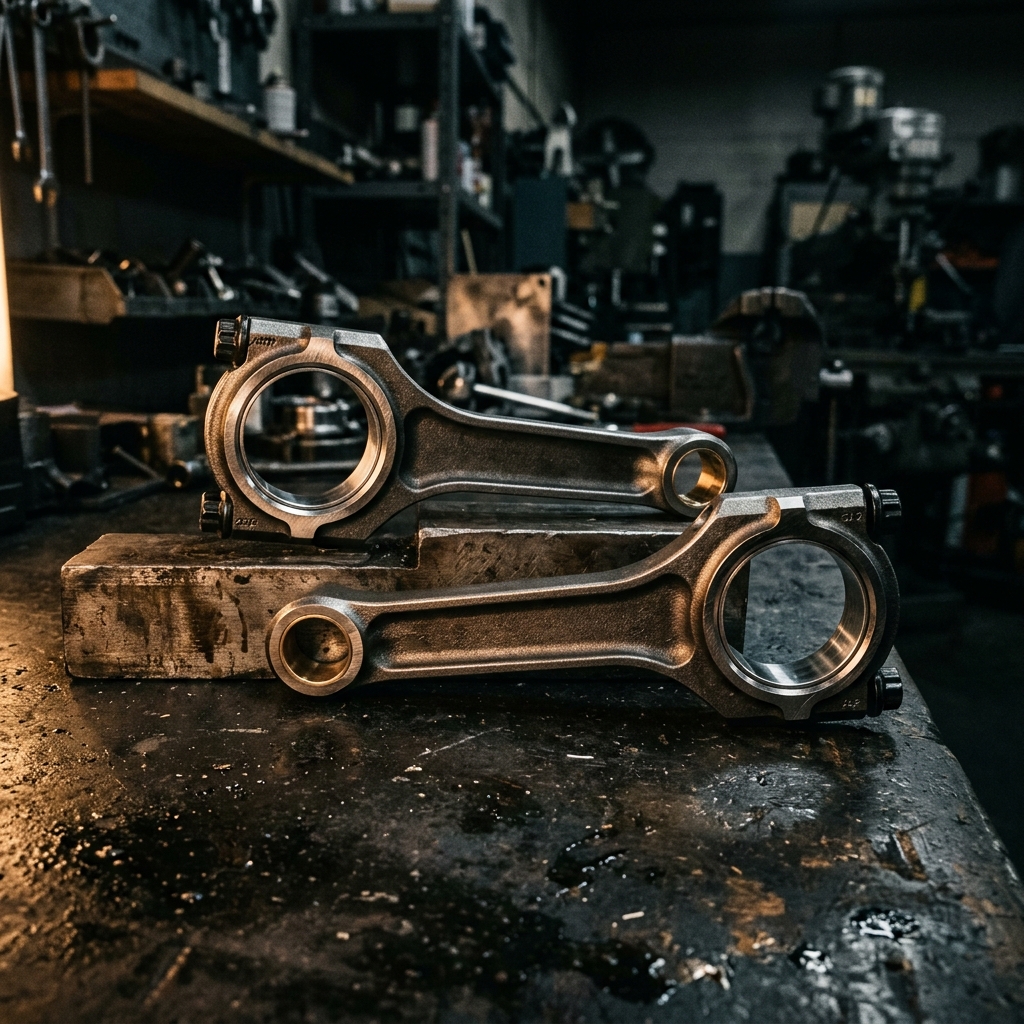
The connecting rod is the mechanical link between the piston and the crankshaft. Its length, relative to the crankshaft stroke, determines how much the rod angles during each revolution — and that angle affects everything from piston side-loading to bore wear to the shape of the torque curve.
Rod-to-stroke ratio (R/S ratio) is the single number that captures this geometry: rod center-to-center length divided by stroke. A higher ratio means less rod angularity. A lower ratio means more. The consequences are measurable in friction, wear, and engine character.
The Physics of Rod Angularity
As the crankshaft rotates, the connecting rod swings through an arc. At 90° after TDC (mid-stroke), the rod reaches its maximum angle from the cylinder centerline. This angle determines how much of the piston’s force pushes sideways against the cylinder wall instead of downward into the crankshaft.
Maximum Rod Angle = arcsin(1 ÷ (2 × R/S Ratio))
| Rod Ratio | Max Rod Angle | Relative Side-Loading |
|---|---|---|
| 1.40 | 20.9° | Very high |
| 1.50 | 19.5° | High |
| 1.60 | 18.2° | Moderate |
| 1.75 | 16.6° | Low-moderate |
| 2.00 | 14.5° | Low |
Every degree of additional rod angle increases the piston’s sideways thrust against the cylinder wall. At a 20.9° rod angle, approximately 36% of the piston force goes into side-loading rather than rotation. At 14.5°, that drops to approximately 25%. The difference is measurable in bore wear, ring friction, and power loss.
Check your combination with the rod-to-stroke ratio calculator.
4 Effects of Rod Ratio on Engine Behavior
1. Piston Side-Loading and Bore Wear
Higher rod angles push the piston harder against the thrust side of the bore during the power stroke. This side-loading:
- Increases friction between the piston skirt and cylinder wall
- Accelerates bore wear on the thrust side
- Can cause piston scuffing if clearance is too tight
- Generates more heat at the piston-to-bore interface
Engines with ratios below 1.50 often show measurable bore wear asymmetry after 50,000 miles — the thrust side wears 0.001–0.002” more than the non-thrust side. Ratios above 1.65 produce much more even wear patterns.
2. Dwell Time at TDC
Rod ratio affects how long the piston stays near top dead center relative to crankshaft rotation. A longer rod (higher ratio) keeps the piston near TDC for more degrees of crank rotation, while a shorter rod (lower ratio) allows the piston to start descending earlier.
| Rod Ratio | Degrees Near TDC (within 0.010” of TDC) |
|---|---|
| 1.40 | ~28° |
| 1.60 | ~32° |
| 1.75 | ~35° |
| 2.00 | ~38° |
Why this matters: More dwell time at TDC gives the combustion flame front more time to develop before the piston begins descending. This can improve combustion completeness and reduce the tendency for detonation — the flame has more time to burn the charge before the piston expands the volume.
3. Piston Acceleration Profile
Rod ratio changes how quickly the piston accelerates away from TDC and decelerates approaching BDC. A shorter rod (lower ratio) produces asymmetric piston motion — the piston accelerates faster on the power stroke than on the exhaust stroke.
This asymmetry affects:
- Inertial loading on the piston pin and rod bearings
- Valve-to-piston clearance timing (the piston drops faster after TDC)
- Ring flutter tendency (faster acceleration = more inertial force on rings)
4. Power Delivery Character
Lower rod ratios tend to produce a punchier, more aggressive power stroke because the piston drops more quickly after TDC, converting cylinder pressure into crankshaft rotation faster. This can produce a stronger initial torque pulse that feels responsive at low RPM.
Higher rod ratios produce a smoother, more linear power delivery that favors high-RPM sustained operation. The power is applied more gradually over the crank rotation.
Rod Ratios Across Common Engine Families
| Engine | Rod Length | Stroke | R/S Ratio | Character |
|---|---|---|---|---|
| Honda S2000 (F20C) | 153.0 mm | 84.0 mm | 1.821 | High-rev screamer |
| BMW S54 (3.2L I6) | 139.0 mm | 89.6 mm | 1.551 | Balanced sport |
| GM LS1 (5.7L) | 152.4 mm | 92.0 mm | 1.657 | Broad powerband |
| Chevy 350 SBC | 144.8 mm | 88.4 mm | 1.638 | Classic street |
| Chevy 383 Stroker (5.7” rod) | 144.8 mm | 95.3 mm | 1.520 | Low-RPM torque bias |
| Chevy 383 Stroker (6.0” rod) | 152.4 mm | 95.3 mm | 1.600 | Balanced stroker |
| Ford 302 | 128.2 mm | 76.2 mm | 1.683 | Moderate |
| Ford 347 Stroker | 128.2 mm | 86.4 mm | 1.484 | Aggressive |
| Cummins 6BT Diesel | 166.7 mm | 120.0 mm | 1.389 | Maximum torque |
Notice the pattern: high-RPM engines (S2000, F20C) have the highest ratios, while diesel and torque-biased engines have the lowest. The Honda S2000’s 1.821 ratio allows it to sustain 9,000 RPM with excellent bore life, while the Cummins 6BT’s 1.389 ratio produces massive low-RPM torque at the cost of higher bore wear.
Choosing Rod Length for a Stroker Build
When building a stroker, you must decide on rod length. This decision directly sets the rod ratio:
Short Rod (Stock Length)
Advantages:
- Lower cost (often uses stock-length rod)
- More piston compression height (easier to find pistons)
- Fits in standard deck-height blocks without modification
Disadvantages:
- Lower rod ratio increases side-loading
- Bore wear accelerates
- Not ideal for sustained high-RPM operation
Long Rod (Upgraded Length)
Advantages:
- Higher rod ratio reduces side-loading
- Better bore life and ring seal
- More dwell time at TDC (better combustion)
Disadvantages:
- Requires shorter compression height pistons (harder to find, may need custom)
- May require longer block (tall-deck) or zero-deck piston position
- Higher cost for custom pistons
Decision Table
| Build Goal | Recommended Rod Length | Target Ratio |
|---|---|---|
| Budget street stroker | Stock length | 1.50–1.55 (acceptable) |
| Performance street | +0.200–0.300” longer | 1.55–1.65 |
| Serious performance | +0.300–0.500” longer | 1.60–1.70 |
| High-RPM racing | Longest available | 1.70–2.00 |
Common Rod Ratio Myths
”Longer rods always make more power”
Not quite. Longer rods reduce friction and improve bore life, but they also slow piston acceleration after TDC, which can reduce the initial torque pulse. On a short-track stock car that needs grunt out of corners at 4,000 RPM, a shorter rod may produce better lap times than a longer rod — even though the longer rod has less friction.
”Rod ratio doesn’t matter below 5,000 RPM”
It matters less for power, but it still affects bore wear and ring seal. A ratio of 1.40 will produce measurable thrust-side wear even at 3,000 RPM cruise — just more slowly than at high RPM.
”Any ratio above 1.5 is fine”
For street engines, this is approximately true. For racing engines that need to last a full season, the difference between 1.55 and 1.70 shows up in bore measurements at teardown. Higher ratios genuinely reduce mechanical wear.
The Rod Ratio Calculator Workflow
- Enter rod length and stroke into the rod ratio calculator.
- Read the ratio and maximum rod angularity.
- Compare options by entering different rod lengths for the same stroke.
- Cross-reference with the mean piston speed calculator to verify the RPM limit.
- Check deck clearance with the deck height calculator to confirm the longer rod fits.
Rod ratio is not the most glamorous engine spec, but it is one of the most consequential. It determines how much of the engine’s energy goes into rotating the crankshaft versus heating the cylinder wall. Getting it right — especially in a stroker build — is the difference between an engine that lasts and one that wears out early.