
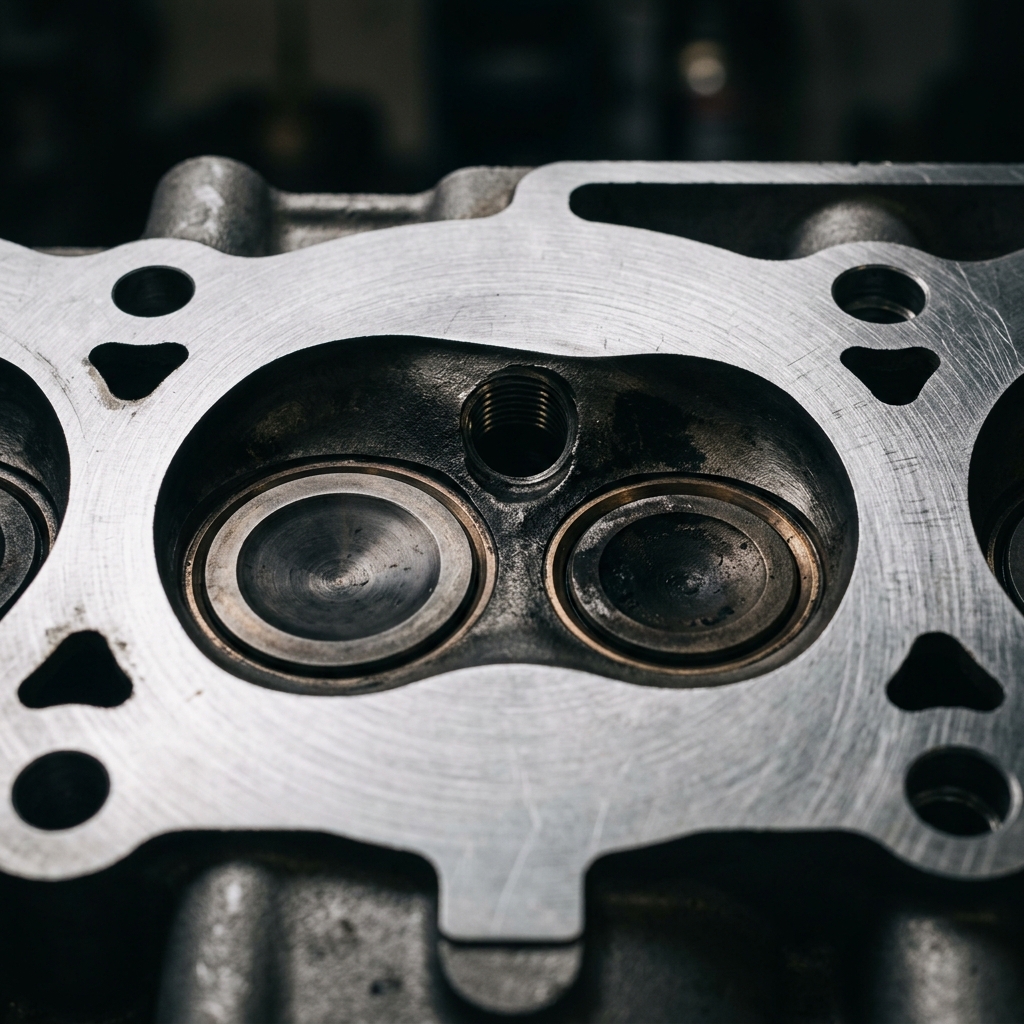
An engine’s displacement tells you how much air it could move. Volumetric efficiency tells you how much it actually moves. The difference between these two numbers is where most of the performance lives.
A 350 CID V8 at 80% volumetric efficiency processes 280 CID of air per cycle. The same engine at 95% VE processes 332.5 CID. That 52.5 CID difference — achieved without changing bore, stroke, or cylinder count — represents approximately 50 horsepower. No machining, no stroker kit, no added displacement. Just better breathing.
What Volumetric Efficiency Means
VE = (Actual Air Volume Ingested) ÷ (Theoretical Swept Volume) × 100
At 100% VE, every cylinder fills completely with air at ambient atmospheric pressure. In reality, intake restrictions, valve timing, exhaust backpressure, and heat all prevent perfect filling:
| VE Range | What It Means | Typical Application |
|---|---|---|
| 60–70% | Poor filling, heavy restrictions | Emissions-choked engines, very old designs |
| 70–80% | Below average | Stock truck engines, mild economy cars |
| 80–85% | Average | Modern stock NA engines |
| 85–90% | Good | Well-designed modern NA engines |
| 90–95% | Excellent | Modified NA with ported heads and cam |
| 95–100% | Near-perfect NA | Full race NA with optimized everything |
| 100–160%+ | Forced induction | Turbocharged or supercharged engines |
The 7 Components That Determine VE
1. Cylinder Head Airflow (Largest Impact)
The intake port and valve are the primary restrictions in the air path. Flow bench testing measures airflow in CFM (cubic feet per minute) at a standard pressure drop (typically 28” H₂O).
| Head Type | Intake CFM @ 28” | VE Potential |
|---|---|---|
| Stock cast iron (SBC) | 175–200 CFM | 75–80% |
| Stock Vortec (SBC) | 215–225 CFM | 82–87% |
| Ported Vortec | 240–260 CFM | 88–93% |
| Aftermarket aluminum (SBC) | 260–300 CFM | 92–98% |
| Full-race CNC ported | 310–350 CFM | 96–100% |
The difference between a stock cast iron head (175 CFM) and a race-ported head (340 CFM) nearly doubles the airflow capacity. This single component change is worth more VE improvement than any other modification.
Use the minimum port area calculator to determine the port size needed for your target airflow.
2. Camshaft Timing and Lift
The camshaft controls when and how far the intake and exhaust valves open. Duration, lift, and lobe separation angle all affect VE:
| Cam Specification | Effect on VE |
|---|---|
| Duration (intake @ 0.050”) | Longer duration = higher VE at high RPM, lower at low RPM |
| Lift (maximum valve opening) | More lift = more flow area = higher peak VE |
| Lobe separation angle (LSA) | Narrower LSA = more overlap = higher peak VE but rougher idle |
| Intake centerline | Advancing centerline shifts peak VE to lower RPM |
A cam swap is typically the second-largest VE improvement after cylinder heads.
3. Intake Manifold Design
The intake manifold distributes air from the throttle body to each cylinder. Its runner length, cross-section, and plenum volume determine where in the RPM range VE peaks:
| Runner Type | Optimized RPM Range | Best For |
|---|---|---|
| Long runners (over 12”) | 1,500–4,000 RPM | Low-RPM torque, trucks, towing |
| Medium runners (8–12”) | 2,500–5,500 RPM | Street performance |
| Short runners (under 8”) | 4,500–7,500 RPM | High-RPM power, racing |
| Variable-length (IMRC/DISA) | Broad range | Modern OEM performance |
4. Exhaust System
Exhaust restrictions reduce VE by preventing complete cylinder evacuation. Exhaust manifold (header) design affects scavenging — the ability of exhaust pulses to help pull fresh mixture into the cylinder:
| Exhaust Component | VE Impact |
|---|---|
| Factory cast manifold | Baseline (restrictive, minimal scavenging) |
| Tubular headers (long-tube) | +3–8% VE at peak RPM |
| High-flow catalytic converter | +1–3% VE recovery |
| Free-flowing muffler | +0.5–1.5% VE recovery |
5. Compression Ratio
Higher compression ratio produces a stronger exhaust blowdown pulse, which improves scavenging and helps pull fresh mixture into the cylinder on the next intake stroke. Each point of CR increase improves VE by approximately 1–2%.
6. Valve Size
Larger intake valves allow more airflow at any given lift. The intake valve curtain area (π × valve diameter × lift) is the effective flow window:
| Intake Valve Size | Curtain Area @ 0.500” Lift | Relative Flow |
|---|---|---|
| 1.940” (stock SBC) | 3.05 sq in | 1.00× |
| 2.020” (mild upgrade) | 3.17 sq in | 1.04× |
| 2.080” (performance) | 3.27 sq in | 1.07× |
| 2.150” (race) | 3.38 sq in | 1.11× |
7. Air Filter and Induction System
The air filter and intake tube are minor restrictions compared to the cylinder head, but they still matter at high flow rates. A high-flow air filter recovers 1–3% VE at peak flow compared to a restrictive paper element.
How to Calculate Horsepower from Displacement and VE
The relationship between VE, displacement, and horsepower is:
HP = (Displacement × RPM × VE × Thermal Efficiency) ÷ Constant
A simplified practical formula:
Estimated HP = (Displacement in CID × RPM × VE) ÷ 9,411 (for average NA engines)
| Engine | CID | RPM | VE | Estimated HP |
|---|---|---|---|---|
| Stock 350 SBC | 350 | 5,000 | 80% | 149 hp |
| Ported 350 SBC | 350 | 5,500 | 92% | 188 hp |
| Full-race 350 SBC | 350 | 6,500 | 98% | 237 hp |
| Stock 302 Ford | 302 | 5,000 | 78% | 125 hp |
| Coyote 5.0L | 302 | 7,000 | 95% | 214 hp |
These are simplified estimates — actual dyno numbers depend on ignition timing, air/fuel ratio, and exhaust system. But the trend is clear: VE improvements produce power gains equivalent to adding displacement without changing the bottom end.
Use the horsepower and torque estimator for more detailed modeling.
VE at Different RPM: The Torque Curve Explained
VE is not constant across the RPM range. It peaks at a specific RPM determined by the intake and exhaust tuning, then falls off at higher RPM as the engine outpaces its air supply:
| RPM | VE (stock 350) | VE (ported 350) | VE (race 350) |
|---|---|---|---|
| 2,000 | 78% | 82% | 75% |
| 3,000 | 82% | 88% | 82% |
| 4,000 | 80% | 92% | 90% |
| 5,000 | 75% | 90% | 96% |
| 6,000 | 65% | 82% | 95% |
| 7,000 | — | 70% | 88% |
The RPM where VE peaks is where torque peaks. This is not a coincidence — it is the fundamental definition. Torque is proportional to cylinder pressure, which is proportional to the mass of air ingested, which is proportional to VE.
The race engine maintains higher VE at high RPM (because of the big cam and ported heads) but sacrifices low-RPM VE. This is the classic trade-off between low-end torque and high-RPM power.
The Airflow-to-Displacement Matching Rule
For a well-designed NA engine, the required intake airflow matches this guideline:
Required CFM per intake port = (Displacement in CID × RPM × VE) ÷ (3,456 × Number of Cylinders)
| Engine | CID | Target RPM | VE | Required CFM/Port |
|---|---|---|---|---|
| Street 350 V8 | 350 | 5,500 | 85% | 59 CFM |
| Performance 350 V8 | 350 | 6,000 | 92% | 70 CFM |
| Race 350 V8 | 350 | 7,000 | 98% | 88 CFM |
| Street 302 V8 | 302 | 5,500 | 82% | 55 CFM |
If the cylinder heads cannot flow the required CFM, VE drops and power falls short of the target. If the heads flow significantly more than needed, the excess capacity is wasted — money spent on airflow the engine cannot use.
Use the carburetor CFM calculator to match induction capacity to displacement and RPM.
The VE Optimization Workflow
- Calculate displacement with the engine displacement calculator.
- Set your target RPM range based on application.
- Estimate required port flow using the airflow matching formula.
- Select cylinder heads that flow the required CFM.
- Match the cam profile to the head flow and RPM range.
- Size the intake manifold runners for the target RPM.
- Model the result with the HP/torque estimator.
Displacement sets the foundation. Volumetric efficiency determines how much of that foundation becomes usable power. The builder who optimizes VE gets more horsepower from every cubic inch than the builder who simply adds more inches.