
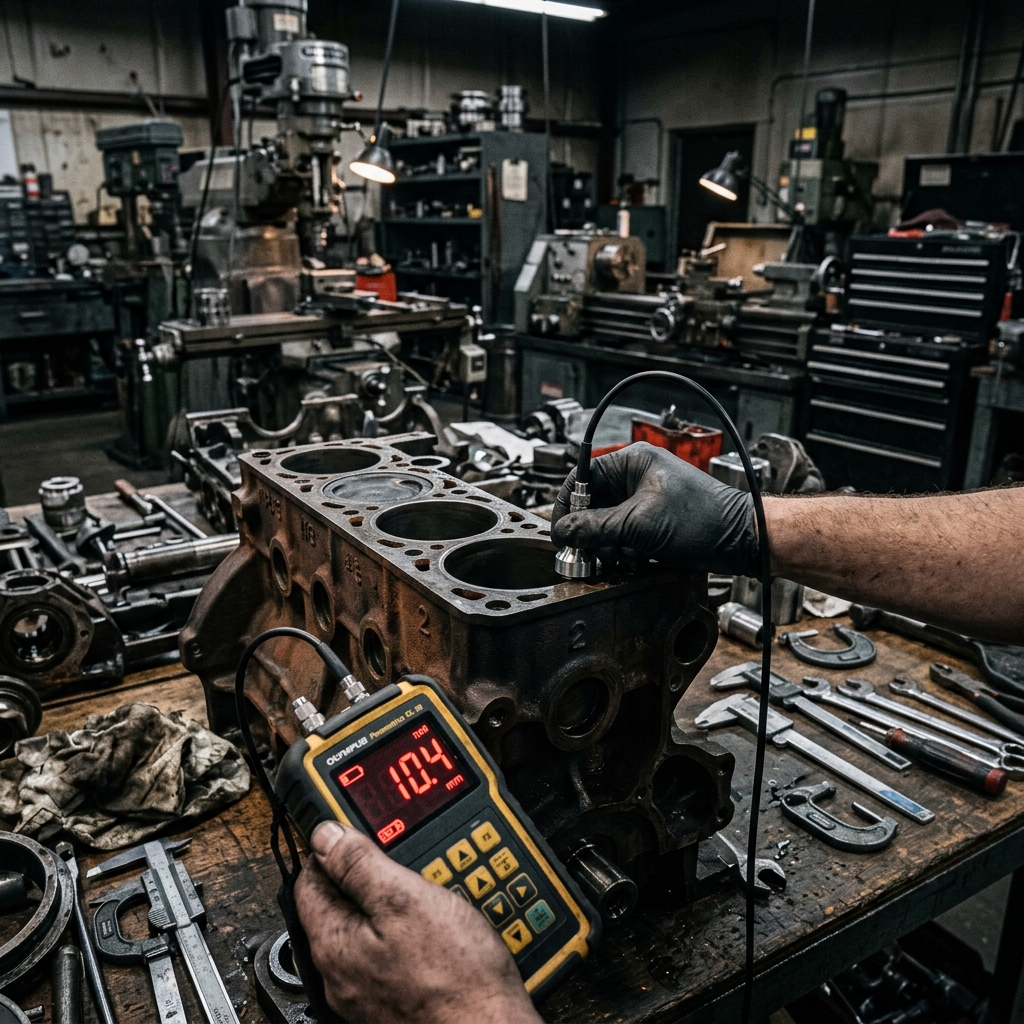
A casting number is the fastest way to identify an unknown engine block. Before you measure the bore, before you pull the crankshaft, before you decode the VIN — the casting number narrows the field to a specific engine family, production era, and likely displacement. For junkyard hunters, engine swappers, and builders evaluating cores, this number is the starting point for every identification.
This guide covers where to find casting numbers on GM, Ford, and Mopar blocks, how to decode what each number means, and which castings are most desirable for performance builds.
Where to Find the Casting Number
General Motors (Chevy/GM)
| Location | What You’ll Find |
|---|---|
| Rear of block (bellhousing flange area) | Primary 7-digit casting number |
| Front of block (near timing cover) | Date code and plant code |
| Block pad (front passenger side, below head) | Stamping code (partial VIN, not casting number) |
| Cylinder heads | Separate casting number on end or center bolt boss |
The primary casting number on a GM small block is a 7-digit number (e.g., 3970010). This is cast in raised lettering and remains visible even on heavily weathered blocks.
Ford
| Location | What You’ll Find |
|---|---|
| Left side (driver side, above oil pan rail) | Primary casting number (alphanumeric) |
| Front of block | Date code |
| Between cylinders 3 and 5 (on V8) | Engine displacement code |
Ford casting numbers follow an alphanumeric format (e.g., D0OE-6015-A) that encodes decade, year, division, and part type.
Mopar (Chrysler/Dodge/Plymouth)
| Location | What You’ll Find |
|---|---|
| Left side (driver side, near deck surface) | Primary casting number |
| Block pad (right side, near tappet rail) | Date code, plant code, displacement code |
| Oil pan rail | Additional casting marks |
Mopar casting numbers are typically 7-digit numbers similar to GM.
Decoding GM Small Block Casting Numbers
GM’s small block Chevy is the most commonly encountered engine family. The casting number identifies the block type, and bore measurement confirms displacement:
Most Common SBC Casting Numbers
| Casting Number | Years | Bore | Displacement | Notes |
|---|---|---|---|---|
| 3932386 | 1962–1967 | 4.000” | 327 | High-performance block, camel hump heads |
| 3970010 | 1968–1980 | 4.000” | 350 | Most common SBC casting ever produced |
| 3970010 | 1970–1980 | 4.125” | 400 | Same casting as 350, bored larger |
| 3951509 | 1969–1970 | 4.001” | 350 | High-performance (Z/28, LT-1) |
| 14010207 | 1986–1995 | 4.000” | 350 | One-piece rear seal, roller cam |
| 10066034 | 1987–1995 | 4.000” | 350 | Truck block, 4-bolt main option |
| 10243880 | 1996–2002 | 4.000” | 350 (Vortec) | Roller cam, 1-piece rear seal |
Key Identification Points
3970010 is the single most important Chevy casting number because it was used for both the 350 (4.000” bore) and the 400 (4.125” bore). To determine which displacement you have:
- Measure the bore — 4.000” = 350, 4.125” = 400
- Check the crank — 3.480” stroke = 350, 3.750” stroke = 400
- Look at the frost plugs — the 400 has larger frost plugs (press-in vs. thread-in)
2-Bolt vs. 4-Bolt Main Caps
Some casting numbers were produced in both 2-bolt and 4-bolt main cap versions:
| Casting | 2-Bolt | 4-Bolt | How to Tell |
|---|---|---|---|
| 3970010 | ✅ Yes | ✅ Some | Look at the main cap bolts from underneath |
| 10066034 | ✅ Yes | ✅ Some | Same — visual inspection required |
| 14010207 | ✅ Yes | ❌ No | Always 2-bolt |
4-bolt main blocks are preferred for performance builds because the additional cap bolts resist main bearing cap movement under high cylinder pressure.
Decoding Ford Casting Numbers
Ford’s casting number system encodes more information in the number itself:
Ford Casting Number Format
Example: D0OE-6015-A
| Position | Code | Meaning |
|---|---|---|
| 1st character | D | Decade (C=1960s, D=1970s, E=1980s, F=1990s) |
| 2nd character | 0 | Year within decade (0=1970) |
| 3rd character | O | Division (A=Ford, M=Mercury, O=Truck, Z=Lincoln) |
| 4th character | E | Engineering part |
| 5th–8th | 6015 | Part group (6015 = engine block) |
| Suffix | A | Revision level |
Common Ford V8 Block Castings
| Casting | Engine | Displacement | Notes |
|---|---|---|---|
| D0OE-6015-A | 302 Windsor | 302 CID | Standard passenger car |
| D3FE-6015-A | 351 Windsor | 351 CID | Larger bore than 302 |
| D0AE-6015-A | 351 Cleveland | 351 CID | Different block from 351W |
| C8FE-6015-A | 390 FE | 390 CID | Big block, FE family |
| D5AE-6015-A | 460 385-series | 460 CID | Largest passenger car Ford V8 |
Ford 302 vs. 351W Identification
The 302 and 351W share a similar external appearance but have different deck heights:
- 302: 8.206” deck height
- 351W: 9.503” deck height
Measure from the crankshaft centerline to the deck surface. The difference is immediately obvious — the 351W is over 1.25” taller.
Decoding Mopar Casting Numbers
Common Mopar Small Block (LA/Magnum) Castings
| Casting | Engine | Displacement | Notes |
|---|---|---|---|
| 2536030 | 318 LA | 318 CID | Standard passenger car, 2-bolt |
| 2780930 | 340 LA | 340 CID | High-performance, larger bore than 318 |
| 3671587 | 360 LA | 360 CID | Truck and performance applications |
| 53006635 | 5.2L Magnum | 318 CID | Updated Magnum heads, roller cam |
| 53010337 | 5.9L Magnum | 360 CID | Same Magnum updates, 360 bore |
Mopar 318 vs. 340 vs. 360 Identification
All three share the same external block dimensions. The difference is bore:
- 318: 3.910” bore
- 340: 4.040” bore
- 360: 4.000” bore
The 340 actually has a larger bore than the 360. The 360 gets its larger displacement from a longer stroke (3.580” vs. 3.310”).
What Casting Numbers Cannot Tell You
| Information | Available from Casting? | How to Get It |
|---|---|---|
| Engine family and era | ✅ Yes | Read the casting number |
| Original bore size (approximate) | ✅ Yes | Cross-reference casting to specs |
| Current bore size (with wear/overbore) | ❌ No | Measure with dial bore gauge |
| Current displacement | ❌ No | Calculate from measured bore and stroke |
| Engine condition | ❌ No | Inspect, leak test, sonic check |
| Overbore history | ❌ No | Measure bore, check for oversize stamps |
| Number of rebuilds | ❌ No | No reliable external indicator |
This is why casting number identification is the beginning of the identification process, not the end. The casting number tells you what the block was designed to be. The displacement calculator with measured bore and stroke tells you what it actually is today.
Desirable Casting Numbers for Performance Builds
Certain casting numbers are sought after because of their features:
| Casting | Why It’s Desirable | Current Market |
|---|---|---|
| GM 3932386 (327) | Thick walls, accepts 4.030” bore easily | $200–$500 |
| GM 3970010 (4-bolt) | Ubiquitous, well-understood, cheap | $150–$350 |
| GM 3951509 (LT-1/Z28) | Forged crank, 4-bolt, high-nickel iron | $500–$1,000 |
| Ford D0AE (Boss 302) | 4-bolt, high-RPM design | $800–$2,000 |
| Mopar 2780930 (340) | 4.040” bore, performance specs | $600–$1,500 |
The Casting Number to Calculator Workflow
- Find the casting number on the block.
- Decode it using the tables above or a casting number database.
- Identify the probable engine family and expected bore/stroke.
- Measure the actual bore with a dial bore gauge to confirm displacement and detect overbore.
- Enter the measured values into the engine displacement calculator for exact displacement.
- If planning a build, use the overbore calculator and stroker planner to model modifications from the confirmed baseline.
The casting number gets you to the right ballpark. The bore gauge and the calculator get you to the precise answer.