
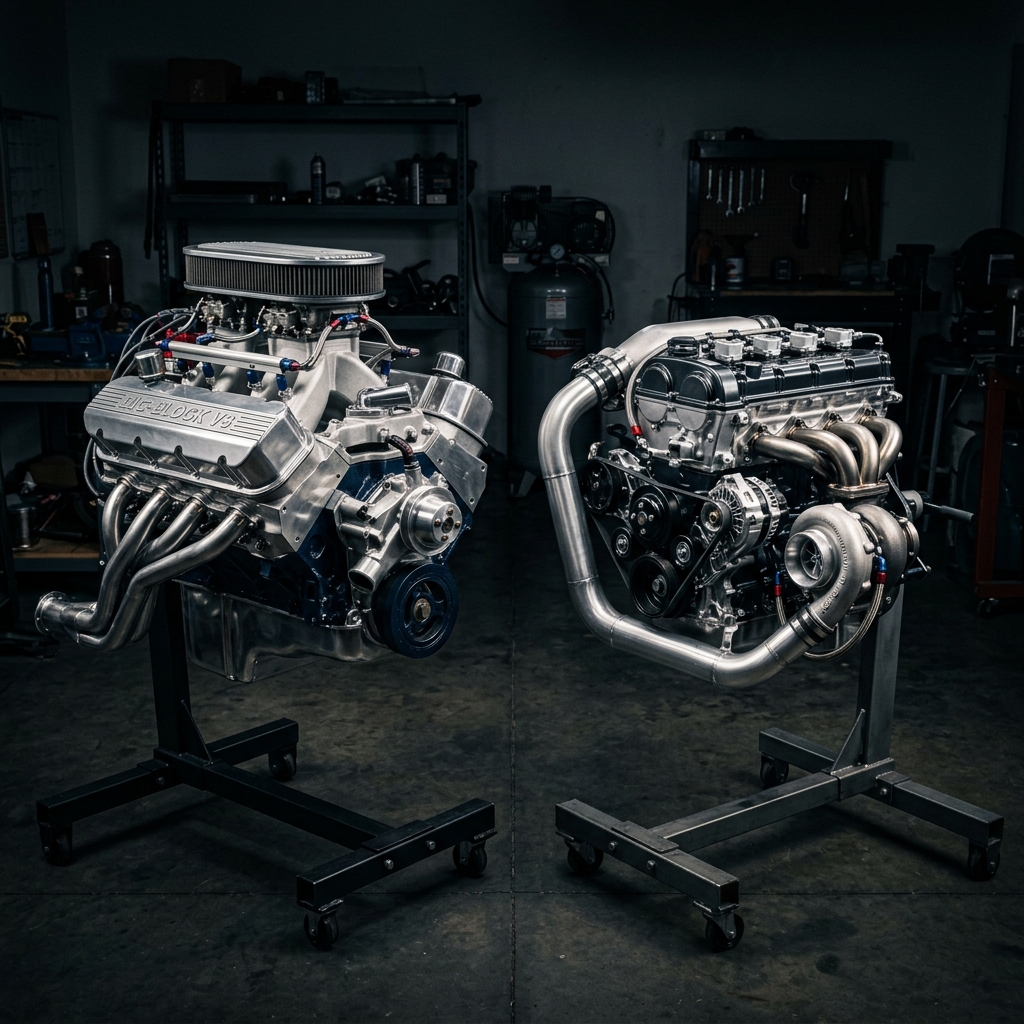
A Chevrolet 6.2L V8 produces 420 horsepower. At highway cruise, it needs approximately 25 horsepower. That means the engine is operating at 6% of its capacity — an enormously wasteful operating point for a large-displacement engine. The throttle is barely open, the cylinders are filling with a thin, inefficient mixture, and the engine pumps more air than it burns.
Cylinder deactivation solves this mismatch by temporarily shutting down half the cylinders during light-load driving, effectively halving the displacement until full power is needed again. The result is 5–15% better fuel economy without sacrificing the performance capability that justified the large engine in the first place.
The Pumping Loss Problem
Every 4-stroke engine loses energy to pumping losses — the work required to draw air past a partially closed throttle on the intake stroke and push exhaust out on the exhaust stroke. At part throttle, these losses are substantial:
| Throttle Position | Manifold Vacuum | Pumping Loss (% of total friction) |
|---|---|---|
| Wide open (100%) | 0 in-Hg | ~5% |
| Half throttle (50%) | 8 in-Hg | ~15% |
| Light cruise (15%) | 18 in-Hg | ~35% |
| Idle (5%) | 22 in-Hg | ~45% |
At highway cruise (15% throttle), pumping losses consume approximately 35% of the engine’s total friction budget. The throttle plate acts as a restriction, and each piston must pull against that restriction on every intake stroke.
How Deactivation Reduces Pumping Losses
When 4 cylinders of a V8 are deactivated, the remaining 4 active cylinders must produce the same power. To do this, the throttle opens wider — from 15% to approximately 30%. This reduces manifold vacuum from 18 in-Hg to approximately 10 in-Hg.
The result: each active cylinder operates at a higher, more efficient load point while the deactivated cylinders contribute zero pumping loss (their valves are closed, so they just compress and expand trapped air with minimal energy loss).
| Mode | Active Cylinders | Throttle Position | Manifold Vacuum | BSFC (lb/hp-hr) |
|---|---|---|---|---|
| V8 (all active) | 8 | 15% | 18 in-Hg | 0.52 |
| V4 (deactivated) | 4 | 30% | 10 in-Hg | 0.44 |
| Improvement | — | — | — | 15% better |
BSFC (brake specific fuel consumption) is the definitive efficiency metric — lower is better. The V4 mode achieves 15% better BSFC at cruise because each active cylinder operates closer to its optimal efficiency point.
How Cylinder Deactivation Works Mechanically
Valve Deactivation
The most common system uses collapsing hydraulic lifters or solenoid-actuated rocker arm disconnects:
| System | Mechanism | Used By |
|---|---|---|
| GM Active Fuel Management (AFM) | Collapsing hydraulic lifters lock out intake and exhaust valve motion | GM V8 (LS/LT family) |
| GM Dynamic Fuel Management (DFM) | Same as AFM but can deactivate any combination of cylinders | GM Gen V LT family |
| Honda Variable Cylinder Management (VCM) | Rocker arm pins disengage from cam followers | Honda V6 (J-series) |
| Chrysler Multi-Displacement System (MDS) | Solenoid-controlled collapsing lifters | Hemi 5.7L, 6.4L |
| Ford | No traditional deactivation; uses turbo downsizing instead | EcoBoost strategy |
When a cylinder is deactivated:
- Both intake and exhaust valves are held closed
- Fuel injection to that cylinder stops
- The spark plug does not fire
- The piston continues its normal stroke cycle, compressing and expanding the trapped gas
The trapped gas acts as an air spring — the energy used to compress it on the upstroke is largely returned on the downstroke, resulting in minimal net energy loss.
Fuel Injection and Ignition Control
The ECU cuts fuel injection and ignition to deactivated cylinders within one engine revolution. The transition is synchronized to occur at specific crank positions to minimize NVH (noise, vibration, harshness).
Which Cylinders Get Deactivated?
The firing order determines which cylinders can be deactivated while maintaining the smoothest possible power delivery:
GM V8 (LS/LT) — Fires as V4
| Firing Order (V8) | 1-8-7-2-6-5-4-3 |
|---|---|
| Active in V4 mode | 1, 4, 6, 7 |
| Deactivated | 2, 3, 5, 8 |
| Firing interval (V4) | Even 180° spacing |
The selected cylinders maintain an even firing interval in V4 mode, producing a smooth power pulse without the shaking that a random 4-cylinder would create.
GM Dynamic Fuel Management (DFM) — Any Combination
GM’s latest system can run on any combination from 1 to 8 active cylinders, switching between 17 different firing patterns per second. This allows the ECU to dial in exactly the right number of active cylinders for any load condition — not just V8 or V4, but V5, V6, V7, or even V3 mode.
Real-World Fuel Economy Impact
| Vehicle | Engine | Highway MPG (all cylinders) | Highway MPG (with deactivation) | Improvement |
|---|---|---|---|---|
| Chevy Silverado 1500 | 5.3L V8 (AFM) | 21 | 24 | +14% |
| Ram 1500 | 5.7L Hemi (MDS) | 20 | 22 | +10% |
| Chevy Camaro SS | 6.2L V8 (DFM) | 24 | 27 | +12% |
| Honda Odyssey | 3.5L V6 (VCM) | 26 | 28 | +8% |
| GM Tahoe | 6.2L V8 (DFM) | 21 | 24 | +14% |
The largest improvements occur on heavy vehicles with large engines that spend significant time at light load — exactly the combination where the displacement-to-demand mismatch is greatest.
The Thermodynamic Explanation
Internal combustion engines have a thermal efficiency map — a relationship between load, RPM, and fuel conversion efficiency. Peak efficiency occurs at approximately 70–85% load and moderate RPM. At 15% load, efficiency drops dramatically.
Cylinder deactivation moves the operating point:
| Parameter | V8 at Cruise | V4 at Cruise |
|---|---|---|
| Required power | 25 hp | 25 hp |
| Active displacement | 376 CID (6.2L) | 188 CID (3.1L) |
| Per-cylinder load | ~6% | ~12% |
| Thermal efficiency | ~22% | ~28% |
By halving the active displacement, the per-cylinder load doubles, moving each cylinder closer to its peak efficiency zone. The engine burns less fuel to produce the same power output.
Displacement Math: Full vs. Effective
The connection to displacement is direct. A 6.2L V8 in V4 mode has an effective displacement of 3.1L at cruise:
Effective Displacement = Total Displacement × (Active Cylinders ÷ Total Cylinders)
| Engine | Full Displacement | V4 Mode | V6 Mode |
|---|---|---|---|
| 5.3L V8 | 5,328 cc | 2,664 cc | 3,996 cc |
| 5.7L V8 (Hemi) | 5,654 cc | 2,827 cc | 4,241 cc |
| 6.2L V8 | 6,162 cc | 3,081 cc | 4,622 cc |
| 3.5L V6 | 3,456 cc | — | 2,304 cc (V4) |
The physical displacement never changes — bore, stroke, and cylinder count remain constant. The engine displacement calculator always reports the full physical displacement. But the effective operating displacement shifts dynamically based on driving conditions.
Common Issues with Cylinder Deactivation Systems
1. AFM Lifter Failure (GM)
GM’s Active Fuel Management lifters have a documented failure rate that causes misfires, ticking noises, and check engine lights. The collapsing lifter mechanism can stick in the deactivated position. Many GM truck owners install AFM delete kits to eliminate the system entirely — trading fuel economy for reliability.
2. VCM-Related Oil Consumption (Honda)
Honda’s Variable Cylinder Management system has been associated with increased oil consumption in some V6 models (2008–2014 Accord, Odyssey). The deactivated cylinders can develop carbon buildup that affects ring seal when cylinders reactivate. VCM Muzzler devices are aftermarket solutions that prevent deactivation.
3. NVH at Transition Points
Some drivers notice a slight vibration or exhaust tone change when the system transitions between modes. Modern active noise cancellation largely eliminates this, but vehicles with aftermarket exhaust systems may experience more noticeable transitions.
Should You Disable Cylinder Deactivation?
| Situation | Keep Active? | Reasoning |
|---|---|---|
| Daily driving, stock engine | ✅ Yes | 10–15% fuel savings are significant over ownership life |
| High-mileage GM V8 (AFM concern) | Consider delete | AFM lifter failures are expensive; prevention may be cost-effective |
| Performance-only vehicle | ❌ Delete | Maximum consistency and no potential for mid-run transition |
| Towing frequently | ✅ Yes | System only activates at light load — never under tow |
| Modified exhaust / cam | Depends | Cam profiles may conflict with deactivation valve events |
The Bigger Picture
Cylinder deactivation demonstrates that physical displacement and effective operating displacement are not always the same thing. The engine retains its full volumetric capacity for acceleration, passing, and towing, but operates as a smaller, more efficient engine when full capacity is not needed.
This is the modern answer to the old “there’s no replacement for displacement” debate — you can have the displacement when you need it and discard it when you don’t. The displacement calculator gives you the physical number. The ECU decides how much of it to use at any given moment.