
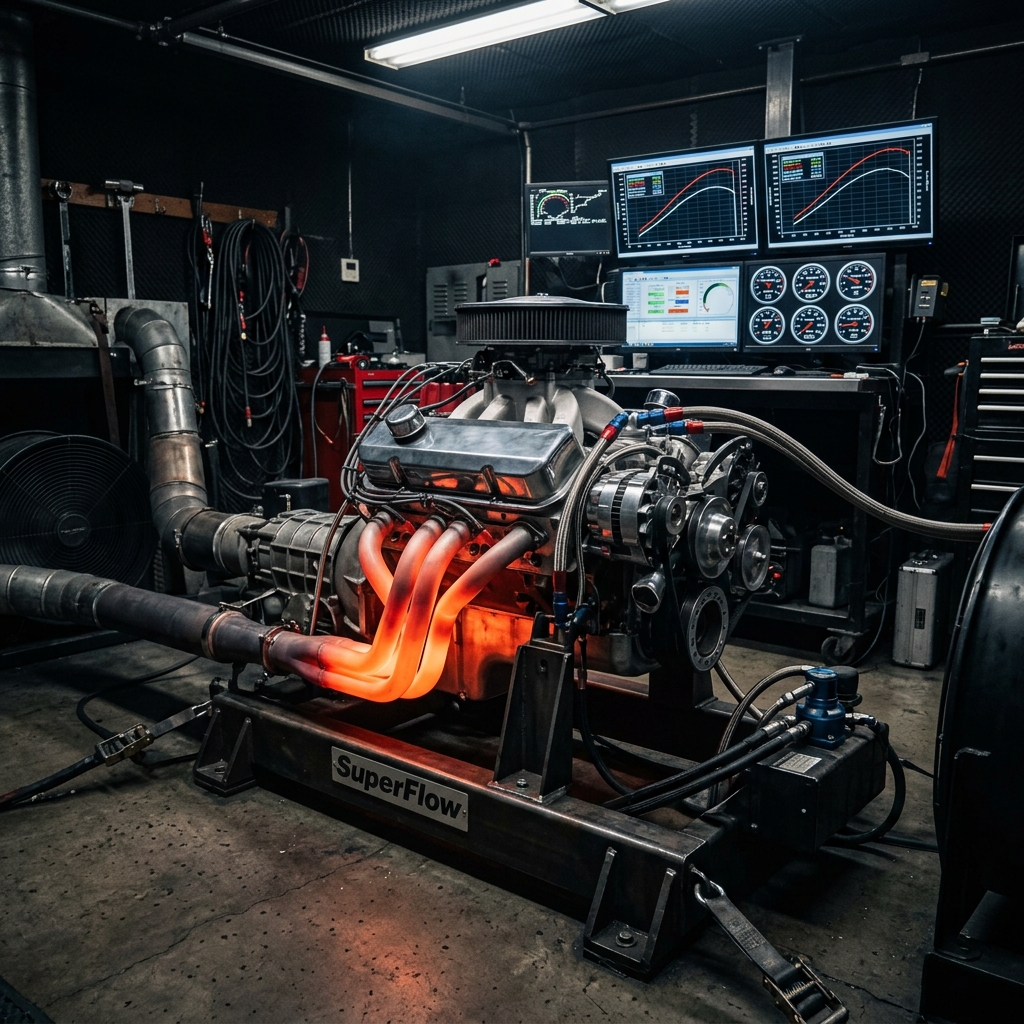
A 1970 Chevelle SS with a 454 big-block was rated at 450 horsepower. A 2024 Chevrolet Camaro ZL1 with a supercharged 6.2L V8 is rated at 650 horsepower. Both are GM V8 engines with similar displacement. It seems like 54 years of engineering only added 200 hp.
That comparison is misleading — not because the engines are different (they are), but because the measurement standards are different. The 1970 engine was tested using the gross horsepower method, which strips away accessories and uses free-flowing exhaust. The 2024 engine was tested using the net horsepower standard, which includes every production component that drains power from the crankshaft.
Understanding this distinction is essential for anyone comparing engines across eras, interpreting vintage specifications, or calculating expected performance from displacement.
What Is Gross Horsepower?
Gross horsepower was the standard rating method used by American automakers from the 1930s through 1971. The engine was tested on a dynamometer with specific components removed or replaced to reduce parasitic losses:
| Component | Gross Test Configuration | Effect on Rating |
|---|---|---|
| Air cleaner | Removed or replaced with open element | +5 to +15 HP |
| Exhaust system | Open headers or tuned dyno exhaust | +15 to +40 HP |
| Alternator/generator | Not driven or removed | +5 to +10 HP |
| Power steering pump | Not connected | +3 to +8 HP |
| Water pump | Standard (usually included) | Minimal |
| Fan and shroud | Removed | +5 to +12 HP |
| Emissions equipment | Not installed (pre-emissions era) | Variable |
The sum of these removed loads typically adds 30 to 80 HP to the measured output compared to a fully-equipped production engine. A 1970 Corvette rated at 370 gross HP with the LT-1 350 likely produced approximately 290-310 HP in installed, production-accessory form.
Why Manufacturers Used Gross Testing
Gross testing was not designed to deceive buyers. It originated as an SAE engineering standard (SAE J245) intended to compare engines as engines, isolated from the vehicle-specific accessories that vary between applications. The same engine block might go into a car with power steering and a truck without it — gross testing provided a common baseline.
The problem emerged when the marketing departments adopted these engineering numbers as consumer-facing specifications. Without context, the numbers implied that the car would deliver that much power to the wheels, which it would not.
What Is Net Horsepower?
Net horsepower is measured with the engine in its production-installed configuration. This includes the factory air cleaner, production exhaust manifolds and full exhaust system, alternator, power steering pump, A/C compressor (if standard equipment), and all emissions controls.
The SAE J1349 standard, adopted in 1972, defines the test conditions:
| Parameter | SAE J1349 Requirement |
|---|---|
| Air cleaner | Production, fully assembled |
| Exhaust system | Production, full length |
| Alternator | Driven at rated load |
| Power steering | Connected and loaded |
| A/C compressor | Engaged if standard equipment |
| Emissions equipment | Fully installed and functional |
| Correction factor | Corrected to 77°F, 29.92” Hg |
The result is a number that represents what the engine produces at the flywheel in its actual installed state, corrected to standard atmospheric conditions. This is not wheel horsepower (which includes drivetrain losses), but it is much closer to real-world output than gross figures.
How Much Did the Numbers Drop?
The table below shows the same or very similar engines rated under both standards. The gross-to-net ratio varies by engine, but typically falls between 0.75 and 0.85:
| Engine | Year (Gross) | Gross HP | Year (Net) | Net HP | Ratio |
|---|---|---|---|---|---|
| Chevy 350 (L48) | 1970 | 300 | 1972 | 200 | 0.67 |
| Chevy 350 (LT-1) | 1970 | 370 | 1972 | 255 | 0.69 |
| Chevy 454 (LS5) | 1970 | 390 | 1972 | 270 | 0.69 |
| Chevy 454 (LS6) | 1970 | 450 | — | ~340 (est.) | 0.76 |
| Ford 351C 4V | 1970 | 300 | 1972 | 266 | 0.89 |
| Pontiac 455 HO | 1971 | 335 | 1972 | 250 | 0.75 |
| Chrysler 440 Six Pack | 1970 | 390 | — | ~305 (est.) | 0.78 |
Why the Ratio Varies
Some engines show a larger drop than others because the production accessories on different vehicles consume different amounts of power. A full-size sedan with power steering, A/C, and heavy-duty alternator loses more than a lightweight sports car with manual steering and no A/C.
Additionally, the 1972 model year introduced emissions controls (lower compression, retarded timing, EGR systems) that reduced actual engine output independently of the measurement standard change. The combined effect of the new rating method AND reduced engine tune made the 1972 numbers look dramatically lower — but only part of the drop was due to the testing change.
The 1971 Discontinuity in Muscle Car History
The 1971–1972 model year transition is one of the most misunderstood moments in American automotive history. Three simultaneous changes created the appearance of a massive power drop:
- Rating method change — Gross to net (approximately −20 to −30%)
- Compression ratio reductions — From 10.5–11.0:1 to 8.5–9.0:1 (to accommodate unleaded fuel)
- Emissions equipment addition — EGR, air injection, restrictive exhaust
Many enthusiasts attribute the entire drop to “detuning,” but the rating method change alone accounts for a substantial portion. A 1970 engine tested under 1972 net standards — with no mechanical changes — would have rated 15–25% lower simply because of the testing methodology.
How to Convert Between Gross and Net
There is no single conversion factor because the accessory load varies by vehicle. However, these approximations are widely used:
| Conversion | Multiplier | Accuracy |
|---|---|---|
| Gross → Net (conservative) | × 0.80 | ±5% for most applications |
| Gross → Net (heavily equipped) | × 0.75 | Better for luxury/truck applications |
| Gross → Net (lightly equipped) | × 0.85 | Better for sports cars without A/C |
| Net → Gross | × 1.25 | Reverse estimate |
Example: A 1969 Camaro Z/28 rated at 290 gross HP (DZ 302 engine) likely produced approximately 290 × 0.83 = 241 net HP. The 2024 Camaro LT1 produces 455 net HP — roughly 88% more actual power from only 2× the displacement.
What Displacement Really Contributes
Displacement sets the engine’s maximum volumetric capacity — the amount of air-fuel mixture it can process per cycle. But displacement alone does not determine horsepower. The full equation is:
HP = Displacement × RPM × VE × BMEP ÷ Constant
Where:
- VE (volumetric efficiency) — How well the engine fills its cylinders (70–110% for NA engines)
- BMEP (brake mean effective pressure) — How effectively cylinder pressure converts to crankshaft torque
- RPM — How many power cycles per minute
A modern 2.0L turbo engine (BMEP > 300 psi, VE > 100% from boost) can produce 300+ HP from 1,998 cc. A 1970s 5.7L V8 with low compression and restrictive breathing (BMEP ~150 psi, VE ~80%) produces 200 net HP from 5,735 cc.
Displacement provides the foundation. Everything else — airflow, compression, cam timing, induction, and fuel delivery — determines how much of that foundation becomes usable power.
Use the horsepower and torque estimator to model the relationship between displacement, VE, boost, and estimated output for your combination.
Modern Testing Standards
Today’s SAE J1349 net horsepower standard is internationally recognized and provides consistent, comparable ratings across manufacturers. Additional standards include:
| Standard | Region | Key Difference |
|---|---|---|
| SAE J1349 | North America | Net, corrected to 77°F / 29.92” Hg |
| ECE R85 | Europe (DIN) | Net, corrected to 25°C / 99 kPa |
| JIS D1001 | Japan | Net, similar to SAE with metric conditions |
| ISO 1585 | International | Harmonized standard, functionally equivalent to SAE net |
Differences between SAE, DIN, and JIS ratings for the same engine are typically less than 2%, making modern international comparisons straightforward.
The Practical Takeaway
When comparing engines across eras:
- Never compare gross to net directly. A 1970 engine rated at 370 gross HP and a 2020 engine rated at 370 net HP are not equivalent — the 2020 engine is approximately 20–25% more powerful in actual delivered output.
- Use the approximate conversion (×0.80) to normalize vintage ratings before comparing.
- Remember that displacement is capacity, not output. Two engines with identical displacement can produce very different horsepower depending on breathing, compression, and tune.
- Use the calculator tools to estimate performance from displacement rather than relying on published ratings alone. The main calculator establishes the volumetric baseline, and the HP/torque estimator bridges displacement to estimated power.