
A Mazda RX-7 with a 13B twin-rotor engine is listed at 1,308 cc of displacement. A Honda Civic with a K20A four-cylinder is listed at 1,998 cc. On paper, the Honda has 53% more displacement. On the track, the turbocharged 13B produces 280 hp and keeps pace with piston engines twice its size.
This paradox exists because rotary and piston engine displacement numbers describe fundamentally different things. Understanding the difference — and the equivalency factors that bridge them — is essential for anyone comparing rotary performance to piston-engine benchmarks, interpreting racing class rules, or understanding why a “1.3L” Wankel behaves like a much larger engine.
How Piston Engine Displacement Works (The Baseline)
In a conventional piston engine, displacement is the total swept volume of all cylinders:
Displacement = (π ÷ 4) × Bore² × Stroke × Cylinders
A 4-cylinder engine with an 86 mm bore and 86 mm stroke produces 1,998 cc. Each cylinder fires once every 2 crankshaft revolutions (in a 4-stroke cycle), so the engine completes 2 power strokes per revolution (4 cylinders ÷ 2 revolutions per cycle = 2 firing events per revolution).
How Wankel Rotary Displacement Works
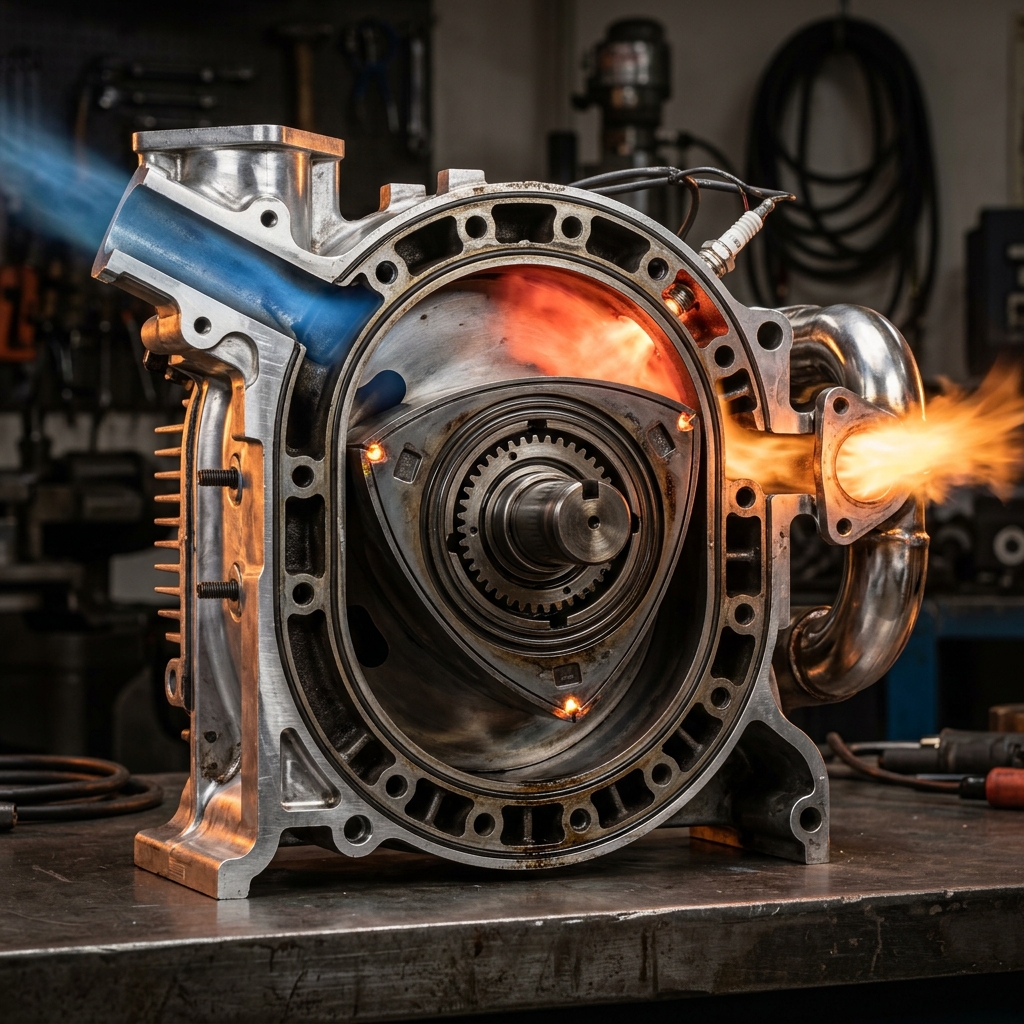
A Wankel rotary engine has no pistons, no cylinders, and no reciprocating motion. Instead, a triangular rotor spins inside an epitrochoidal (figure-8-shaped) housing. Each face of the triangular rotor creates a sealed chamber that expands and contracts as the rotor turns.
The Geometry
| Component | Piston Engine Equivalent | Rotary Value (13B) |
|---|---|---|
| Chamber count per rotor | Cylinders | 3 faces |
| Rotors | — | 2 |
| Chamber displacement | Swept volume per cylinder | 654 cc per face |
| Total displacement | Bore² × Stroke × N | 654 × 2 = 1,308 cc |
| Output shaft revolutions per power stroke | 2 (4-stroke) | 1 (each face fires once per rotor revolution) |
The critical difference is in the last row. In a piston engine, each cylinder fires once every 2 crankshaft revolutions. In a Wankel, each rotor face fires once every 1 output shaft revolution (because the eccentric shaft turns 3 times for every 1 rotor revolution, and each face completes its intake-compression-combustion-exhaust cycle in that period).
Why This Matters
A twin-rotor 13B has 6 working chambers (3 faces × 2 rotors). Each face fires once per output shaft revolution. That means:
- 13B at 6,000 RPM: 6 firing events per revolution × 6,000 RPM = 36,000 power strokes per minute
- K20A at 6,000 RPM: 2 firing events per revolution × 6,000 RPM = 12,000 power strokes per minute
The rotary completes 3× more power strokes per minute than the piston engine at the same RPM. Even though each power stroke sweeps less volume (654 cc vs. 500 cc per event), the rotary processes significantly more total air-fuel mixture per unit time.
The Equivalency Factor Debate
Because raw displacement numbers do not capture the firing frequency advantage, racing sanctioning bodies apply a multiplication factor to rotary displacement for classification purposes:
| Organization | Factor | 13B Equivalent | Rationale |
|---|---|---|---|
| IMSA GTP (1990s) | 1.8× | 2,354 cc | Balanced for turbo rotary vs. turbo piston |
| FIA (naturally aspirated) | 1.5× | 1,962 cc | Conservative — reflects NA airflow advantage |
| FIA (turbocharged) | 2.0× | 2,616 cc | Accounts for boost + firing frequency |
| SCCA (various classes) | 1.5–1.8× | 1,962–2,354 cc | Varies by class and era |
| Informal enthusiast consensus | 2.0× | 2,616 cc | ”Double the displacement” rule of thumb |
There is no single “correct” factor because the advantage depends on RPM range, boost level, and how the class rules define parity. A naturally aspirated rotary at low RPM has a modest advantage over a piston engine of equal displacement. A turbocharged rotary at 8,000 RPM has a dramatic advantage.
The Three Mazda Rotary Engines Compared
| Engine | Rotors | Chamber cc | Total cc | Equiv. (×1.8) | Peak HP (stock) |
|---|---|---|---|---|---|
| 12A | 2 | 573 | 1,146 | 2,063 | 130 hp |
| 13B-NA | 2 | 654 | 1,308 | 2,354 | 160 hp |
| 13B-REW (turbo) | 2 | 654 | 1,308 | 2,354 | 255 hp |
| 20B (3-rotor) | 3 | 654 | 1,962 | 3,532 | 300 hp |
The 20B three-rotor is particularly interesting — at 1,962 cc of nominal displacement, it was classified equivalent to a 3.5L piston engine in most racing series. Its 9 working chambers (3 faces × 3 rotors) produce an extraordinary number of overlapping power pulses, creating the characteristic smooth, turbine-like power delivery.
Why the Displacement Formula Cannot Cross Over
The piston engine displacement formula (π/4 × Bore² × Stroke × Cylinders) fundamentally cannot describe a Wankel because:
- There is no bore. The housing is not cylindrical — it is an epitrochoid. The chamber width changes continuously as the rotor sweeps.
- There is no stroke. The rotor does not reciprocate. It orbits eccentrically while rotating on its own axis.
- There are no discrete cylinders. Each rotor face creates a chamber that changes shape continuously. The maximum chamber volume minus the minimum chamber volume gives the “displacement” per face, but this is geometrically unrelated to bore × stroke.
Rotary displacement is calculated from the housing profile geometry:
V_chamber = 3√3 × e × R × b
Where:
- e = eccentricity (offset between rotor center and output shaft center)
- R = rotor generating radius
- b = rotor width (depth of the housing)
This formula produces the volume difference between the largest and smallest chamber states — analogous to swept volume in a piston engine, but derived from completely different geometry.
5 Performance Characteristics Unique to Rotary Engines
1. Naturally High Redline
Without reciprocating mass (no pistons, no connecting rods), the primary RPM limit is apex seal durability, not piston speed. Production 13B engines redline at 8,000–9,000 RPM. Race-prepared 13B engines sustain 10,500+ RPM.
2. Compact Size and Light Weight
A 13B engine weighs approximately 250 lb — less than most 4-cylinder piston engines of similar output. The entire engine is shorter than a conventional inline-4, making it ideal for front-midship weight distribution.
3. No Valve Train
Wankel engines have no valves, no camshaft, no valve springs, no lifters, and no timing chain. Port timing is controlled by the rotor edge uncovering fixed ports in the housing wall. This eliminates an entire system of components and failure modes.
4. High Oil Consumption by Design
Rotary engines inject oil directly into the housing to lubricate the apex seals. This is intentional and normal — not a defect. Consumption of 1 quart per 3,000–5,000 miles is typical and expected.
5. Thermal Inefficiency at Low Load
The elongated combustion chamber shape produces a high surface-area-to-volume ratio, which increases heat loss to the housing walls. At low load and low RPM, this reduces thermal efficiency compared to piston engines, resulting in higher fuel consumption during city driving.
How to Compare Rotary and Piston Engine Performance
The most honest comparison framework avoids displacement entirely and focuses on output metrics:
| Metric | How to Compare |
|---|---|
| Horsepower per liter | Use equivalent displacement (×1.8) for fair comparison |
| Torque per liter | Use nominal displacement — rotaries are torque-deficient per cc |
| Power-to-weight | Compare directly — the rotary’s light weight is its biggest advantage |
| Fuel efficiency | Compare directly — rotaries are typically 15–25% less efficient |
| Racing classification | Use the sanctioning body’s specific equivalency factor |
Practical Takeaway
When someone says a rotary engine “only” displaces 1.3 liters, they are using a number that describes the volume of one rotor face times the number of rotors — not the engine’s effective volumetric throughput. The firing frequency advantage means a 1.3L rotary processes air at a rate comparable to a 2.0–2.6L piston engine, depending on RPM.
For piston engine displacement calculations, the standard engine displacement calculator remains the correct tool. For rotary engines, displacement comparison requires the equivalency context described above — and the awareness that no single multiplier captures the full picture across all operating conditions.