
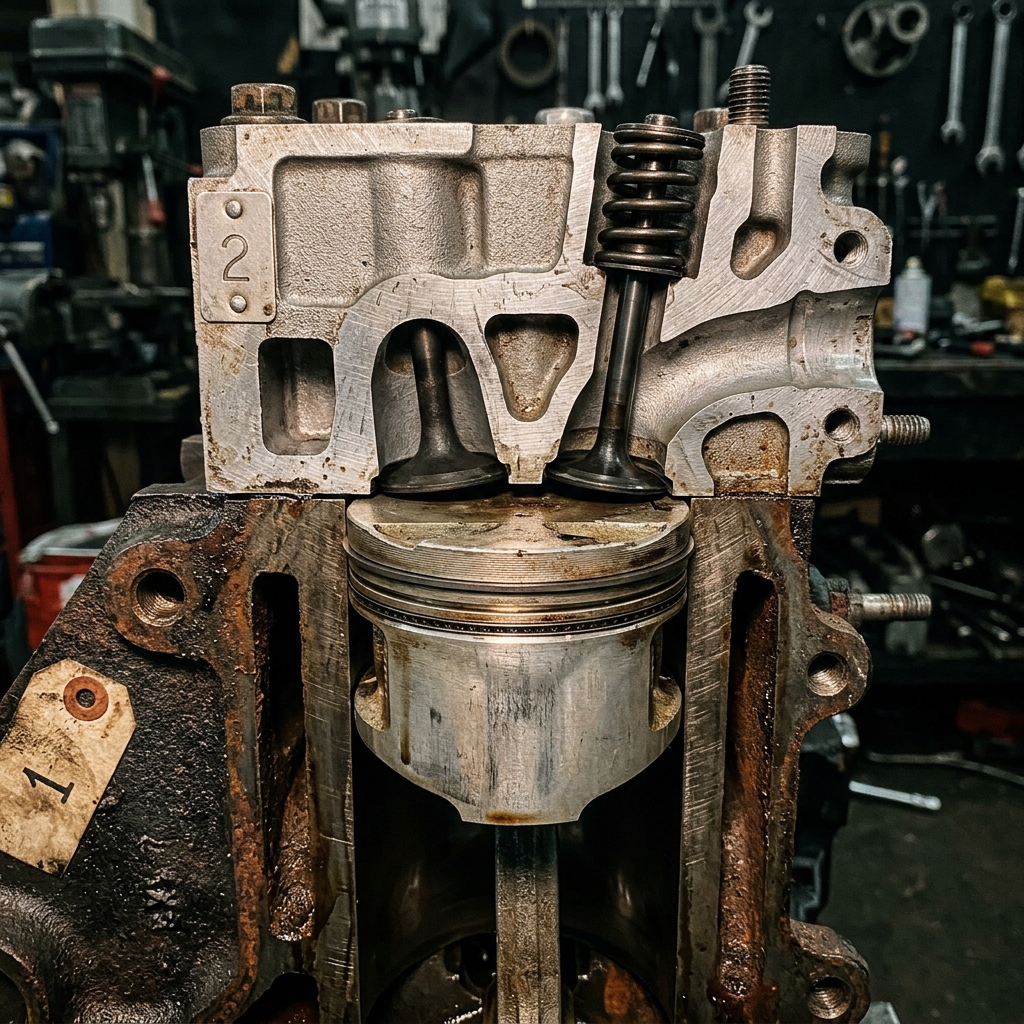
Deck height is one of those engine terms that gets used casually but has precise mechanical meaning. It connects three critical specifications — block geometry, piston position, and combustion chamber behavior — into a single number that determines whether an engine resists detonation or invites it.
Understanding deck height, deck clearance, and quench distance is essential for anyone building or modifying an engine. The difference between a quench gap of 0.040” and 0.080” can be the difference between an engine that runs cleanly on 91 octane and one that detonates under load.
3 Terms That Get Confused
Deck Height (Block Dimension)
Deck height is a fixed block dimension: the perpendicular distance from the crankshaft main bearing bore centerline to the top of the block deck surface. It is set during casting and machining.
| Engine Family | Standard Deck Height |
|---|---|
| Chevy SBC (standard) | 9.025” (229.2 mm) |
| Chevy SBC (tall deck) | 9.325” (236.9 mm) |
| Chevy BBC | 9.800” (248.9 mm) |
| Ford 302/351W | 8.206” (208.4 mm) |
| Ford 351C | 9.206” (233.8 mm) |
| GM LS | 9.240” (234.7 mm) |
| Honda K20A | 8.455” (214.8 mm) |
Deck height determines the maximum stroke length the block can physically accommodate. If stroke + rod center-to-center + piston compression height exceeds deck height, the piston protrudes above the deck — a condition that must be avoided or carefully managed.
Deck Clearance (Piston Position)
Deck clearance is the gap between the piston crown at TDC and the block deck surface. It is a calculated result:
Deck Clearance = Block Deck Height − (Half Stroke + Rod Length + Compression Height)
Or measured directly with a dial indicator and bridge fixture across the bore.
| Condition | Description |
|---|---|
| Positive deck clearance | Piston below deck at TDC (most common) |
| Zero deck | Piston flush with deck surface |
| Negative deck (piston proud) | Piston above deck at TDC (requires notched gasket or head relief) |
Typical performance builds target 0.000” to +0.015” deck clearance (flush to slightly below). This puts the piston as close to the head as possible for maximum quench effect.
Quench Distance (Combustion Geometry)
Quench distance is the total gap between the piston crown flat area and the flat portion of the cylinder head at TDC:
Quench Distance = Deck Clearance + Compressed Head Gasket Thickness
This is the dimension that determines combustion turbulence and detonation resistance.
| Quench Distance | Effect |
|---|---|
| < 0.028” | Dangerous — piston-to-head contact risk from thermal expansion |
| 0.035–0.045” | Optimal — maximum quench turbulence, best detonation resistance |
| 0.050–0.060” | Acceptable — quench effect diminishes |
| 0.070–0.100” | Weak quench — little turbulence benefit, detonation risk increases |
| > 0.100” | No quench — flat-top pistons offer no combustion improvement |
How Quench Actually Works
The quench effect is a fluid dynamics phenomenon. When the piston approaches TDC, the mixture trapped in the narrow gap between the piston’s flat area and the head’s flat area is rapidly compressed and accelerated outward toward the combustion chamber center.
This produces two benefits:
1. Turbulence Promotes Faster Burn
The high-velocity squish jet creates turbulence in the combustion chamber, which breaks up the flame front into a turbulent ball that burns faster. Faster burn means the pressure rise is complete earlier in the power stroke, producing more work and better thermal efficiency.
A well-quenched engine at 10.0:1 compression can produce the same power as a poorly quenched engine at 10.5:1 — with less detonation risk.
2. End-Gas Cooling Prevents Detonation
The rapid motion of the mixture away from the hot cylinder walls and toward the cooler center of the chamber reduces the temperature of the unburned end-gas. Detonation occurs when end-gas reaches its autoignition temperature before the flame front arrives. By cooling and moving that end-gas, quench extends the detonation boundary.
Calculating Deck Clearance for Your Combination
The deck clearance equation requires 4 dimensions:
Deck Clearance = Deck Height − (Stroke ÷ 2 + Rod Length + Piston Compression Height)
Worked Example: Chevy 383 Stroker
| Component | Dimension |
|---|---|
| Block deck height | 9.025” |
| Stroke (383 stroker crank) | 3.750” |
| Half stroke | 1.875” |
| Rod length (5.700” rod) | 5.700” |
| Piston compression height | 1.425” |
| Deck clearance | 9.025 − (1.875 + 5.700 + 1.425) = 0.025” |
With a 0.041” compressed gasket thickness:
Quench distance = 0.025 + 0.041 = 0.066”
That is acceptable but not optimal. To improve quench, the builder could:
- Use a piston with 1.435” compression height → deck clearance becomes 0.015” → quench = 0.056”
- Use a thinner gasket (0.028” compressed) → quench = 0.053”
- Machine the block deck by 0.010” → quench = 0.056”
Use the deck height and quench calculator to model these combinations instantly.
How Gasket Thickness Fits In
The head gasket is a permanent spacer between the piston and the head. Its compressed thickness directly adds to the quench distance:
| Gasket Type | Compressed Thickness | Best For |
|---|---|---|
| Standard composition | 0.039–0.045” | Stock rebuilds, mild performance |
| MLS (multi-layer steel) | 0.040–0.054” | High-compression, boosted applications |
| Copper (solid) | 0.020–0.043” | Racing — custom thickness, needs O-ring |
| Ultra-thin MLS | 0.027–0.032” | Maximum quench, extreme builds |
For quench optimization, thinner gaskets are always better — but they also raise compression ratio (because they reduce total clearance volume). The build must balance quench benefit against compression-related detonation risk.
The Deck Clearance Stack-Up
Every component in the piston-to-head stack-up either adds or subtracts from deck clearance:
| Component | Increases Deck Clearance | Decreases Deck Clearance |
|---|---|---|
| Longer stroke | — | ✓ (piston moves up) |
| Longer connecting rod | — | ✓ (piston moves up) |
| Taller compression height | — | ✓ (piston moves up) |
| Block deck machining | — | ✓ (deck moves down) |
| Shorter stroke | ✓ (piston drops) | — |
| Shorter rod | ✓ (piston drops) | — |
| Shorter compression height | ✓ (piston drops) | — |
The sum of these components must produce a deck clearance that, when added to gasket thickness, lands in the 0.035–0.045” quench zone.
Quench Area Percentage
Not all of the piston crown contributes to quench. Only the flat area that is parallel to and close to the head’s flat surface produces the squish effect. Domed pistons reduce effective quench area. Dished pistons have quench only at the outer ring.
| Piston Crown | Approximate Quench Area |
|---|---|
| Flat-top (no reliefs) | 90–95% of bore area |
| Flat-top (with valve reliefs) | 75–85% of bore area |
| Dished | 25–40% (outer ring only) |
| Domed | 40–60% (around dome perimeter) |
A flat-top piston with tight quench clearance produces the strongest squish effect. This is one reason flat-top pistons are preferred for maximum-efficiency NA builds.
Common Deck Height Mistakes
1. Confusing Deck Height with Deck Clearance
Deck height is a block spec. Deck clearance is the calculated gap. Using them interchangeably produces wrong calculations.
2. Ignoring Thermal Expansion
At operating temperature, an aluminum piston grows approximately 0.002–0.003” toward the head. A quench clearance of 0.035” cold becomes approximately 0.032” hot. Cast iron blocks expand less than aluminum blocks, further tightening the gap.
3. Not Verifying After Assembly
Published component dimensions have tolerances. A piston listed at 1.425” compression height may actually be 1.427”. The rod may be 5.698” instead of 5.700”. These add up. Always verify deck clearance with a dial indicator after trial assembly.
4. Using the Wrong Gasket Thickness
Compressed gasket thickness is not the same as uncompressed. A gasket marked “0.051” thick” may compress to 0.041” under head bolt torque. Use the compressed dimension.
The Complete Quench Optimization Workflow
- Determine block deck height from the manufacturer spec or by measuring with a dial indicator from the main bore to the deck.
- Calculate deck clearance using the formula or the deck height calculator.
- Select gasket thickness based on application and sealing requirements.
- Add deck clearance + compressed gasket to find quench distance.
- Target 0.035–0.045” for optimal quench performance.
- Adjust components (piston compression height, rod length, or deck machining) to hit the target.
- Verify with mock assembly using a dial indicator before final build.
Deck height is where block geometry, piston positioning, and combustion science intersect. Getting this number right is what separates an engine that makes clean power from one that rattles and pings.