
Engine math has its own vocabulary. Terms like BMEP, quench, volumetric efficiency, and compression height appear constantly in forum discussions, parts catalogs, and calculator outputs — and using them incorrectly leads to wrong parts, wrong calculations, and expensive mistakes.
This glossary defines the 50 most important engine terms in plain language, organized by category. Each definition includes the units of measurement and links to the calculators where the term appears.
Displacement and Volume Terms
1. Bore
The internal diameter of the cylinder. Measured in inches (in) or millimeters (mm). Bore is squared in the displacement formula, so small bore changes have a significant effect on total displacement.
2. Stroke
The distance the piston travels from top dead center (TDC) to bottom dead center (BDC). Measured in inches or mm. Stroke determines crank throw length and affects piston speed.
3. Displacement (Swept Volume)
The total volume swept by all pistons during one complete engine cycle. Calculated as (pi/4) x Bore² x Stroke x Cylinders. Expressed in cc, liters, or cubic inches (CID). Calculate yours with the displacement calculator.
4. Clearance Volume
The volume remaining in the combustion chamber when the piston is at TDC. Includes the combustion chamber, head gasket volume, piston dish/dome volume, and deck clearance volume. Used to calculate compression ratio.
5. Compression Ratio (CR)
The ratio of total cylinder volume (swept + clearance) to clearance volume alone: CR = (Swept + Clearance) / Clearance. A 10:1 ratio means the mixture is compressed to 1/10 of its original volume. Calculate with the compression ratio calculator.
6. Cubic Centimeters (cc)
Metric unit of volume equal to one milliliter. Standard unit for motorcycle and small engine displacement. 1,000 cc = 1 liter.
7. Cubic Inches (CID)
Imperial unit of volume. Standard unit for American V8 displacement. 1 cubic inch = 16.387 cc. Convert with the displacement converter.
8. Liter (L)
Metric unit equal to 1,000 cc. Used as the primary marketing displacement unit for most modern automobiles.
Piston and Cylinder Geometry
9. Top Dead Center (TDC)
The highest point of piston travel in the cylinder. The position where the power stroke begins after ignition.
10. Bottom Dead Center (BDC)
The lowest point of piston travel. The position where the intake stroke begins.
11. Piston Compression Height
The distance from the piston pin centerline to the piston crown surface. Critical for deck clearance calculations. Measured in inches or mm.
12. Deck Height
The fixed block dimension from the crankshaft main bearing centerline to the top of the block deck surface. Not the same as deck clearance.
13. Deck Clearance
The gap between the piston crown at TDC and the block deck surface. Positive = piston below deck. Zero = flush. Negative = piston above deck (proud). Calculate with the deck height calculator.
14. Quench Distance
Deck clearance plus compressed head gasket thickness. The final gap between the piston flat area and the cylinder head flat area at TDC. Optimal range: 0.035–0.045 inches.
15. Squish
The rapid outward motion of the mixture caused by the piston approaching the head’s flat surface. Often used interchangeably with “quench,” but technically squish describes the gas motion while quench describes the cooling effect.
16. Bore-to-Stroke Ratio
Bore divided by stroke. Oversquare (ratio above 1.0) favors high RPM. Undersquare (below 1.0) favors torque. Square (1.0) is balanced.
17. Overbore
Machining the cylinder bore larger than the original factory diameter. Typically 0.020–0.060 inches. Increases displacement slightly and cleans up worn cylinder walls. Model with the overbore calculator.
Crankshaft and Connecting Rod Terms
18. Crank Throw
Half the stroke length. The distance from the crankshaft main journal centerline to the rod journal centerline. Determines crank leverage for torque production.
19. Connecting Rod Length
Center-to-center distance of the connecting rod — from the big end (crank journal) to the small end (piston pin). Measured in inches or mm.
20. Rod-to-Stroke Ratio (R/S Ratio)
Rod length divided by stroke. Higher ratios reduce piston side-loading. Typical range: 1.4–2.0. Calculate with the rod ratio calculator.
21. Rod Angularity
The maximum angle the connecting rod makes relative to the cylinder centerline during the power stroke. Determined by rod ratio. Higher angularity increases piston side-loading.
22. Stroker
An engine built with a crankshaft that has a longer stroke than stock, increasing displacement. Example: Chevy 350 stroked to 383 using a 3.750” stroke crank. Plan with the stroker planner.
23. Rotating Assembly
The combined crankshaft, connecting rods, and pistons. The “bottom end” of the engine. Must be balanced as a complete assembly.
24. Mean Piston Speed (MPS)
The average speed of the piston over one complete revolution: MPS = 2 x Stroke x RPM / 60. Measured in ft/s or m/s. Material limit for cast pistons is approximately 20 m/s. Calculate with the piston speed calculator.
Airflow and Breathing Terms
25. Volumetric Efficiency (VE)
The ratio of actual air ingested to theoretical swept volume. Expressed as a percentage. Stock NA engines: 75–90%. Modified NA: 90–100%. Forced induction: above 100%.
26. CFM (Cubic Feet per Minute)
Airflow measurement used for cylinder heads, carburetors, and intake systems. Measured on a flow bench at a standard pressure drop (typically 28 inches of water). Calculate requirements with the carburetor CFM calculator.
27. Port Cross-Sectional Area
The cross-sectional area of the intake or exhaust port at its narrowest point. Determines maximum airflow capacity. Calculate with the port area calculator.
28. Intake Runner Length
The distance air travels from the plenum to the intake valve. Longer runners favor low-RPM torque. Shorter runners favor high-RPM power.
29. Throttle Body
The butterfly valve that controls airflow into the intake manifold. Sizing must match engine displacement and RPM range.
30. Camshaft Duration
The number of crankshaft degrees that the cam holds a valve open. Measured at 0.050 inches of lifter rise for standardized comparison. Longer duration favors high-RPM power.
31. Camshaft Lift
The maximum distance a valve opens from its seat. More lift = more flow area = more potential VE. Measured in inches.
32. Lobe Separation Angle (LSA)
The angle in crankshaft degrees between the intake and exhaust cam lobe centerlines. Narrower LSA = more overlap = higher peak VE but rougher idle.
Power and Performance Terms
33. Horsepower (HP)
A unit of power: HP = Torque (ft-lb) x RPM / 5,252. Determines top speed and high-RPM acceleration capability. Estimate with the HP calculator.
34. Torque (ft-lb or Nm)
Rotational force produced by the engine. Determines pulling power, acceleration from low RPM, and towing capability.
35. BMEP (Brake Mean Effective Pressure)
The average pressure acting on each piston during the power stroke that produces useful work. Measured in psi or bar. Allows comparison of engine efficiency independent of displacement. Typical NA: 150–200 psi. Turbocharged: 250–400 psi.
36. BSFC (Brake Specific Fuel Consumption)
The fuel consumed per unit of power produced per hour: lb/hp-hr. Lower is better. Typical gasoline engines: 0.40–0.55. Best efficiency point is typically at 70–85% load.
37. Power-to-Weight Ratio
Horsepower divided by vehicle weight. Determines acceleration capability better than horsepower alone. Calculate performance with the quarter-mile calculator.
38. Thermal Efficiency
The percentage of fuel energy converted to useful mechanical work. Modern gasoline engines: 30–40%. Calculate with the Otto cycle calculator.
Fuel and Combustion Terms
39. Stoichiometric Ratio
The chemically perfect air-to-fuel ratio for complete combustion: 14.7:1 for gasoline (by mass). The ECU targets this ratio for emissions compliance in closed-loop operation.
40. Air-Fuel Ratio (AFR)
The mass ratio of air to fuel in the combustion mixture. Lean (above 14.7:1) = less fuel. Rich (below 14.7:1) = more fuel. WOT power target: 12.5–13.0:1.
41. Detonation (Knock)
Uncontrolled autoignition of the end-gas before the flame front reaches it. Causes a metallic pinging sound and can destroy pistons. Controlled by fuel octane, compression ratio, ignition timing, and quench distance.
42. Octane Rating
A fuel’s resistance to detonation. Higher octane = more knock resistance. Regular: 87. Premium: 91–93. Race fuel: 100–116.
43. Fuel Injector Flow Rate
The volume of fuel an injector delivers per unit of time at a standard pressure. Measured in lb/hr or cc/min. Must be sized to the engine’s peak airflow requirement. Calculate with the fuel injector calculator.
Forced Induction Terms
44. Boost Pressure
The pressure above atmospheric that a turbocharger or supercharger forces into the intake manifold. Measured in psi, bar, or kPa. Each psi of boost increases effective displacement by approximately 6.8%.
45. Effective Displacement
Physical displacement multiplied by the pressure ratio: Effective = Physical x (1 + Boost/14.7). A 2.0L at 15 psi has an effective displacement of approximately 4.0L.
46. Intercooler
A heat exchanger that cools the compressed intake charge after the turbo or supercharger. Cooler air is denser, allowing more air mass per cycle without additional boost pressure.
47. Wastegate
A valve that bypasses exhaust around the turbocharger turbine to control boost pressure. Internal wastegates are integrated into the turbo housing. External wastegates are separate units for higher-boost applications.
Measurement and Machining Terms
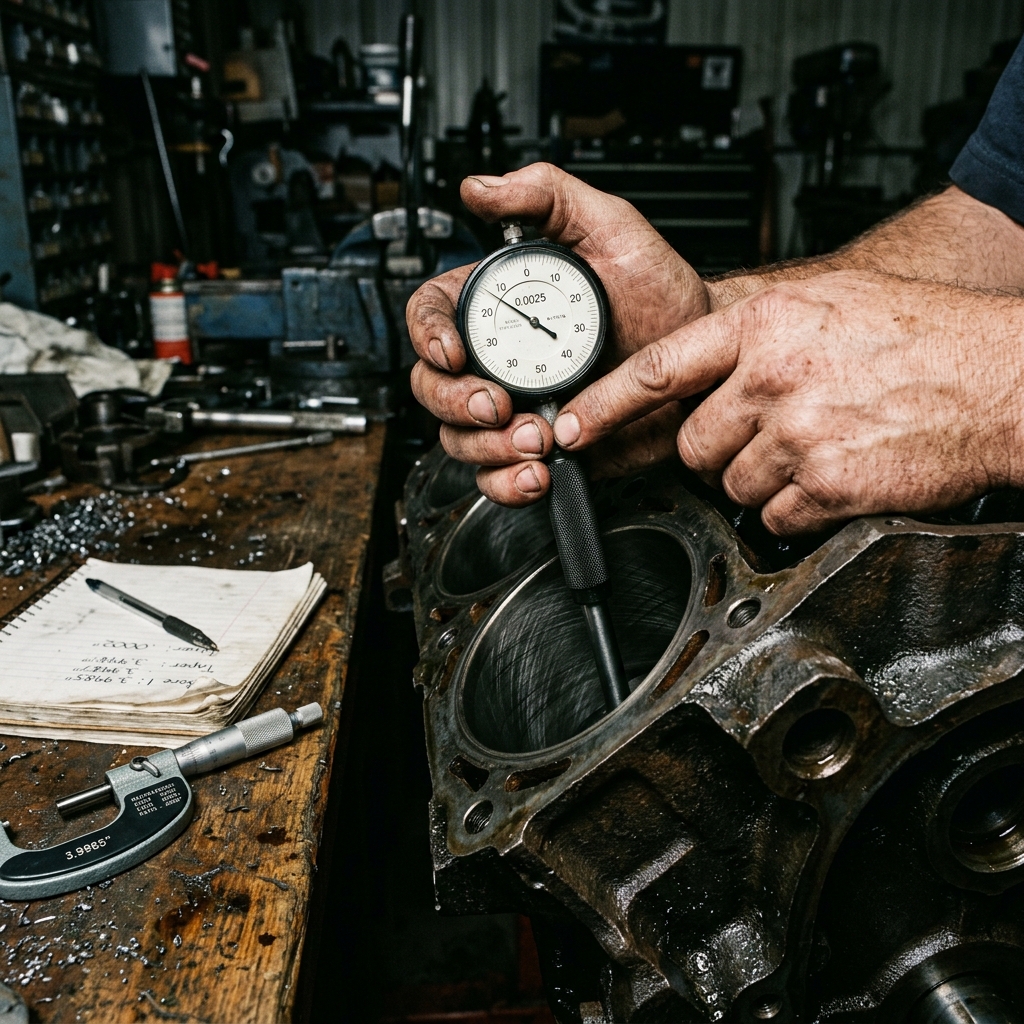
48. Dial Bore Gauge
A precision instrument for measuring cylinder bore diameter to 0.0001-inch accuracy. Essential for determining actual displacement and detecting taper/out-of-round conditions.
49. Sonic Testing (Ultrasonic)
Using ultrasonic sound waves to measure cylinder wall thickness without disassembly. Determines how much overbore a block can safely accept.
50. Blueprinting
The process of measuring every component of an engine and machining them to exact target specifications (not just within tolerance). Produces the most consistent and reliable performance.
Quick Reference: Units and Conversions
| Unit | Conversion |
|---|---|
| 1 liter | 1,000 cc |
| 1 cubic inch | 16.387 cc |
| 1 liter | 61.024 cubic inches |
| 1 bar | 14.504 psi |
| 1 ft-lb | 1.356 Nm |
| 1 hp | 745.7 watts |
| 1 lb/hr (injector) | 10.5 cc/min |
Use the displacement converter for instant unit conversions and the main calculator to put these terms into practice.